Science1 publisher3 min readPublished
A truck carried 92 antiprotons 8 kilometres around CERN without losing one
Antiprotons had never travelled by road before March. BASE's mobile trap held its cargo long enough to prove the concept, and the precision gain the group wants still depends on a laboratory in Dusseldorf that is not finished.
The Scientist · Science desk
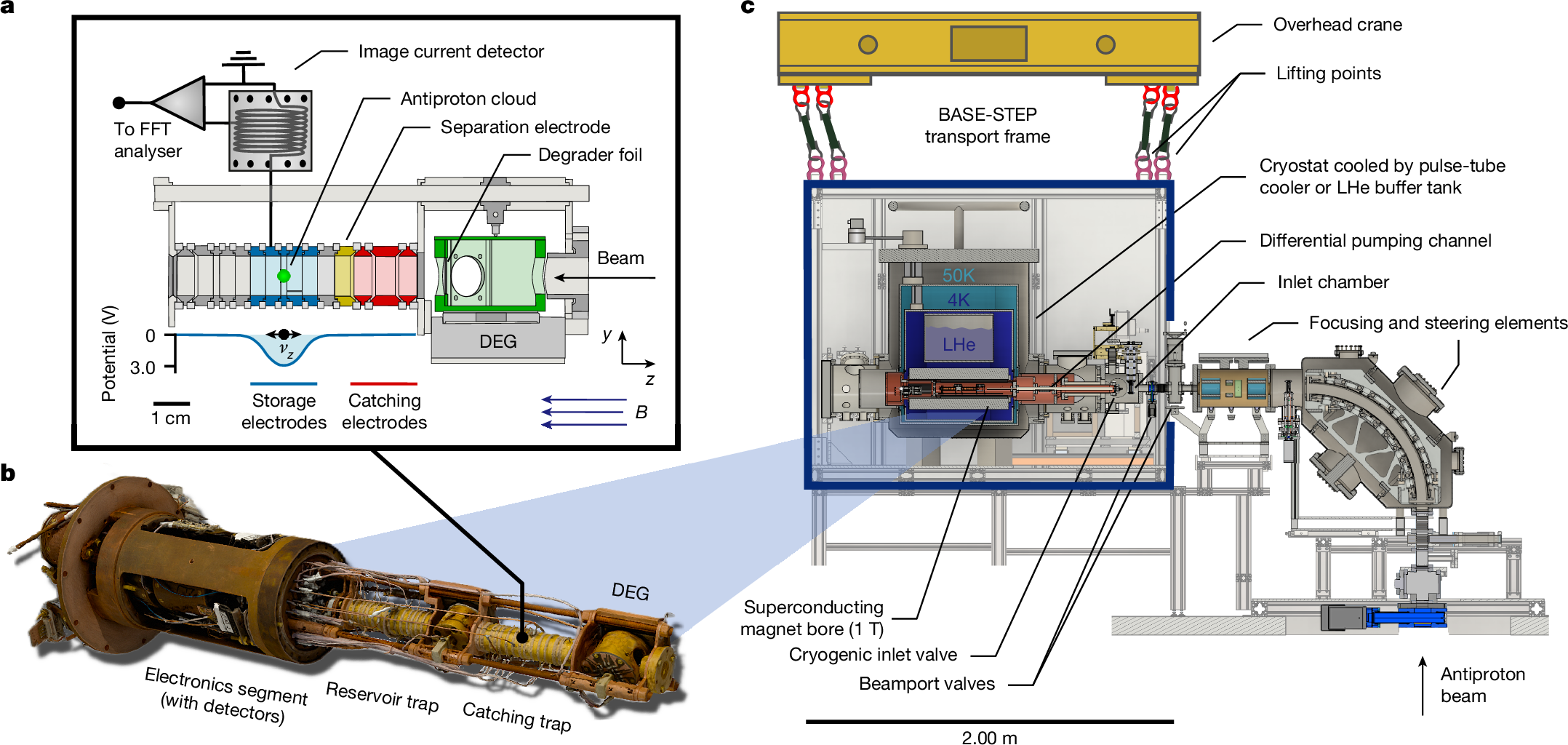
What happened
- In March 2026 the BASE collaboration extracted 92 antiprotons from CERN's Antimatter Factory, sealed them in the mobile BASE-STEP trap and drove them about 8 kilometres around the Geneva site in half an hour.
- Unloading the trap after the drive cost the team none of the stored antiprotons, the first road transport of antimatter.
- Pressure inside the trap stayed better than 2.2 x 10⁻¹⁸ mbar for the whole storage period, against a design target of 1 x 10-16 mbar, in an open system that antiprotons can be injected into and pulled back out of.
- Lead author Marcel Leonhardt says the team went on to store and manipulate the particles in a controlled way for more than a month in total.
- Smorra says accuracy at the Antimatter Factory is capped by magnetic-field fluctuations from facility operation, and the group is aiming for at least a 100-fold improvement at a quieter site.
Compiled by The ScientistSomething wrong?How this is made
Why it matters
- capability More than a month of hold time gives the group weeks of margin around a ten-hour drive, so the binding limit on a road transfer becomes the trap's autonomy and power.
- constraint Because the antiproton magnetic moment is known about five times less precisely than the proton's, the matter-antimatter test only improves when the antiproton side does, and that is the side CERN's magnetic environment holds back.
- decision With one facility in the world making low-energy antiprotons, a group that wants a quieter measurement must choose between building beside the accelerator and putting its particles on a truck.
- precedent The hundredfold precision gain is a target for a laboratory still being set up. The March result is evidence about transport and storage, not about the physics it is meant to enable.
The truck never left the CERN site, and the loop worked out to an average near 16 kilometres an hour [19]. The journey BASE wants is the 10-hour run from Geneva to Dusseldorf, twenty times longer than the March drive [17][21]. Christian Smorra, the BASE-STEP principal investigator and corresponding author, described the March transport as a successful dress rehearsal that demonstrated the idea works, and said the group's next target is to make the trap autonomous enough for a 10-hour transport from Geneva to Dusseldorf [17].
Residual gas is what ends a storage run. Marcel Leonhardt, a doctoral researcher in physics at Heinrich Heine University Dusseldorf and lead author of the paper in Nature [27][3], said, "It is particularly important to realize an extremely good vacuum in a mobile trap for long-term storage to ensure that the antiprotons are not lost through collisions with other particles." [7] The pressure the team held is roughly 45 times below the figure the trap was designed to reach [20]. The same trap carried protons by road in October 2024, and the antiproton run used it again [16].
The reason to move antimatter at all is magnetic. Smorra said, "We cannot further improve measurement accuracy at the AMF because facility operation causes magnetic-field fluctuations, which affect our measuring equipment. We can only find better conditions outside CERN." [9] Stefan Ulmer, who founded BASE and holds the Chair of Quantum Technologies and Fundamental Symmetries at HHU, said the group has already measured the intrinsic magnetic moment of both particles "with an accuracy of 0.3 ppb for protons and 1.6 ppb for antiprotons" [10][28]. One ppb is one part in a billion [11]. The antiproton value is the coarser of the two by a factor of about five [22], and a comparison between matter and antimatter can be no sharper than its coarser half. Take that 1.6 ppb down by the factor Smorra named and it lands near 0.016 ppb [23].
Comparing the two is one of the more promising routes to a difference between matter and antimatter, and a gap in mass or magnetic moment would bear on why the cosmos is lopsided [15]. Ultra-high-vacuum Penning traps are the instrument for it [14]. CERN's Antimatter Factory is still the only facility in the world where low-energy antiprotons are produced, stored and studied [13], so a quieter measurement means moving the particles to a quieter site.
The destination Ulmer's team has in mind is a high-precision laboratory at HHU that is still being established [18]. The precision gain is therefore a target set for that laboratory, and the March run supports the transport claim on its own. Protons and antiprotons have so far shown no difference within the accuracy available [12].
What to watch
- Whether an autonomous version of BASE-STEP completes the Geneva to Dusseldorf leg with its full complement of antiprotons recovered.
- The first antiproton magnetic-moment measurement taken outside CERN, and whether it improves on 1.6 ppb.
- Whether the trap holds a better-than-design vacuum across ten hours on public roads.