Science1 distinct publisher2 min readPublished
A corrected melting curve for carbon is the real product here. It does double duty, governing where diamond turns liquid inside Neptune and how hard a fusion capsule should be hit on the first shock.
The Scientist · Science desk

Compiled by The ScientistSomething wrong?How this is made
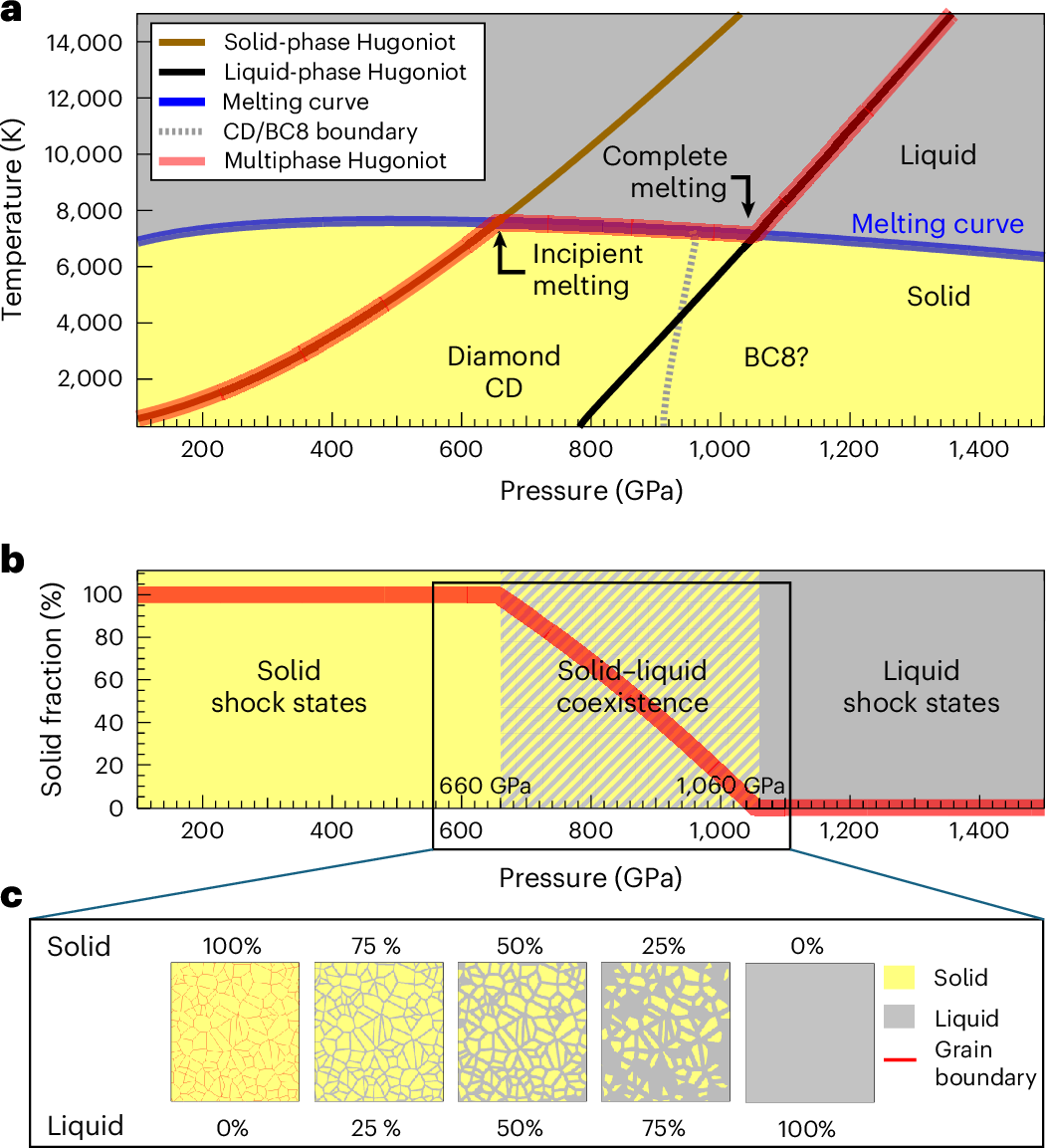
The paper's numbers invite a simple division. If the disagreement between laboratory measurement and quantum-mechanical prediction ran as high as 20 percent [5], and that 20 percent was worth more than a thousand kelvins [6], then the melting temperature under argument sits at roughly 5,000 K [16]. Two decades of effort had failed to reconcile the two figures [1].
What closed the gap was a diagnostic, not brute force. Ultrafast X-ray diffraction [4] read the sample's structure while it held above three times Earth's core pressure at temperatures like the sun's surface for about a billionth of a second [3], and the melting point it returned agrees with modern quantum-based models [7].
The reason this travels out of planetary physics is that the same curve tells a target designer where a capsule stops being solid. LLNL's sample resembled the target used at the National Ignition Facility, which pursues a power-positive inertial confinement reaction [15], and the authors' conclusion is that the opening shock has been harder than the job requires: a slower, gentler one still melts the diamond capsule completely [12]. You cannot make that call without knowing the melt line to better than a thousand kelvins.
What the result does not settle is whether a real shot behaves like the model. The factor of three is computed rather than fired [13], and it describes energy released by the fuel inside the capsule, which is a different denominator from the energy the facility spends; by the paper's own accounting the improvement does not reach engineering breakeven [14].
The planetary half has a seam in it too. phys.org describes diamond rain as diamond melting and the liquid dropping toward the core [9], while the experiment's surprise is that the solid phase is the buoyant one, floating on liquid metallic carbon [8]. Those two pictures put solid diamond in different places, and what the shot pins down is a phase boundary and a density ordering, not a rainfall rate. Neptune's excess radiated heat has long been attributed to friction from falling diamond [10]; the new data give that attribution measured pressures and temperatures for the first time [11] rather than an extrapolation.
One billionth of a second produced two separate payoffs. Interior modellers get a calibration point where they had a guess. Target designers get a number that feeds straight into a pulse shape, which is why theirs is the one that gets spent first.
Ranked by verification strength, evidence, and original report placement.
Physicists at Lawrence Livermore National Laboratory published a paper in Nature Physics that resolves a 20-year-old scientific mystery about diamond's melting point; despite their best efforts, scientists previously could not get measurement and theory to match.
The experiment was carried out at the University of Rochester's Omega Laser Facility, where the laser vaporized the outer layer of a diamond sample and that vaporization sent a shock wave through the interior of the diamond.
The shock compressed the diamond to pressures more than three times that of Earth's core, with resulting temperatures equivalent to the surface of the sun, but only for a billionth of a second.
The researchers instrumented the shot with as many sensors as they could, including an ultrafast X-ray diffraction technique.
Previous physical measurements of diamond's melting point disagreed with computer models based on quantum mechanics by up to 20 percent.
In the context of these experiments, that 20 percent discrepancy represented a difference of more than 1,000 kelvins between the theoretical and observed melting points.
Distinct publishers with included, body-backed reporting in this cluster.
phys.org
1 article · August 29, 2026
Follow any of these and your For You feed starts watching them — no settings page required.
science
Diamond crushed past Neptune's core pressure closes a 20-year gap in fusion capsule physics1 distinct publisher
product
LLNL closes a 20 percent gap in diamond melting, and stakes a fusion gain claim on it1 distinct publisher
product
Inertia's fusion claim is a factory claim: fuel pellets in hours, not a week1 distinct publisher
build
Pacific Fusion pours concrete in Albuquerque; the yardstick is 500 megajoules at one shot per second2 distinct publishers
Evidence-backed comparisons of source perspectives and observed adoption signals. Read the methodology
Which Builder, Operator, and Investor concerns the observed source mix emphasized—not a truth score.
Evidence, demonstrated adoption, hype gap, incentives, and confidence are assessed independently, each on its own current evidence. How these are measured.
Peer-reviewed underneath, single-voiced above
The foundation is strong: a named Nature Physics paper with a DOI, a specific facility, and a stated diagnostic. What sits on top is thinner. phys.org is the only account we have, it draws its most quotable material from LLNL's press release, and the two numbers doing the most work — the 20 percent gap and the threefold yield — reach the reader without uncertainty ranges or a second pair of eyes.
No one has fired the gentler shock
A journal publication is not uptake. Our coverage shows no NIF shot using the slower first shock, no capsule redesign, and no other high-pressure group applying the corrected melting curve — so there is nothing here to measure, only a recommendation awaiting someone to act on it.
Neptune sells it, the melting curve delivers
The headline reaches for raining diamonds and tripled fusion output; the durable product is a corrected carbon melting curve that finally agrees with quantum mechanics. phys.org supplies its own brake — orders of magnitude short of engineering breakeven, stated plainly — which is why this reads as enthusiastic framing rather than inflation.
The lab that measured it also owns the facility
LLNL ran the experiment and runs the National Ignition Facility whose yield story the result improves, and the write-up's descriptive material comes from LLNL's own release. None of that makes the melting curve wrong — peer review is a real check on the physics — but the sentence about tripling fusion output has an interested author and, in our coverage, no outside physicist positioned to disagree.
Confident about the melt, not the payoff
Split the story and the confidence splits with it. That diamond was melted at these conditions and that the measurement now matches theory rests on peer-reviewed work and holds up well. That a gentler first shock triples capsule yield rests on one calculation, relayed once, by the institution it benefits — and until a shot tests it, that half stays provisional.