Product1 publisher3 min readPublished
Inertia's fusion claim is a factory claim: fuel pellets in hours, not a week
The startup says crystal growth now takes 30 minutes instead of up to a week, and a whole pellet two to three hours. Nine of its ten stated barriers remain.
The Product Desk · Product desk
Drafted by a language model from the sources cited here and checked against its claim ledger before publication. How we use AISend a correction
What happened
- Inertia Enterprises said it has found a way to cut the time it takes to make its fuel pellets from several days to just minutes, and gave TechCrunch an exclusive first look at the process.
- After several rounds of development, Inertia was able to grow the fuel crystals in about 30 minutes, something that could take up to a week at NIF.
- Altogether, a single Inertia fuel pellet can be made in about two to three hours, and the process can be ramped to industrial scale.
- By slashing fuel filling time, Inertia says it has knocked down one of the ten barriers it must overcome to deliver the first phase of its commercial power plant ambitions.
- Nine of the ten barriers Inertia says it must overcome for the first phase of its commercial plant remain.
Compiled by The Product DeskSomething wrong?How this is made
Why it matters
Inertia Enterprises told TechCrunch it has cut the time to fill its fusion fuel pellets from several days to minutes, growing the frozen fuel crystal in about 30 minutes and completing a full pellet in roughly two to three hours [1][2][3]. The company says that clears one of ten barriers standing between it and the first phase of its commercial power plant, which by its own count leaves nine [4][5].
The distinction worth holding onto is that nothing here is a physics result. The ignition scheme came from the National Ignition Facility, where Inertia co-founder and chief scientist Annie Kritcher designed the first experiment to release more power than it consumed [6]. What Inertia says it changed is the production method: at NIF, a pellet can take a week or more and cost a small fortune [7]. CEO Jeff Lawson's framing to TechCrunch was that NIF makes a handful a year, which makes them prototypes, and that the company is hiring industrial engineers from firms including Apple to make the same object at volume [8][9].
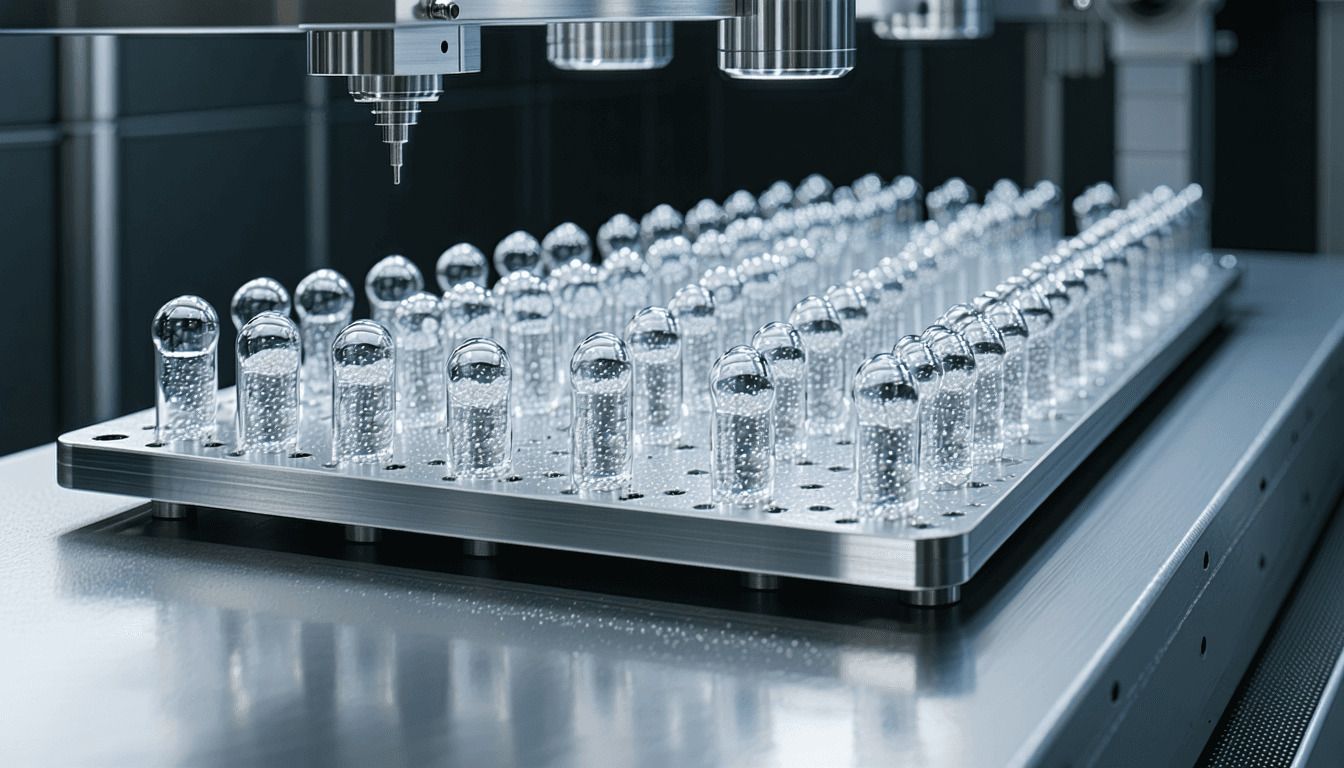
The object is not a trivial one to mass produce. Per TechCrunch, it is a spherical diamond shell holding a thin layer of frozen deuterium and tritium around a gaseous deuterium-tritium core, with each solid layer required to be as close to perfectly spherical as possible, then wrapped in a gold hohlraum that converts laser light into compressing X-rays [10][11]. Small deviations from sphericity can disrupt ignition [12].
Inertia's stated route around that tolerance problem is a capital trade rather than a metrology one. Because it plans to use a laser four times more powerful than NIF's, it says it can tolerate more imperfection in the pellet, and Lawson describes oversizing the driver as a deliberate strategy to buy margin everywhere else in the system [13][14]. That is a coherent engineering position, and it also means the manufacturing claim depends on a laser the company does not yet operate.
The volume arithmetic is where the phrase "can be ramped to industrial scale" [3] carries the most weight. Inertia expects a full-scale plant to consume ten pellets per second [15], which is about 864,000 per day [16]. At a 2.5-hour cycle time, sustaining that rate implies roughly 90,000 pellets in process at any moment [17]. Cutting cycle time from a week to hours is necessary for that, but it is not close to sufficient on its own.
The other consequence is inventory. Faster filling means less tritium held at once, which matters because tritium is radioactive, costs about $30,000 per gram, and exists in a global stockpile of roughly 25 kilograms, according to the journal Science as cited by TechCrunch [18][19]. At that price the entire world stockpile is worth about $750 million, more than the $450 million investors have put into Inertia on the premise that NIF technology can be commercialized [20][21]. The company plans to breed its own tritium eventually but still needs starting inventory [22].
What to watch: yield. TechCrunch's account reports cycle times but no defect rate or yield figure for the faster process [23], and a pellet made in two hours only counts if it implodes. Also watch the public-private partnership with Lawrence Livermore National Lab, which supplied help developing the process [24], and whether the oversized laser arrives on the schedule the tolerance argument assumes.