Science1 publisher3 min readPublished
Brookhaven imaging turns a few of Murchison's organic formulas into actual structures
The MagLab's 21-tesla spectrometer found tens of thousands of carbon-based molecules in two meteorites, and noncontact atomic force microscopy at Brookhaven pinned down the shape of a handful of them.
The Scientist · Science desk
What happened
- Teams at the National High Magnetic Field Laboratory and Brookhaven National Laboratory combined mass spectrometry with single-molecule imaging on fragments of two carbon-rich meteorites.
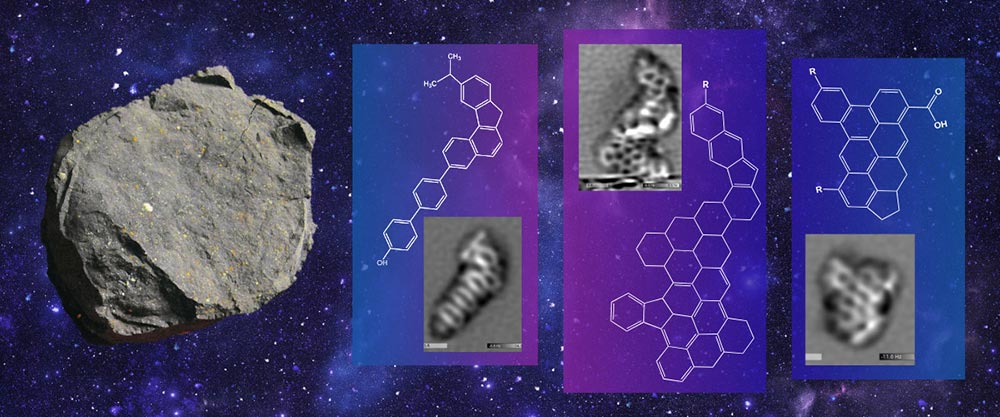
- Percy Zahl at Brookhaven's Center for Functional Nanomaterials used high-resolution noncontact atomic force microscopy to see the structures of a handful of those molecules.
- The two meteorites belong to the same cosmic family and look alike at the surface, yet they share only a small fraction of their complex molecules.
Compiled by The ScientistSomething wrong?How this is made
Why it matters
- capability A formula measured from a meteorite extract can be checked against a picture of the molecule itself, so isomer ambiguity in extraterrestrial samples becomes testable rather than assumed from the mass alone.
- constraint At days to months per successful image, structural coverage of an inventory this size is out of reach by this route, and structural statements about meteorite organics will rest on a few molecules for some time.
- contradiction The account frames the chemistry as woven through the universe while the same study finds two related stones sharing little of it. Abundance and a shared inventory are separate claims, and only the first is supported here.
- precedent The limiting factor on a stone that fell in 1969 was instrument resolution, so curated museum collections are now the cheapest supply of new organic-chemistry data of this kind.
The gap these two instruments close is between a chemical formula and an actual molecule. Mass spectrometry fixes the formula, and one formula can correspond to many different structures [11]. Zahl's method hovers an ultra-sharp tip above a surface and measures atomic repulsion to map the molecule beneath it [13]. Mass spectrometry, Zahl said, "can reveal the molecular formulas hidden within a meteorite" [20].
The imaging side is slow. The spectrometry found tens of thousands of carbon-based molecules in a small sample from each stone [5], and each detected formula may stand for several distinct molecules [6]. Zahl imaged a handful [12], and a few individual molecules pulled out of a mixture like this can take several days to several months to image successfully [14]. Ten imaged molecules against ten thousand formulas is one in a thousand [22]. What the pairing establishes is that the structural check can be done on meteorite extracts. The inventory itself stays where it was.
The comparison between the two stones does not support the framing. The phys.org account says the work "suggests that the chemical foundation for life is deeply woven into the fabric of the universe" [17]. The two meteorites are from the same cosmic family and look alike at the surface, yet share only a small fraction of their complex molecules [15]. Complex organics being common and the same complex organics being common are different claims, and this comparison supports the first while cutting against the second. Frye-Jones stated the modest version: "This can shed light on how much complex organic material is out in space," he said [8].
One fragment of each stone went into the machine. Murchison fell in Australia in 1969 and the piece came from the Field Museum in Chicago [3]; Aguas Zarcas fell in Costa Rica in 2019, supplied by Arizona State's Buseck Center for Meteorite Studies [4], 50 years later [21]. The paper's reading of the difference is that different asteroids experienced radically different environments as they formed [16]. With a single fragment each and half a century between the two falls, terrestrial residence and curation history are also on the list of candidate causes. Everything in the spectra came out of methanol and ethanol [10]. So the inventory covers the solvent-soluble fraction only.
On age and complexity, Frye-Jones said: "The Murchison meteorite is at least 5.5 billion years old, 1 billion years older than Earth, and this is just as complex as petroleum deposits, which are some of the most complex mixtures that we have analyzed in our lab." [9] The account does not state sample masses, the number of molecules imaged, or how that age figure was derived [24].
The petroleum comparison is the practical one. The same 21-tesla instrument, the highest-performing in the world for ion cyclotron resonance, has been used on petroleum, forever chemicals and dissolved organic matter [10]. Most Murchison analysis was done soon after the 1969 fall, and five decades of improvement in techniques and instrumentation is what makes a re-run worth doing [18]. "With the highest-resolution mass spectrometer in the world, we can look at things that others cannot," Frye-Jones said [19].
This analysis stops short of testing whether any of these molecules contributed to biology on Earth. The claim about cosmic ingredients raining down on the early planet is an interpretation laid over the composition data [17]. The paper is in The Planetary Science Journal [2].
What to watch
- Whether noncontact atomic force microscopy throughput can rise above a few molecules per months of work, which decides if structural coverage ever scales.
- Whether the published paper reports the sample masses and procedural blanks left out of the release, which bears on terrestrial contamination.
- Whether further fragments from the same meteorite group reproduce the low molecular overlap between stones.