Science1 publisher3 min readPublished
Laser-shocked diamond melts about 700 C below where earlier experiments put it
A Nature Physics measurement lands on the temperature models had already predicted, so the older laboratory numbers were the outliers. The same shots saw no intermediate solid carbon phase before the diamond went liquid.
The Scientist · Science desk
What happened
- A laser-shock experiment published Aug. 13 in Nature Physics puts diamond's melting temperature more than 700 C below the value earlier laboratory experiments had measured.
- Until now, previous experimental data and model-predicted melting temperatures for diamond disagreed by 1,244 C, a difference of roughly 20 percent, and nobody could account for it.
- X-ray diffraction during the shots showed the diamond going straight to liquid without first reorganising into another solid form of carbon, possibly because rearranging the atoms costs too much energy.
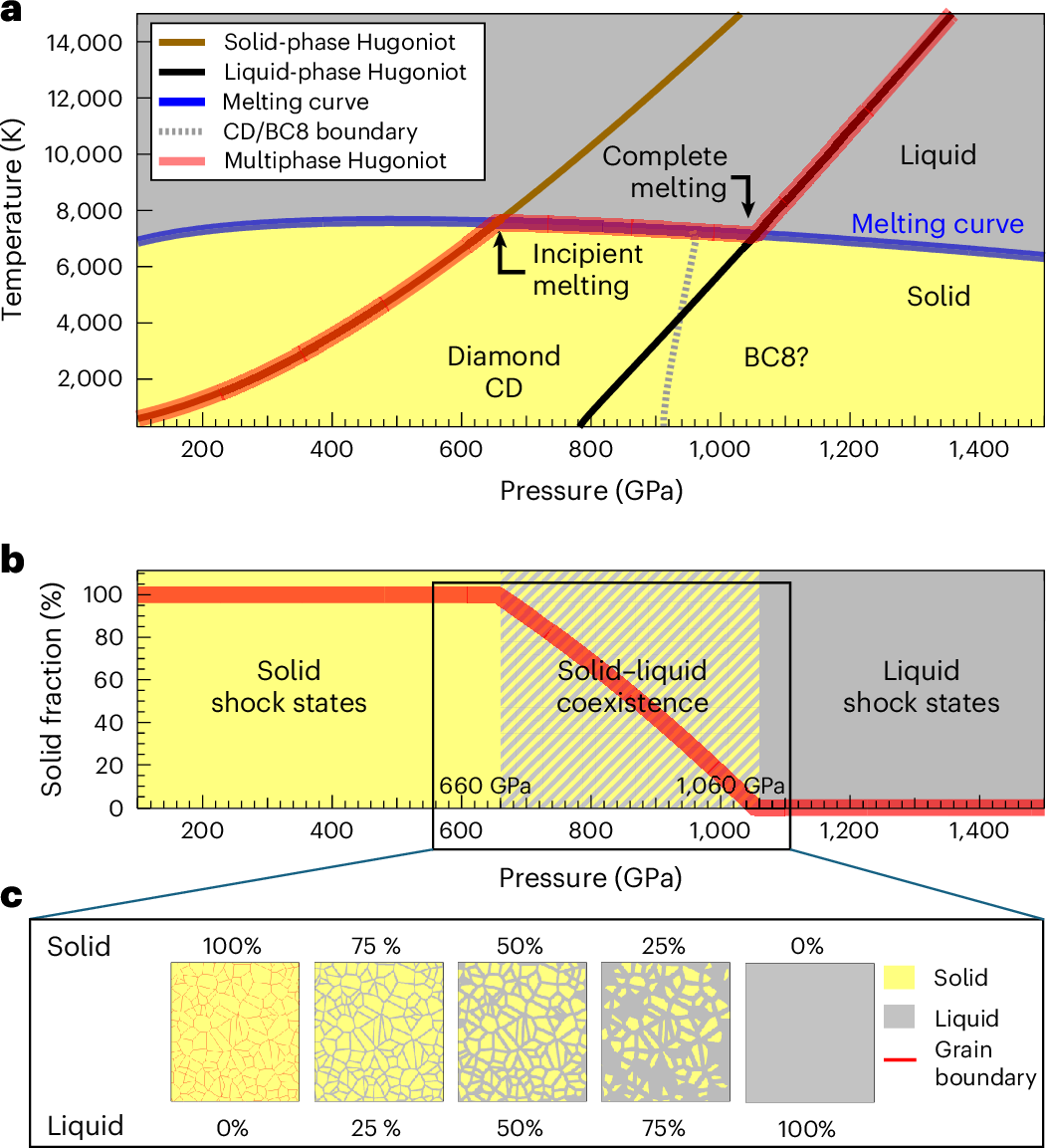
- Between roughly 660 and 1,060 gigapascals, the team found solid diamond chunks coexisting with liquid carbon, with more of the sample converting to liquid as the pressure rose.
Compiled by The ScientistSomething wrong?How this is made
Why it matters
- contradiction The account credits the new value with explaining the long-standing discrepancy, but a 700 C shift covers only about 56 percent of the 1,244 C gap, so anyone tracking model residuals needs the paper's error bars before treating the case as closed.
- constraint Capsule implosions are driven by shaped, repeated shocks, and the team's own hypothesis is that multiple shocks might drive the solid transition its single-shock data did not see, so the null cannot be generalised to a design path.
- capability Getting atomic structure, temperature, density and reflectivity from the same shot at these conditions gives modellers a joint constraint where previously they had a disputed single point.
The correction runs downward, toward the models. Older experimental melting temperatures sat more than 700 C above the new measurement, according to Live Science's account of the study [1], and the new value lines up with what theory predicted [3]. Models of how diamond responds to laser shocks are built for fusion development [14] and used to read the interiors of Uranus and Neptune [12]. On this evidence it was the older measurements that were the outliers [3].
The gap between previous experimental data and model-predicted melting temperatures was 1,244 C, about 20 percent [2]; a shift of 700 C covers about 56 percent of that [1]. That leaves a remainder. The correction is given as more than 700 C, so the residual may be smaller than the subtraction implies, and the uncertainty on the new temperature and the number of shots behind it were not given in the account.
The team fired an ultraviolet laser at tiny plates of synthetic diamond [4]. As the shock crossed each sample the diamond went from transparent to mirror-like, a change in appearance. That increase in reflectivity is one indication of melting, and pairing it with how brightly the samples glowed gave the temperature [5].
Marius Millot, a research scientist at Lawrence Livermore National Laboratory in California and a co-author, said in a statement, "We were able to take tiny diamond samples and shock compress them to temperatures hotter than the surface of the sun and to pressures higher than the center of Neptune and Uranus" [11].
The diffraction result describes the single-shock path the team sampled, where the diamond went straight to liquid, possibly because the energy needed to rearrange the atoms was too large [6]. It is also the part of the work most likely to be over-read. The researchers hypothesised that multiple shocks could be powerful enough for that transition to occur, and that the way the shocks are applied might affect how the diamond changes phase [7].
The window where solid and liquid carbon coexist runs from about 660 to 1,060 gigapascals [9]. Fusion experiments of the kind described crush a diamond capsule to put its solid deuterium and tritium above 30 petapascals, or 30,000 gigapascals, and above 100 million C [8]. That peak is roughly 28 times the top of the measured melting window [2].
Inside the window, at around 6,727 C, solid diamond exists as chunks floating in liquid carbon, and more of it converts as pressure rises [9]. Liquid carbon is metallic, so it conducts electricity, and it is denser than diamond [10]. The ice giants are the other application of this physics, work that rests on Voyager 2 measurements from the late 1980s and on laboratory experiments [12].
What to watch
- Whether a multi-shock experiment produces the solid-solid carbon transition the team hypothesised but did not see.
- The published uncertainty on the new melting temperature, and how many laser shots stand behind it.
- Whether the residual difference between the corrected experiment and the model predictions survives reanalysis.