Science1 publisher3 min readPublished
Semaglutide added nearly 100 days to the median lifespan of 20-month-old mice
An NIH-funded UC Berkeley team dosed old, healthy female mice, then fed a second group 24% fewer calories to match what the drug's appetite suppression achieved. The drug still did more on memory and blood sugar.
The Scientist · Science desk
What happened
- An NIH-funded team at UC Berkeley led by Danica Chen gave semaglutide to 20-month-old female mice for three months, testing the drug at a point when aging in the animals was already well underway.
- To test whether appetite suppression explained the effect, the team ran a five-month comparison against a 24% calorie-restricted diet matched to what the drug-treated mice were eating.
- The drug-treated animals held their metabolic rate largely unchanged over those five months while metabolism slowed in the calorie-restricted group.
Compiled by The ScientistSomething wrong?How this is made
Why it matters
- constraint The survival evidence and the calorie-restriction evidence come from different cohorts with different endpoints, so the 100-day number does not support a claim that the drug does better than eating less.
- contradiction The summary describes effects going beyond calorie restriction, while the measurements it reports were mostly similar between the two groups. A reader weighing the comparison gets a narrower result than the framing implies.
- capability If the extra effects run through a route independent of calorie intake, that route becomes a target a drug could be designed against, and identifying it is the next step Chen names.
- exposure Treating this as a reason to take semaglutide for longevity means extrapolating from healthy 20-month-old female mice to people. The NIH release does not make that extrapolation.
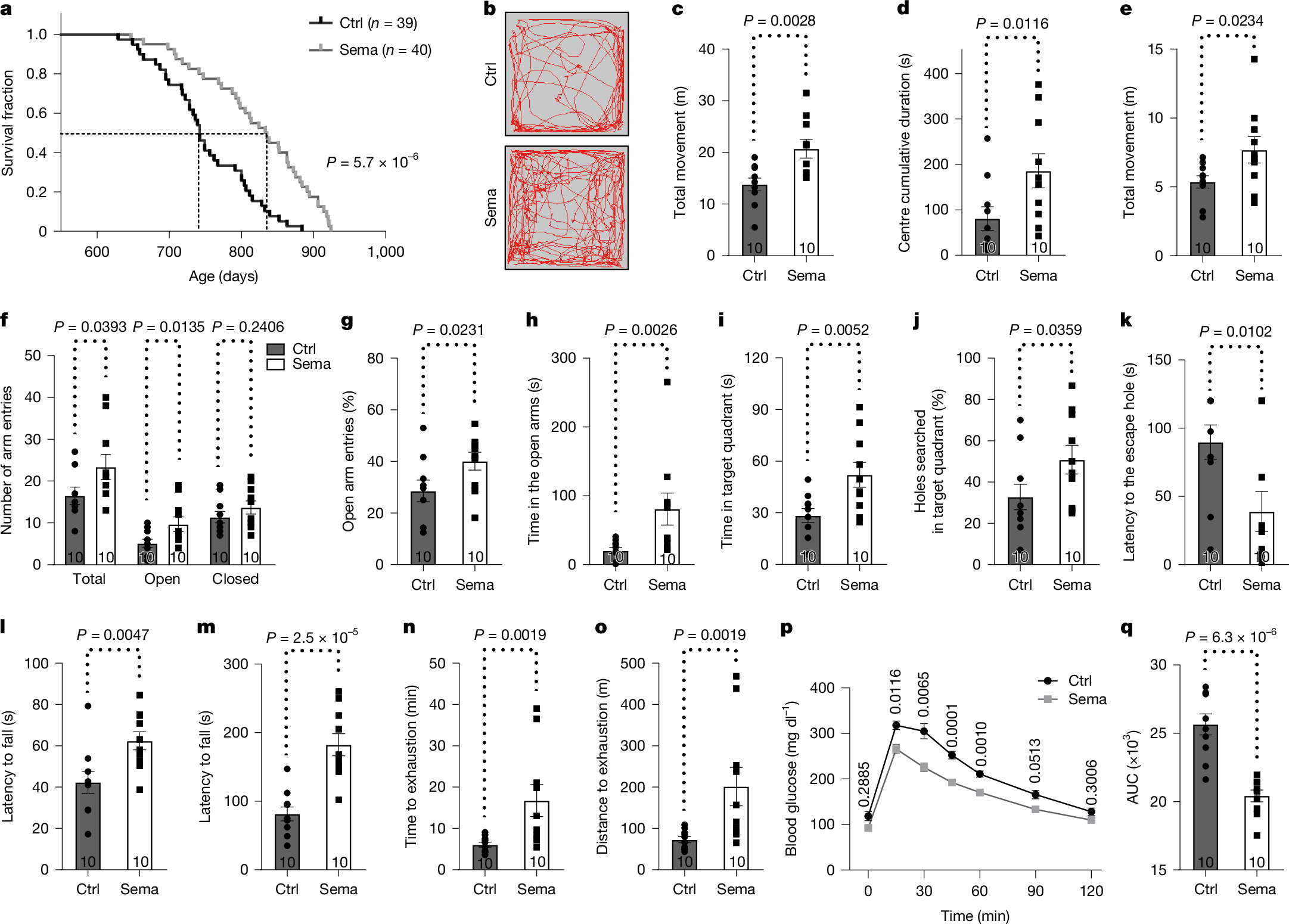
The comparison arm is the interesting part of the design. Semaglutide suppresses appetite, and eating less is already one of the best-established ways to extend lifespan in laboratory animals [13]. So any anti-aging effect in a treated mouse has an obvious alternative explanation. The Berkeley group went at it directly. For five months, one group of 20-month-old females got the drug while another was put on a diet cut by 24%, set to match how much the treated animals were eating [6].
A few of the measured differences held up. The drug-treated mice improved beyond their own starting levels on exploratory behavior, spatial memory and blood-sugar maintenance [8], and their metabolic rate stayed largely unchanged while metabolism slowed in the restricted animals [9]. The NIH summary also reports that the two approaches produced many similar effects and that most physiological measurements stayed stable [7].
The lifespan figure comes from a different experiment. A separate cohort treated until death had a median lifespan nearly 100 days longer than untreated mice [5]. Those animals were roughly 600 days old when dosing began [18], so the addition is about a sixth of the age they had already reached [19]. The release does not give the untreated median, so there is no way to turn the 100 days into a percentage of lifespan [21]. The survival result is set against untreated controls, and the matched-intake comparison measured function and metabolism over five months. A survival comparison between the drug and calorie restriction has not been run [20].
"These differences point to the possibility that GLP-1 drugs tap into a biological pathway independent of calorie restriction," said Danica Chen, the corresponding author and a professor of metabolic biology and nutrition at UC Berkeley [10]. Her team's three-month experiment in 20-month-old females also found better muscle and cognitive function than in untreated animals; gene activity showed reduced inflammation and less decline in the ability to repair and regenerate tissue [3][4].
Rafael de Cabo, a senior investigator at the National Institute on Aging who wrote a commentary on the study [12], put the logic as a conditional. "Most chronic diseases are deeply rooted in the aging process. If GLP-1 agonists do indeed slow it down, then a wide range of clinical benefits is exactly what you'd expect to see," he said [11]. He is describing a hypothesis about why GLP-1 drugs have helped across so many conditions. This study does not report that as a result.
The animals here were old and healthy [23], and they were not obesity or diabetes models. That is what makes the effects hard to attribute to weight loss alone, and it is also what separates them from the patients now taking these drugs [1]. The NIH release states plainly that the findings do not show Ozempic, Wegovy or other GLP-1 drugs can extend human lifespan, and that clinical research is needed to find out [14]. It points to the recent post-hoc analysis of the SLIM LIVER trial as one example of that work [15]. Earlier animal studies had already shown these drugs delaying the onset of multiple age-related diseases [16].
What to watch
- A survival curve for the calorie-restriction arm, which would test whether the drug adds days on top of matched intake or only preserves function.
- Per-group animal counts and full survival data in the peer-reviewed paper behind the NIH summary.
- Replication in male mice, and at starting ages other than 20 months.