Science2 distinct publishers3 min readPublished
A Berkeley group ran the drug against a matched 24 percent food cut and found it equalled dieting on strength and coordination while beating it on memory and glucose. The lifespan race between the two is still running.
The Scientist · Science desk

Compiled by The ScientistSomething wrong?How this is made
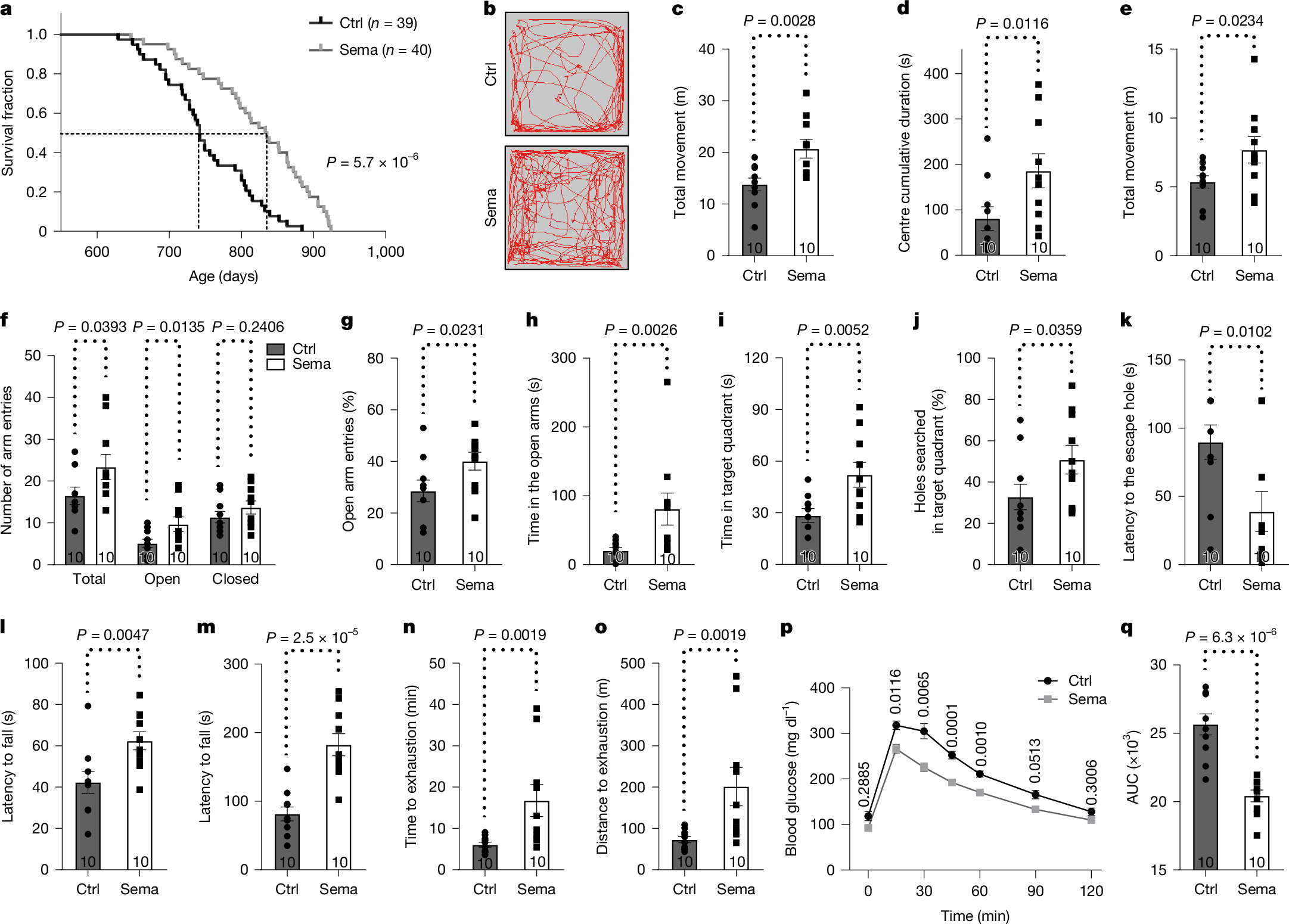
That 12 percent carries a large constant in its denominator. Injections began at 20 months, about 600 days of life already spent, and the saline controls reached a median of 742 days [2][1]. So the untreated animals had roughly 142 days of median life remaining when treatment started, and the treated ones about 234: a gain nearer 65 percent of remaining life than 12 percent of total life [17]. Use a 30.4-day month for the start point and it comes out at 69 percent [17]. Both framings are honest, they answer different questions, and the survival-curve number is the conservative one.
The most useful piece of the design is the matched-intake arm. Semaglutide cut food intake by 24 percent, and the comparison group was simply fed 24 percent less for five months [13][4]. That subtraction is what licenses any claim about effects independent of eating less. On muscle strength and coordination the two arms landed together [4]. On exploratory drive, spatial memory and glucose control the drug ran ahead, and the Nature abstract reports improvements above the animals' own baselines rather than a slower decline [12]. Why the drug has that edge is unresolved; Chen's answer is that they do not know yet [7].
The housekeeping measurements point the same way. After adjusting for body weight, locomotor activity, respiratory exchange ratio, oxygen consumption, carbon dioxide production and energy expenditure were not significantly changed [13], so the visible lever is intake rather than burn rate. The behavioural gains, including maze solving and rotarod balance, survived adjustment for the treated animals being leaner [5]. Liver gene activity overlapped substantially with published calorie-restriction data, with inflammation and fat processing damped and glucose-handling and protein-maintenance genes raised in both [6].
The thing this does not tell you is which intervention wins on survival. The paper does not rank dieting against the drug, and Nir Barzilai of the Albert Einstein College of Medicine, who was not involved, told Scientific American the data is not there and it bugs him [8]. Chen says that experiment is running now [9]. It also does not tell you about males: the cohort was female C57BL/6 mice, one sex in one strain in one laboratory [11].
What makes this more than another mouse geroprotector is the drug's existing paperwork. Semaglutide is approved for type 2 diabetes and obesity, for lowering cardiovascular risk, for slowing kidney decline and for fatty liver disease, with trial data accumulating in sleep apnea and osteoarthritis [10]. Chen's stated motivation was that nobody could explain why one molecule helps so many unrelated conditions [10]. A calorie-restriction mimetic is one explanation [15], and it is the kind of explanation that generates human trials quickly, because the molecule, the dosing and the safety file already exist. A mouse survival curve is not a longevity indication, and the arm that would test the mimetic claim head to head has not reported [9].
Ranked by verification strength, evidence, and original report placement.
Female mice injected with semaglutide starting at 20 months of age and continuing for the rest of their lives had median lifespan rise about 12 percent, from 742 days to 834 days, against a same-age comparison group that ate freely and received saline injections.
Treatment began in mice 20 months old, described in the report as roughly equivalent to a woman in her 60s, and injections continued for the remainder of the animals' lives.
The study was published in Nature; the senior author is Danica Chen, a longevity researcher at the University of California, Berkeley, who has studied calorie restriction for two decades.
In a separate five-month experiment, one group of late-life mice received semaglutide while another was fed 24 percent less food, about the same reduction the treated mice made through appetite suppression; semaglutide matched the diet on measures of muscle strength and coordination.
Semaglutide-treated mice explored more, balanced longer on a rotating rod, ran farther on a treadmill and solved a maze faster, and those gains held after the researchers accounted for the animals being leaner than their peers; their tissues were less worn out and inflamed.
The semaglutide mice had better memory scores, curiosity levels and blood sugar than the calorie-restricted mice; Chen said 'In that sense, it's more than just a calorie restriction' and, asked why the drug has this edge, said 'The short answer is: we don't know yet.'
Distinct publishers with included, body-backed reporting in this cluster.
1 article · September 1, 2026
1 article · September 2, 2026
Follow any of these and your For You feed starts watching them — no settings page required.
science
A century of malaria surveys catches warming pushing West Africa past the transmission ceiling1 distinct publisher
science
A pole-on magnetar hands vacuum birefringence its first astrophysical candidate1 distinct publisher
science
A new theory grounds the four pure hues in the narrow palette of the natural world1 distinct publisher
science
A phage kinase with no target list: EMBL finds one enzyme that breaks several bacterial defences1 distinct publisher
Evidence-backed comparisons of source perspectives and observed adoption signals. Read the methodology
Which Builder, Operator, and Investor concerns the observed source mix emphasized—not a truth score.
Evidence, demonstrated adoption, hype gap, incentives, and confidence are assessed independently, each on its own current evidence. How these are measured.
A real survival curve, from a single bench
This rests on a peer-reviewed primary report with the parts that matter stated plainly: pre-treatment weights that did not differ, control survival inside the published range for the strain, and metabolic-rate nulls after covariance adjustment so the 24 percent intake cut cannot be waved away as changed activity. What holds the score down is scope rather than rigour — one sex, one strain, one laboratory, no replication anywhere in our coverage, and a mechanism section we can only see secondhand.
Mice only; the drug's uptake is for other diseases
Semaglutide is enormously adopted and none of that adoption is for this. The approved uses run from diabetes to fatty liver; the ageing use exists in one mouse cohort on lifelong daily injections. Treat the large installed base as the reason this finding will be read quickly, not as evidence that anyone is acting on it.
Hot prose over a conservatively stated number
The overstatement is in register, not in arithmetic. 'Transformational,' 'a new age of medicine' and a flat 'It worked' sit above what a single-lab mouse survival study can carry, and the headline verb slides toward humans. Pulling the other way: the 12 percent everyone quotes is the modest framing, since the same medians describe a roughly two-thirds increase in life remaining at the moment dosing started. And Scientific American does print the objection that the drug-versus-dieting lifespan comparison has not been run, which is most of what keeps this near alignment.
A twenty-year hypothesis, tested by its own proponent
The senior author has spent two decades on calorie restriction and went in expecting the drug to mimic it; the result confirms the frame she brought, which is worth knowing when reading how cleanly it lands. Scientific American's contribution is to import an outside sceptic rather than only amplify. What we cannot score is the commercial channel: no funding source, no manufacturer involvement and no author disclosure appears anywhere in the material we have, and we are not going to assume either its presence or its absence.
Firm on what was measured, quiet on what wasn't
Our two accounts agree on every number because one is derived from the other, so agreement buys less here than usual — but the underlying report is primary, peer-reviewed and specific to the figure level, and the interviews add a named dissent instead of a chorus. The residual doubt is about reach, not accuracy: the mechanism analysis reaches us secondhand, and the question a reader actually wants answered — drug or diet, for lifespan — is explicitly still open.