Science1 publisher3 min readPublished
A DNA computer in a water droplet reaches its answer by settling into its lowest-energy state
The Scaffolded DNA Computer ran more than 700 computations in salt water, including 100-bit programs, by letting billions of strands compete for places on a scaffold until the stable arrangement encodes the result.
The Scientist · Science desk
What happened
- The researchers demonstrated more than 700 computations across ten programs, among them addition, multiplication by three, division by two, eight-bit parity detection and 100-bit computations.
- Small calculations finished in under a minute, with 10 + 3 taking around 30 seconds.
- The study calls long-term applications speculative, naming molecular data storage, energy-efficient computation and devices able to run inside living cells.
Compiled by The ScientistSomething wrong?How this is made
Why it matters
- capability The operating requirement is a droplet of salt water and a heating and cooling cycle, with no power supply or interface. That is what puts devices inside living cells and smart materials on the authors' list of targets.
- constraint Chemistry sets the ceiling: answers arrive on the scale of tens of seconds, so nothing that needs many results per second can be served by this design.
- decision Groups already storing data in DNA now have a specific property to evaluate, since Eshra says data held in these structures would come with error correction built in.
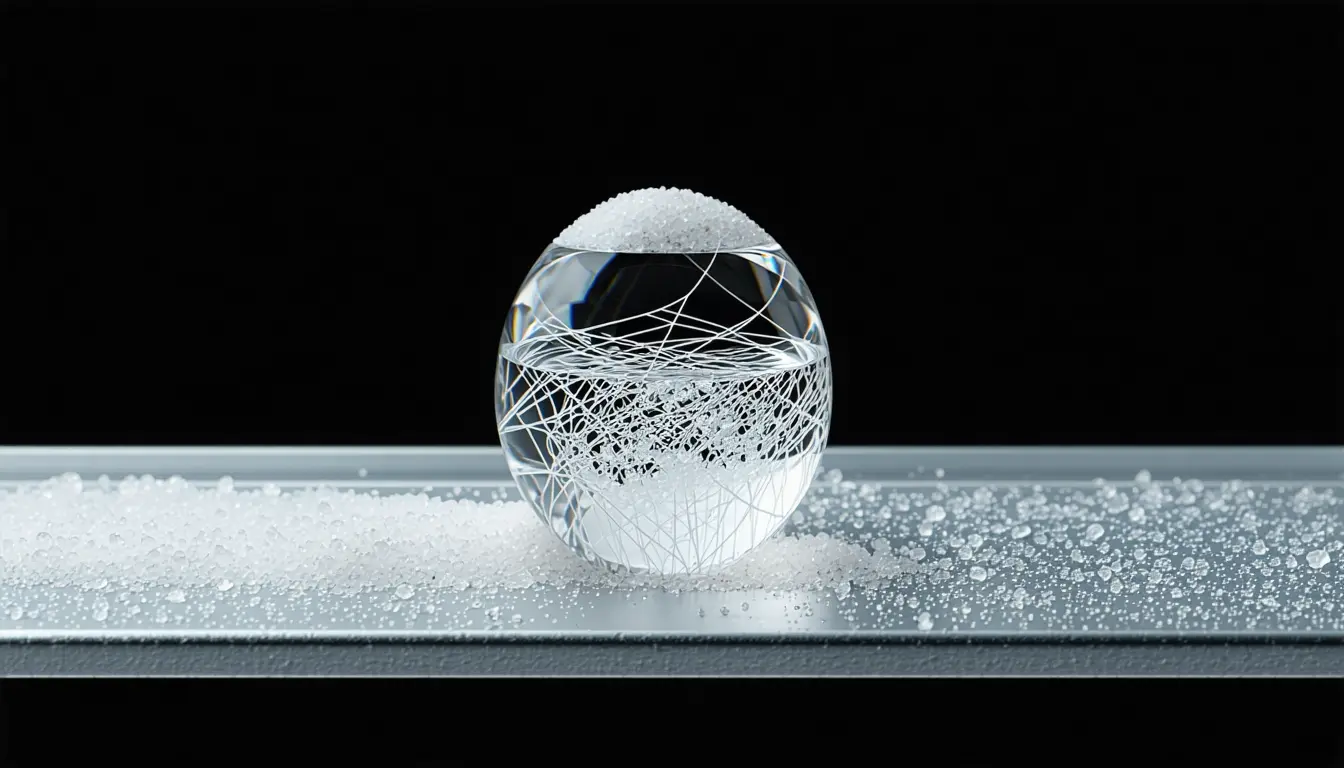
Start with the tube. Short DNA strands and a much longer DNA scaffold go into a small amount of salt water, which is heated and then cooled [2]. The sequences decide which strand can attach to which, and to which position on the scaffold, and choosing those binding rules is the programming step [3]. "The clever part is that the binding process is competitive: the DNA molecules compete with each other to select a winner, which succeeds in binding to the scaffold; all of the jostling and competition process information and execute a computation," Damien Woods, a professor of computer science at Maynooth University in Ireland and a co-author of the study, told Live Science in an email [4]. "Eventually, the system settles down into its energetically-preferred state which encodes the answer to the computation," he said [5].
"A small droplet of liquid contains billions, and sometimes trillions, of DNA strands," Abeer Eshra, an assistant professor of computer science and a co-author, said in a statement [14]. Those strands are not each running a program. They compete for places on one scaffold, and the structure they settle into carries one answer [4]. Small calculations finished in under a minute even though the computation has to proceed through chemical reactions that take the same amount of time or longer [13]. More than 700 computations across ten programs also works out to roughly 70 runs per program [20]. That is a lot of repeats for a first demonstration.
As reported, the efficiency claim is a claim about design. The system is arranged so that the energetically favorable state is the correct answer, so no energy goes into forcing a calculation through a series of processing steps [6]. Live Science reports the scientists describing this as more efficient than the conventional computers in wide use today [8]; the comparison the study itself draws is with biological computers that wire living cells to traditional hardware [7]. No measured energy per operation is reported [21].
"They're trivial calculations you could easily do faster yourself, and a silicon computer would finish in an instant," Constantine Evans, a senior research fellow at Maynooth University and a co-author, told Live Science [18]. In my view that closes the speed question and leaves the open one exactly where the authors put it, on what a competitive-binding answer costs to reach [6].
Eshra pointed at narrower uses than general computing. "Molecular computers like this are not trying to replace electronic ones, but they could be used in biological environments, smart materials and archival DNA data storage," he told Live Science via email [15]. "Our work is a new direction for DNA data storage, since any data stored in such a system would have natural built-in error correction properties," he said [16].
What to watch
- A head-to-head energy measurement of the SDC against a silicon adder running the same 100-bit program.
- Whether the programs scale past 100 bits, and how long those runs take in the tube.
- Whether an archival DNA storage group tests Eshra's built-in error correction claim on real stored data.