Science1 publisher2 min readPublished
Oxford weighed individual virus-like particles as they assembled, one subunit at a time
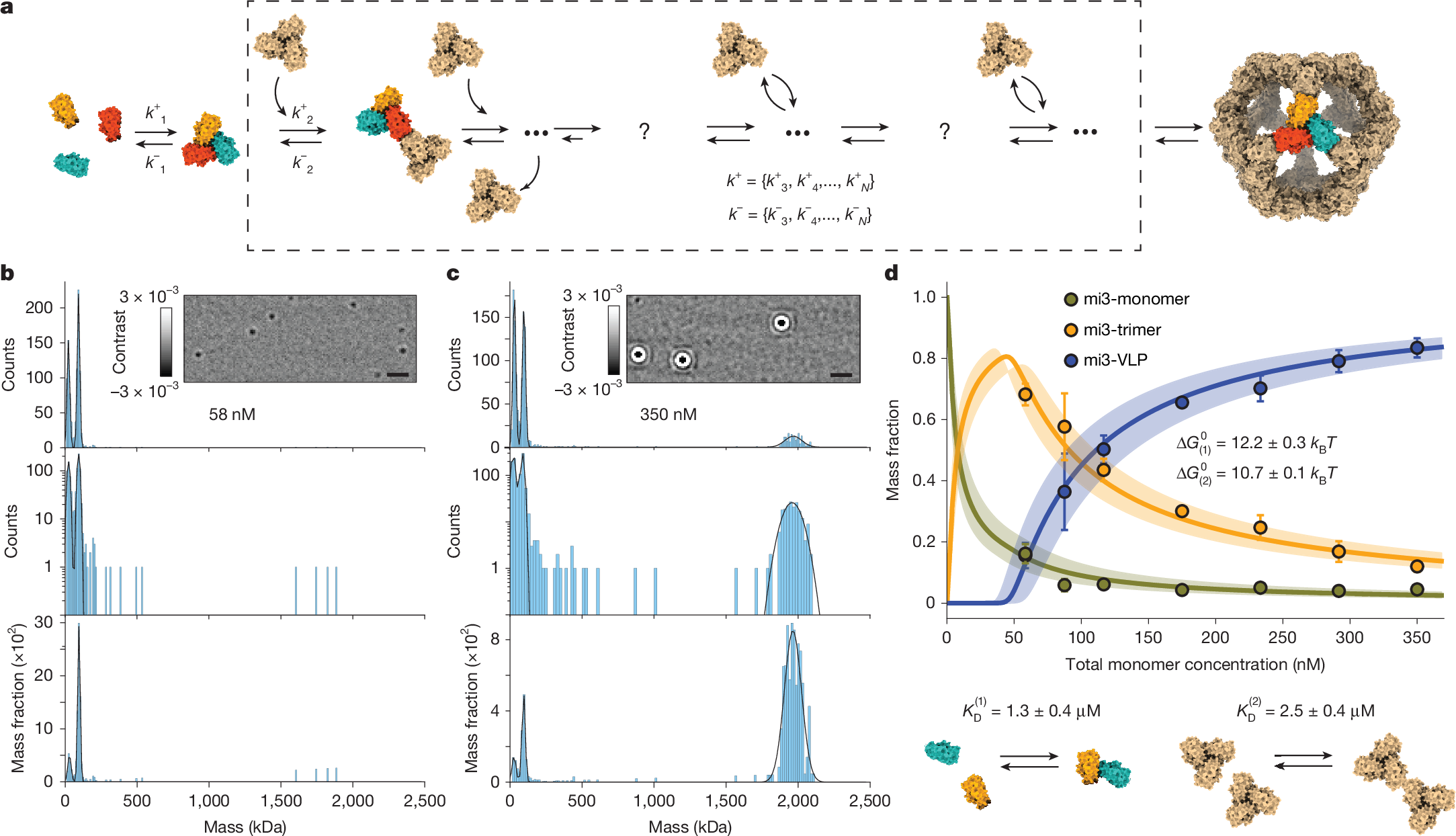
By holding single molecules still and weighing them over and over, an Oxford team recorded each protein subunit joining a 60-unit shell. The traces put the first stable structure at a closed ring of five.
The Scientist · Science desk
What happened
- Oxford chemists reported in Nature on September 16 that they had followed individual virus-like particles through assembly, recording each protein component as it joined.
- They used mass photometry, which weighs single molecules from the light they scatter, together with a new way of confining one molecule so the same particle could be measured as it grew.
- Once building blocks form particular closed structures, their multiple connections make them much more stable, and those few intermediates funnel an enormous number of possible routes.
- The first particularly stable structure in the pathway is a closed pentagonal ring formed by five of the larger protein building blocks.
- After that ring forms, each new stable stage requires fewer additional building blocks than the last, so assembly speeds up as it proceeds.
Compiled by The ScientistSomething wrong?How this is made
Why it matters
- capability A rare, short-lived intermediate no longer has to be trapped or purified in bulk to be studied: it can be identified in one particle's mass trace as it appears and passes.
- constraint Any inhibitor or design argument drawn from this pathway inherits the limits of a 60-subunit engineered particle, and shells with hundreds or thousands of components may not funnel the same way.
- decision Groups building virus-like particles as vaccine scaffolds gain a criterion to judge a design by, namely whether their subunits reach an early closed, multiply-bonded intermediate at all.
The components can fit together in thousands of ways [18]. Weak contacts keep a wrong one from being expensive: subunits that meet in the wrong arrangement come apart, and try again [4]. The path becomes hard to undo only when a closed structure forms, and five of the larger building blocks closing into a ring make enough connections at once to hold [6]. Roi Asor, a co-lead author in Oxford's Department of Chemistry and the Kavli Institute for Nanoscience Discovery, said, "The weak interactions give the system room to make mistakes. Most encounters don't have to be successful: the components can separate and try again." [12]
Structures like that ring are scarce and often short-lived, so conventional experiments could show what was present before and after assembly without the steps that connect them [8]. Mass photometry, developed at Oxford, measures the mass of a single molecule by detecting the light it scatters [3]. The team paired it with a way of confining one molecule so it could be watched continuously, then read the mass again each time a subunit arrived [3]. Philipp Kukura, a co-lead author, said, "Until now, much of our understanding of how these structures assemble has had to be reconstructed from snapshots or theoretical models." [13] Dan Loewenthal, a co-first author and PhD student, said, "This method lets us study the assembly process directly. We just take a video." [14]
The particle they used is engineered and has 60 protein units [2]. Oxford's own account notes that capsids can contain tens or even thousands of protein components [9]. Sixty sits at the small end of that range [16]. Whether a shell of several hundred subunits also funnels through a handful of stable waypoints is a separate measurement.
Oxford puts the therapeutic case in the future tense: understanding assembly, and what disrupts it, could ultimately help design novel antiviral treatments and engineer vaccines and other therapies [15]. The announcement does not report a compound tested against this pathway [17]. The result still points somewhere for a chemist. Weakening one reversible contact leaves the components free to separate and try again [4]; preventing the ring from closing would remove the first stage at which the growing structure becomes stable [6], and every stable stage after it needs fewer subunits than the one before [7]. That asymmetry is why the difficult nucleation step is followed by much faster growth [10].
What to watch
- Whether the confinement plus mass photometry approach can resolve a capsid of several hundred subunits, where the number of stable waypoints is still open.
- A follow-up in which the contacts that close the pentagonal ring are mutated on purpose, to test whether the pathway stalls where the model says it should.
- Whether groups engineering virus-like particles report assembly yields that track the appearance of an early closed intermediate.