Science1 publisher2 min readPublished
A DNA computer reaches its answers by settling into thermodynamic equilibrium
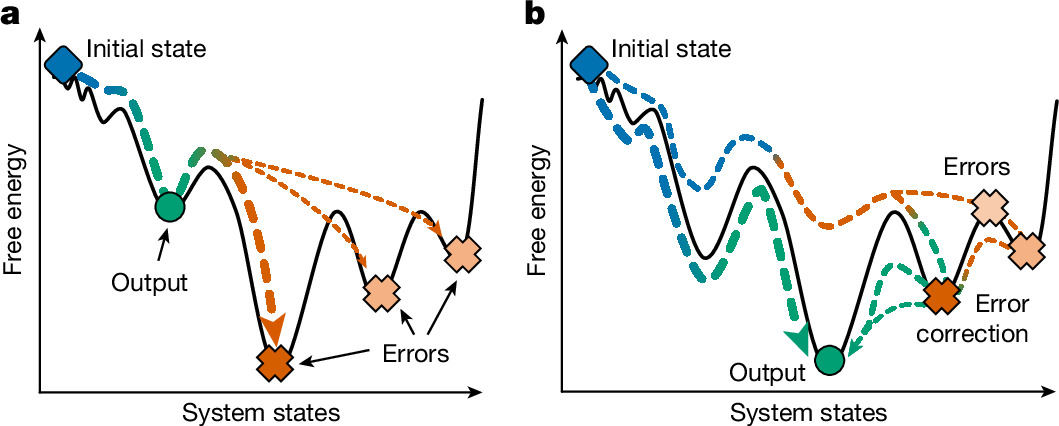
In a Nature paper, tiles assembling on a DNA scaffold make the correct output the thermodynamically favoured state. The authors say that removes the need for explicit error-correction subsystems, and small instances finish in under a minute.
The Scientist · Science desk
What happened
- A Nature paper demonstrates a Scaffolded DNA Computer on 10 programs, among them multiplication-by-3, division-by-2, 8-bit parity detection and the addition of 25-bit numbers, which the authors count as a 100-bit computation.
- The machine is a one-dimensional DNA scaffold of unique binding domains plus tiles carrying three program and data bits on each side, and a program with its input is a chosen subset of those tiles mixed with the scaffold.
- The authors report simple experimental protocols, reuse of the same system dozens of times, and small instances that finish in under a minute.
- They state the design needs neither error correction nor precise kinetic control, because the intended output is the thermodynamically favoured state.
- The paper says the design still has thermodynamic costs, and that what it avoids is the explicit error-correction subsystem.
Compiled by The ScientistSomething wrong?How this is made
Why it matters
- capability Molecular programmers now have a working example of a design whose correctness does not depend on kinetics, in a field where leaks, stray nucleation and buffer sensitivity are the failure modes to engineer around.
- constraint Until someone measures energy per operation on this substrate, the efficiency argument cannot size any claim against conventional hardware.
- precedent A physical demonstration turns an old theoretical result into something later equilibrium-computation work in other synthetic media can be measured against, and puts the burden on kinetic designs to justify their control overhead.
Correctness in a molecular program is usually a kinetic outcome. Strand-displacement circuits leak, algorithmic self-assembly nucleates where it should not, preparation is manual, and the systems are sensitive to experimental conditions [12]. The Scaffolded DNA Computer puts correctness into the free energy instead. Tiles bind along a one-dimensional scaffold of unique binding domains, and the authors' claim is that the configuration encoding the right output is highly favoured, outcompeting exponentially many off-target configurations [8][9]. If that holds, nothing in the system has to spend energy vetoing wrong states [11].
The design follows from the four requirements the paper sets for equilibrium computation: expressiveness, programmability, easily prepared initial states, and an energy landscape that can be navigated quickly to the target with high probability [18]. A program and its input are a subset of tiles mixed with the scaffold, each tile carrying three program and data bits on each side [8]. The authors describe the landscape as efficiently traversable, with parallel kinetics and multiple pathways to the output [10].
The energy case rests on a comparison the abstract makes in general terms: a large gap between modern computing energy consumption and the minimal theoretical requirement [14]. Machine learning and search algorithms already borrow the equilibrium idea, the authors note, while running on non-equilibrium architectures at enormous energy cost [7]. The paper also says the SDC design has thermodynamic costs of its own [11]. The abstract does not give a yield figure or a joules-per-operation number [16], so a direct comparison against silicon cannot be made from it.
Equilibrium computation was available in theory before this [6]. The paper supplies a medium in which it runs on real molecules [1]. The largest demonstration is the addition of 25-bit numbers, which the authors count as a 100-bit computation [2], where earlier DNA work had shown self-assembling 6-bit programs [13]. The sub-minute timing is attached to small instances [3], and the four programs named in the abstract are four of ten, leaving six documented elsewhere in the paper [17].
Kinetic proofreading and error correction stay necessary wherever the answer is not the equilibrium state. For these ten programs, the authors designed the equilibrium to be the answer [4]. They write that the work "creates a new way to think about equilibrium computation in all manner of synthetic systems" [19].
What to watch
- Independent replication of the reuse claim, and of the 25-bit addition, in another laboratory's conditions.
- A measured energy-per-operation figure for the SDC, which is what the abstract's comparison with modern computing energy use would need to become a comparison.
- Whether run times stay near a minute as the number of scaffold positions grows past the 100-bit case.