Science1 publisher3 min readPublished
Superfluid helium cools muonium into a beam fit for a muon gravity test
ETH Zurich and PSI report in Nature Physics that antimuons stopped in a film of superfluid helium near absolute zero come out as muonium atoms at similar speeds and almost parallel, the beam quality a free-fall measurement needs.
The Scientist · Science desk
What happened
- Researchers at ETH Zurich and the Paul Scherrer Institute report in Nature Physics a way to produce muonium atoms in a cold state, moving at similar speeds and almost parallel to one another.
- Muonium is the chosen atom because it is electrically neutral, and gravity is weak enough next to electromagnetism that stray fields would overwhelm the effect on a charged muon.
- The equivalence principle has been demonstrated only with ordinary matter or first-generation antimatter, so a muonium measurement would be the first involving a second-generation particle.
Compiled by The ScientistSomething wrong?How this is made
Why it matters
- capability With a neutral second-generation atom arriving at similar speeds in nearly one direction, how the muon responds to gravity becomes a problem of instrument design.
- constraint Decay caps the fall at tens of picometres, so a longer apparatus buys no larger signal; precision has to be bought with atom flux and displacement resolution.
- precedent Whatever figure the group eventually publishes would be the first experimental bound on gravity for a second-generation particle, and models that treat muons differently would have to fit inside it.
Neutrality is the reason muonium is the target at all. Gravity is extremely weak next to electromagnetism, and a free-fall experiment on a bare charged muon would mostly be measuring stray electromagnetic fields [11]. An antimuon bound to an electron has no net charge [3]. "After all, to make something fall, you need something neutral," Soter said [12].
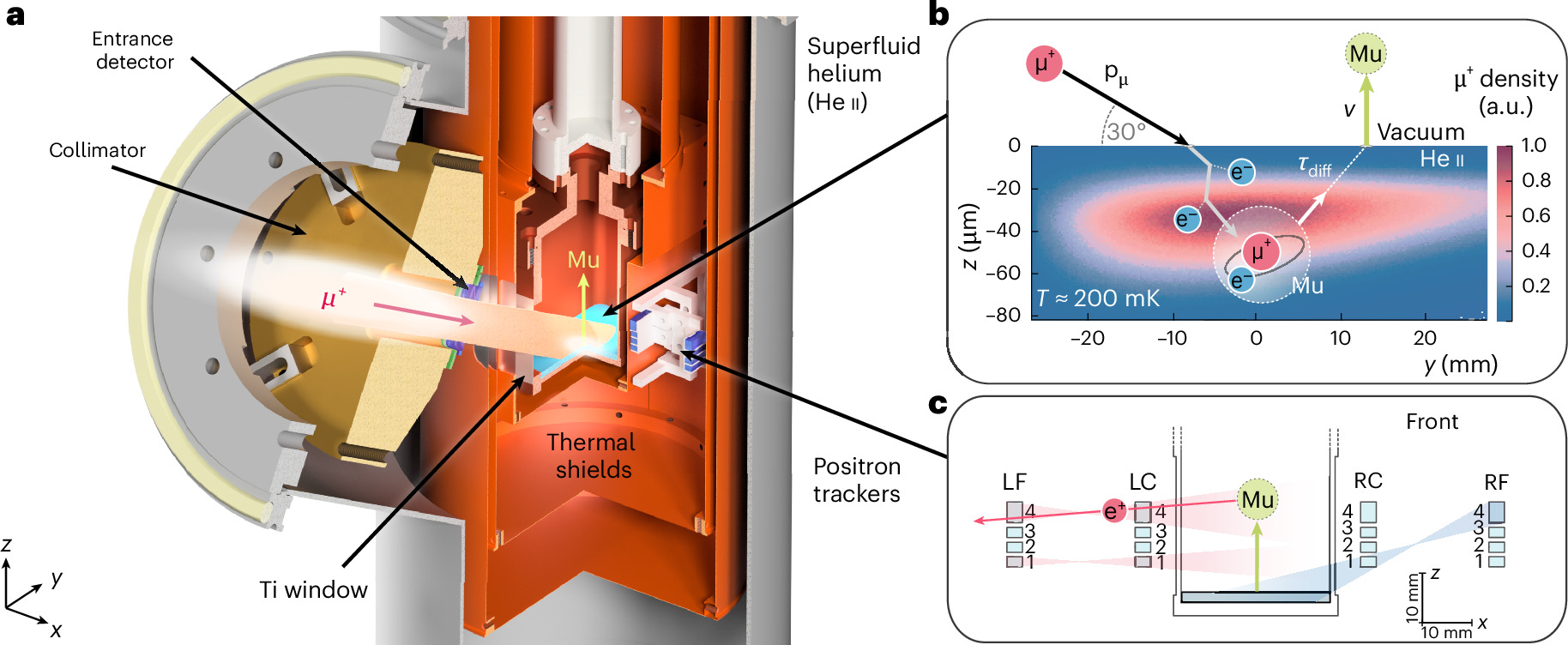
The production step happens inside a thin layer of superfluid helium. Antimuons from PSI's accelerator enter the film and slow down, and when one meets a free electron the pair forms muonium [10]. "In order to achieve this, we used superfluid helium that had been cooled close to absolute zero at minus 273 degrees Celsius," said Jesse Zhang, the study's lead author [8]. Zhang described the medium as "a quantum fluid, in which the individual helium atoms lose their identity, and which does not tolerate any impurities within it" [9].
Earlier methods made muonium atoms traveling at different speeds and in many directions [5]. For a precise gravity measurement that is close to useless. Soter said the team has now produced the atoms in a "cold" state, "which is what makes the gravity experiment possible in the first place" [6], and defined the word: "In this case, 'cold' means that the atoms propagate at similar speeds, almost parallel to one another" [7].
Decay sets the time available for the fall. A muon lives about 2.2 microseconds [4]. Free fall at the Earth's surface over that interval covers about 24 picometres, from 0.5 x 9.81 m/s^2 x (2.2 x 10^-6 s)^2 [18]. Since decay fixes the flight time, a longer flight path cannot buy more fall, so the sensitivity has to come from how many atoms arrive and how finely a displacement that small can be resolved [22].
ETH Zurich's announcement puts the group at the preparation stage [1]. "We have taken an important step towards carrying out an exciting experiment on this topic," Soter said, and added: "We want to measure the gravitational interaction of the muon" [17]. The release does not include a target precision or a start date, and it does not describe the detection scheme [21].
Objects at the same point in a gravitational field fall at the same rate, a universality Galileo and Newton recognized and Einstein later tied to the equality of gravitational and inertial mass [20]. That has been demonstrated so far only with ordinary matter or first-generation antimatter, which is why a muonium measurement would be the first involving a second-generation particle [13]. The Standard Model sorts particles into three generations. It does not explain why they exist [14]. "But we physicists do not yet understand why these additional generations exist at all in the first place," Soter said. "And why are there three in total?" [15] ETH Zurich's summary says any unexpected difference from Einstein's prediction would be a major surprise and could point toward new physics, including a hypothetical fifth force [16].
What to watch
- A published detection scheme and target sensitivity from the ETH Zurich-PSI group. Those are what would turn the beam result into a schedulable free-fall measurement.
- Reported numbers for beam flux, velocity spread and divergence out of the helium film, the quantities that set how small a deflection can be resolved.
- Whether any competing group claims a second-generation equivalence-principle test by another route.