Science1 publisher3 min readPublished
A centuries-old Coulomb's law test could out-search accelerators for millicharged particles
Physicists at Fermilab, Stanford and Delaware project that a Faraday cage shielding measurement would be three times more sensitive to millicharged particles than accelerator searches.
The Scientist · Science desk
Drafted by a language model from the sources cited here and checked against its claim ledger before publication. How we use AISend a correction
What happened
- Millicharged particles (mCPs) are hypothetical particles predicted to carry a very small electric charge, a small fraction of the electron charge; they are expected to interact very weakly with ordinary matter and electromagnetic fields, making them difficult to detect in conventional particle physics experiments.
- Some studies have hypothesized that millicharged particles make up a small fraction of the dark matter in the universe.
- Researchers at Fermi National Accelerator Laboratory, Stanford University and the University of Delaware showed that the Cavendish test, one of the oldest precision experiments performed by physicists, could be used to search for millicharged particles; the paper was published in Physical Review Letters.
- The paper's authors are Asher Berlin, Zachary Bogorad, Peter W. Graham and Harikrishnan Ramani, with Ramani as senior author.
- Four authors are named, across three listed institutions.
Compiled by The ScientistSomething wrong?How this is made
Why it matters
Four physicists at Fermi National Accelerator Laboratory, Stanford University and the University of Delaware have published a proposal in Physical Review Letters to repurpose the Cavendish test, one of the oldest precision experiments in physics, as a search for millicharged particles [3][4][5]. Their projections put it about three times more sensitive than existing or planned accelerator-based experiments [6], which is the interesting part: the limiting resource here is apparatus design, not beam energy.
Millicharged particles, or mCPs, are hypothetical particles carrying a small fraction of the electron's charge, and their weak coupling to ordinary matter and to electromagnetic fields is exactly what makes them hard to see in conventional particle physics experiments [1]. Some work has proposed that they make up a small fraction of dark matter [2]. Harikrishnan Ramani, the paper's senior author, told Phys.org that mCPs are among the simplest extensions of the Standard Model yet remain poorly constrained after decades of scrutiny [7]. He describes allowed parameter space in which the coupling is strong enough that mCPs would be produced in cosmic-ray collisions, thermalize locally because their mean free paths are tiny, and interact with Earth's large-scale electric and magnetic fields so that they accumulate [8].
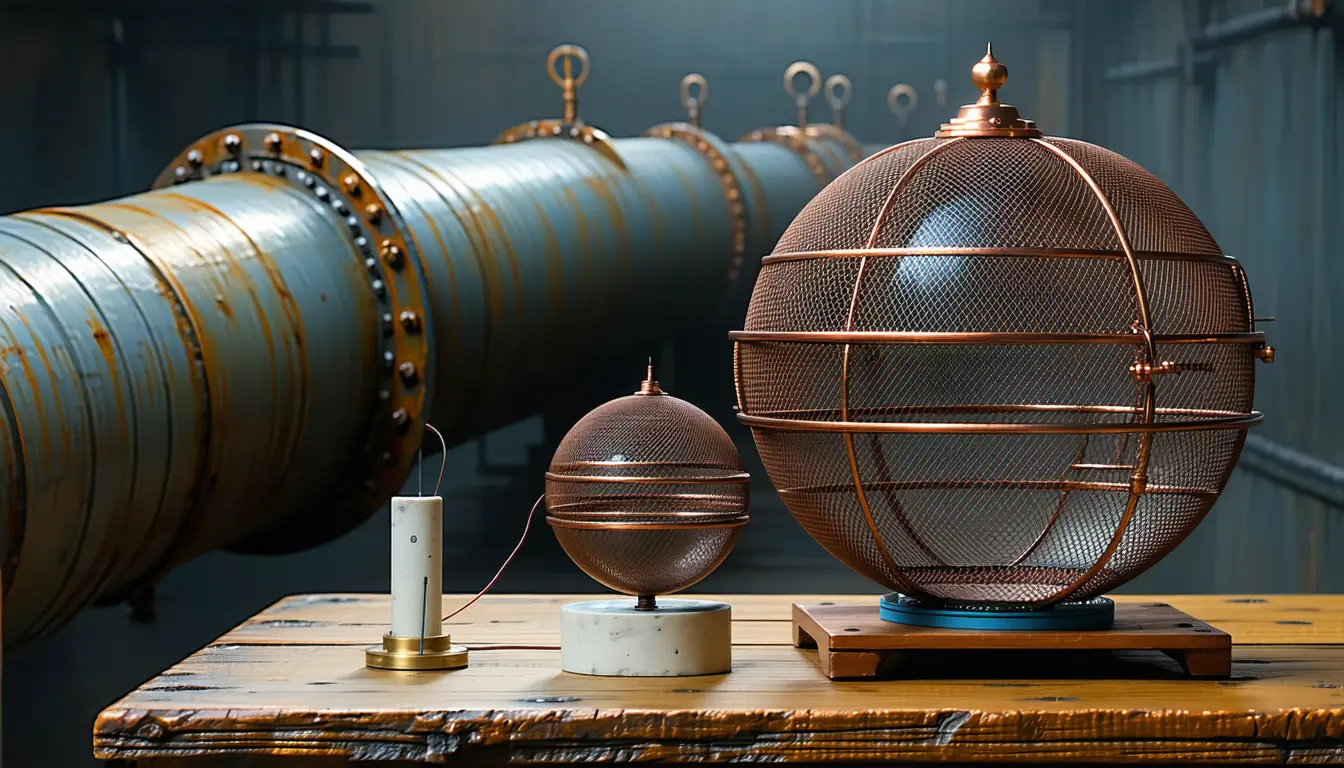
That accumulation is the premise of the measurement. A Cavendish test measures Coulomb's law using a large Faraday cage, a conductive shell that blocks external electric fields and radiation [11]. If Coulomb's law and therefore Gauss's law hold exactly, the interior is perfectly shielded and no field is induced inside [12]. Ramani says mCPs would break that in two ways: they give the photon a plasma mass, a screening effect, and Coulomb's law requires the photon to be massless [13]; and if the cage is driven with oscillating positive and negative potentials, ambient mCPs rush in and out in response, producing an oscillating electric field [14]. Standard Model charges do not do this, because their work function makes the cage hard to penetrate, so the shell doubles as a sieve that admits only mCPs [14]. The team's device oscillates the trapped particles' charges and reads out the weak field that results [9].
There is a genealogy worth noting. The same class of apparatus was historically used to set limits on the photon's mass, because a massive photon and a population of mCPs, otherwise unrelated, both show up as a deviation from Gauss's law [10]. The published material describes the apparatus only as a Faraday cage measurement of Coulomb's law and calls it one of the oldest precision experiments, without giving a date [16] - it is not the gravitational measurement that usually carries Cavendish's name in textbooks.
Two cautions. A factor of three is a projection, not a result, and it is a narrow margin by the standards of a field that usually claims orders of magnitude; a real build will spend some of it on systematics. And the proposal is said to be sensitive to two distinct sources of mCPs, but the available text cuts off before the second is described [15].
What to watch: whether any group commits hardware to this, since the projected gain over accelerators is small enough that engineering choices in the cage and the readout will decide it; and whether the two source populations imply different signal frequencies, which determines whether one apparatus can chase both.