Science1 publisher2 min readPublished
ETH Zurich and PSI eject muonium from superfluid helium as a cold, near-parallel beam
The equivalence principle has only ever been checked on first-generation matter. Anna Soter's group reports in Nature Physics a muonium source whose atoms leave the liquid at similar speeds, the condition a free-fall measurement needs.
The Scientist · Science desk
What happened
- Anna Soter's group at ETH Zurich and the Paul Scherrer Institute reported in Nature Physics a new way to make muonium, the atom formed from a positively charged antimuon and an electron.
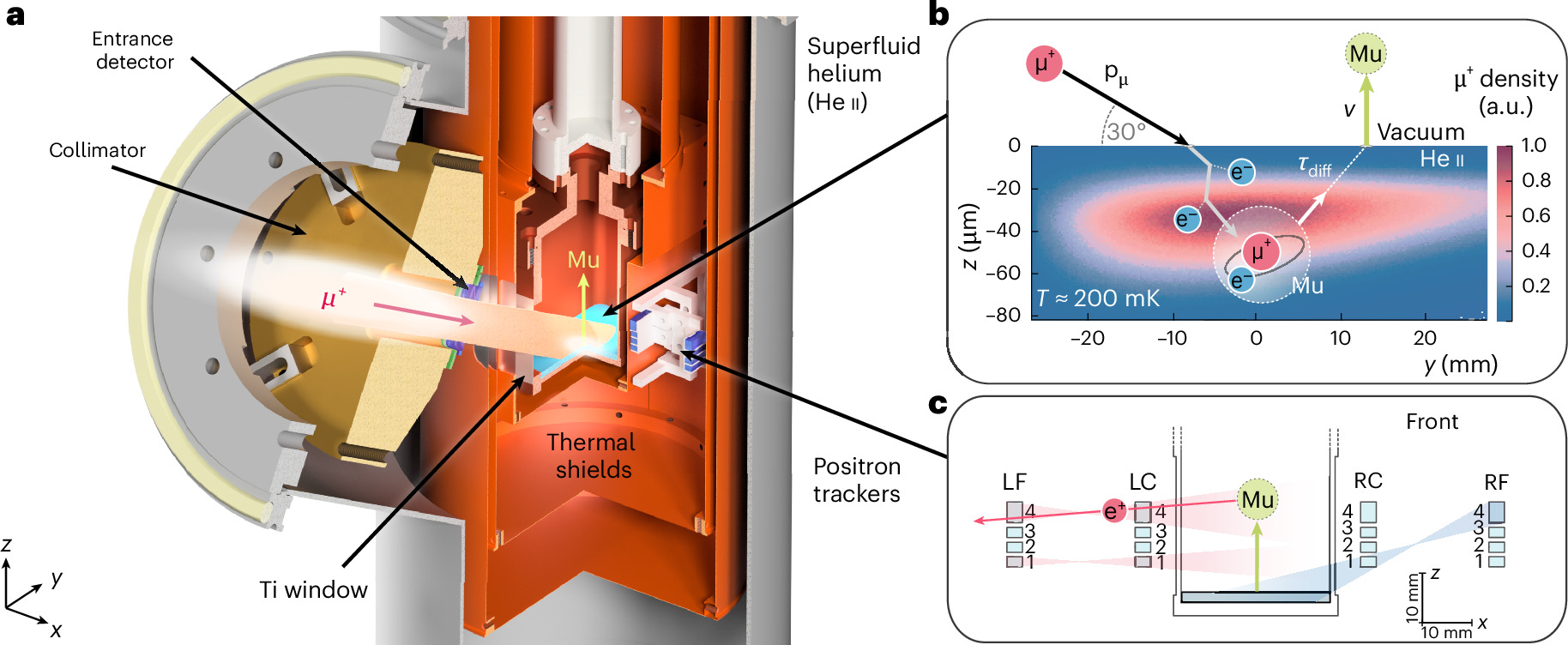
- Antimuons from the PSI accelerator are slowed inside a thin layer of superfluid helium cooled close to absolute zero, and the muonium that forms is forced out of the liquid and leaves it vertically.
- Earlier muonium sources sent atoms off in many directions at different speeds, and were therefore unsuitable for the kind of precise experiment a gravity measurement requires.
- The equivalence principle has so far been demonstrated only with ordinary matter and first-generation antimatter, so muonium would be the first look at how a second-generation particle falls.
- Muonium is electrically neutral, and on a charged particle the weak pull of gravity would be masked by stray electromagnetic fields.
Compiled by The ScientistSomething wrong?How this is made
Why it matters
- capability A free-fall measurement on muonium is now something the group can attempt at PSI, since Soter puts the cold state as the step that makes the experiment possible at all.
- constraint The 2.2 microsecond muon lifetime caps how large and slow the downstream apparatus can be, because each atom must cross the helium, escape and be measured before it decays.
- precedent If muonium settles the question for the second generation, only the third generation would still need a direct free-fall check.
"In this case, 'cold' means that the atoms propagate at similar speeds, almost parallel to one another," Soter said [13]. She also called that state the precondition for everything after it: "We have managed to produce the muonium atoms in a 'cold' state, which is what makes the gravity experiment possible in the first place" [12].
An antimuon fired into the helium is slowed, picks up a free electron, and the muonium atom that results carries a positive chemical potential, so the liquid forces it out; at the surface the potential becomes kinetic energy and the atom shoots vertically away [17]. "So we're using the chemical potential as an atomic cannon," said Jesse Zhang, the study's lead author [18][23].
Helium was picked for how it lets an atom pass through. The helium was cooled close to absolute zero, at about -273 C, according to Zhang [15]. "Superfluid helium is what is known as a quantum fluid, in which the individual helium atoms lose their identity and which does not tolerate any impurities within it," he said [16]. The muonium has to move through it at a particular speed and without collisions; scattered, given the muon's very short lifetime, it never reaches the surface at all [19].
For the counting statistics, the group leans on the beam. "For our experiments, we also rely on PSI's particle accelerator, which generates the world's most intense, continuous muon beams," Soter said [20]. "Thanks to this high-quality source, a great many muonium atoms can be produced" [21].
The paper does not say whether the muon falls like the electron. It is about making the beam [14]; no free-fall result is reported, and Soter describes the work as a step toward the measurement: "We have taken an important step toward carrying out an exciting experiment on this topic" [3][25]. The universality of free fall goes back to Galileo and Newton, and as the equality of gravitational and inertial mass it is a cornerstone of Einstein's gravitation [6].
The motivation is a hole in theory. "But we physicists do not yet understand why these additional generations exist in the first place," Soter said, "And why are there three in total?" [22]. Muonium, the neutral pairing of an antimuon with an electron, is the handle on the second of those generations [5]. Even a clean result on it would still leave the third generation to be tested by a direct fall [24].
What to watch
- A published free-fall deflection for muonium, with the precision reached, would turn a source demonstration into an actual test of the equivalence principle.
- The muonium flux at the new source in atoms per second, and whether it supports an interference measurement inside the muon lifetime.
- Whether other muon facilities can reproduce superfluid-helium ejection, or the method stays tied to PSI's continuous beam.