Science1 publisher2 min readPublished
One trapped calcium ion shows a focused laser couples most strongly off the beam axis
A single trapped calcium ion has confirmed a years-old prediction that the strongest coupling point of a tightly focused laser sits off the beam axis, and the size of the displacement tracks wavelength alone.
The Scientist · Science desk
What happened
- An international team working at the Paul Scherrer Institute focused laser light on a single trapped ion and measured the interaction, the first experimental observation of the optical Magnus effect.
- Tight focusing complicates the beam's electromagnetic field structure, and the strongest interaction with the ion turns up slightly to one side of the center instead of at the brightest point.
- Researchers at the University of Amsterdam had predicted the optical Magnus effect theoretically several years before this measurement was made.
- Trapped ions of the kind used here as a sensor are themselves used as qubits in quantum computing, with their quantum states manipulated by carefully controlled laser pulses.
Compiled by The ScientistSomething wrong?How this is made
Why it matters
- constraint Crosstalk estimates that compute a neighboring ion's exposure from its distance to the beam axis are working from the wrong reference point, and the error does not shrink when the optics improve.
- capability A group with an ion trap and a tight focus can now map the field structure inside that focus using the ion as the sensor, with no separate instrument on the bench.
- decision Ion-trap architects have a choice to make between suppressing the off-axis force and engineering with it, and PSI's first author is pointing at the second option.
The size of the sideways shift depends only on the wavelength of the light, PSI reports, and not on how tightly the beam is focused [7]. Tighten the focus and the waist gets smaller while the displacement stays where it is, so the displacement grows as a fraction of the waist [14]. A group that focuses harder to keep light off a neighboring ion ends up with a relatively larger offset inside the smaller spot [14].
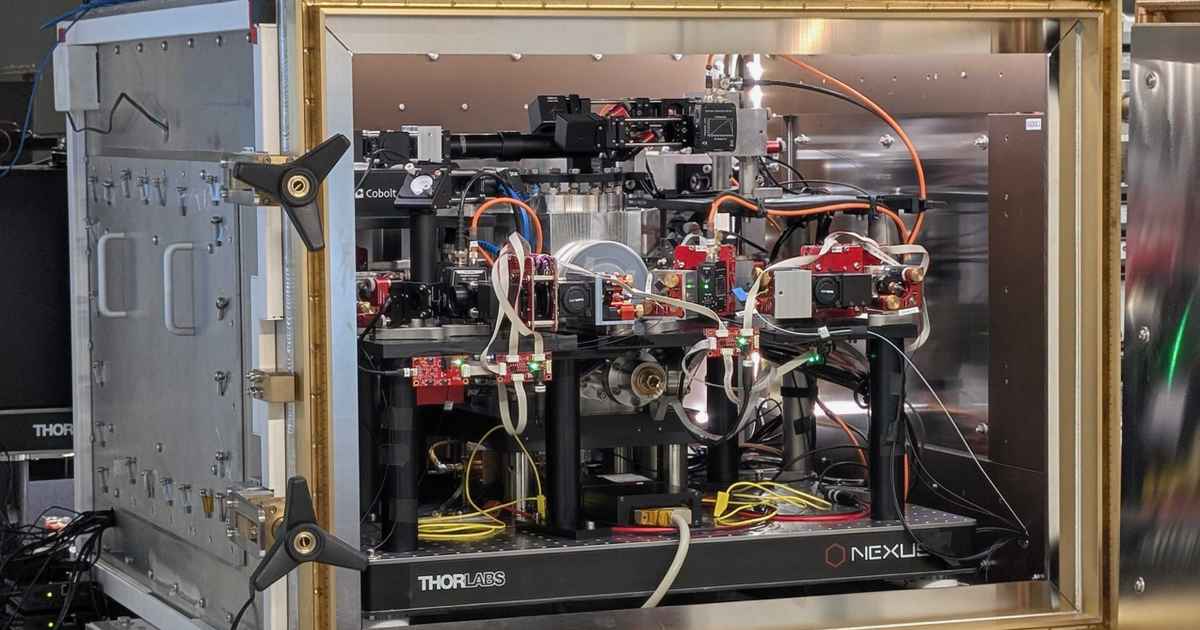
The probe was a single calcium ion, held nearly motionless in an electromagnetic trap and moved through different parts of the focused beam while the team recorded how strongly it interacted with the light at each position [4]. "Our ion acts like a tiny sensor that we can use to feel out the structure of the laser light," Leindecker said [5]. The scan resolved a very small displacement. "This makes it possible to measure a shift of just a few hundred nanometers," he said [6].
PSI's release says that if the effect is ignored it could interfere with high-precision laser control of qubits and contribute to errors [8]. It does not quantify that error [15]. The experiment's own method indicates where the offset matters and where it does not: the maximum was located by scanning the ion's position and keeping the point of strongest response [4]. A beam calibration that works the same way lands on the displaced maximum without ever naming it, while a model that assumes the coupling peak sits on the intensity axis carries the displacement as a systematic error [16].
Leindecker, the paper's first author, is at the PSI Center for Photon Science and the physics department at ETH Zurich [12]. He said of the effect: "The forces it generates could be used to couple qubits to one another, enabling more complex computations" [9]. Whether that force is strong enough to drive a two-qubit gate is a separate question from whether it is strong enough to spoil a single-qubit one.
The paper, "Direct Observation of the Optical Magnus Effect with a Trapped Ion", appeared in Physical Review Letters at DOI 10.1103/kj5p-qqs5, with Rene Gerritsma and Robert J. C. Spreeuw among its authors [10][12].
What to watch
- A figure giving the displacement in units of the beam waist at the wavelengths used for gate operations.
- Whether an ion-trap group reports the offset inside a measured crosstalk or addressing-error budget, and how large it is there.
- Whether the off-axis force can be made strong enough to couple two qubits, as Leindecker suggested it might.