Invest1 distinct publisher3 min readPublished
The San Francisco Democratic Party broke with its state party 17-4 to oppose Prop 40, but the six billionaires who have already ended their California residency are the only votes on this measure that are already counted.
The Investor · Invest desk

Compiled by The InvestorSomething wrong?How this is made
Start with the gross figure that neither campaign quite states. Five percent of the more than $2 trillion held by the roughly 200 people the measure would reach [6] is upwards of $100 billion of theoretical liability [1], and the Legislative Analyst's Office will commit only to tens of billions over several years [8], a haircut of half or better that the state's own scorer attributes to moving stock prices and to the difficulty of knowing what actions billionaires would take to reduce the amount of tax they pay [9].
Now price the responses. More than $118 million has gone into Propositions 41 and 42 [15], the pair funded through Building a Better California [12] that would force audits of programs financed by new special taxes and outlaw retroactive taxation outright [13][14]. Against $100 billion of gross exposure, that campaign is running at about twelve basis points [2], roughly a tenth of a cent for every dollar at stake, which makes ballot language the cheapest instrument available to the people being assessed.
Relocation is the expensive one, and six people have bought it [4]. Six out of about 200 is 3 percent of the headcount [3]; at the arithmetic average of $10 billion each [4] that is $60 billion of base and $3 billion of tax out of reach before a single vote is cast [5]. The average is a crude stand-in for a distribution nobody has published, so treat the $3 billion as an order of magnitude rather than an estimate.
The form of the bill matters more than its size for anyone whose net worth is a mark rather than a balance. Mark Cuban's point on X, that the founders of ten-billion-dollar startups are cash poor and stock rich because little of what they raise ever reaches them [18], describes a liability denominated in dollars sitting on wealth held in stock [19], and spreading payment over five years costs more than paying at once [7], so the menu is a sale, a loan, or the installment premium.
For the state the trade is a one-time take in the tens of billions [8] against under $1 billion a year of ongoing income-tax revenue lost to departures and behaviour changes [10], plus tens of millions of administrative cost [11]. Take $30 billion as a midpoint and that is roughly thirty years of foregone base bought with one payment [6], which might be worth doing at any plausible discount rate, except that nobody in this fight has published one.
My read, and it is a reading of the check-writers rather than the electorate: the 17-4 in San Francisco [1] is information about where the base sits, because that is the city holding the densest concentration of founders, investors and executives whose wealth is in stock rather than cash [19], and 48 to 41 in the Berkeley Institute of Governmental Studies poll [16], with 11 points unallocated [7], is not a margin built to absorb $118 million of organised opposition. The counter-thesis is sturdy, or rather the more interesting version of it is: 194 of the 200 stayed [3], the sponsors are labour rather than a lone donor, with SEIU-United Healthcare Workers West placing it on the ballot and the California Labor Federation, the Teamsters, Ro Khanna and Bernie Sanders behind it [17], and a permanent leak of under $1 billion a year [10] is a price a state that leans this hard on wealthy residents [19] might rationally pay. This is probably wrong, but the residency terminations are the series I would trust over the polling. I abandon the thesis if that count is still in single digits in November and Proposition 42 loses.
Ranked by verification strength, evidence, and original report placement.
The San Francisco Democratic Party voted 17-4 to oppose Proposition 40, with five members abstaining, five members absent and one member recording no endorsement.
The California Democratic Party endorsed Proposition 40 in August after a contentious vote that succeeded above the party's 60% threshold.
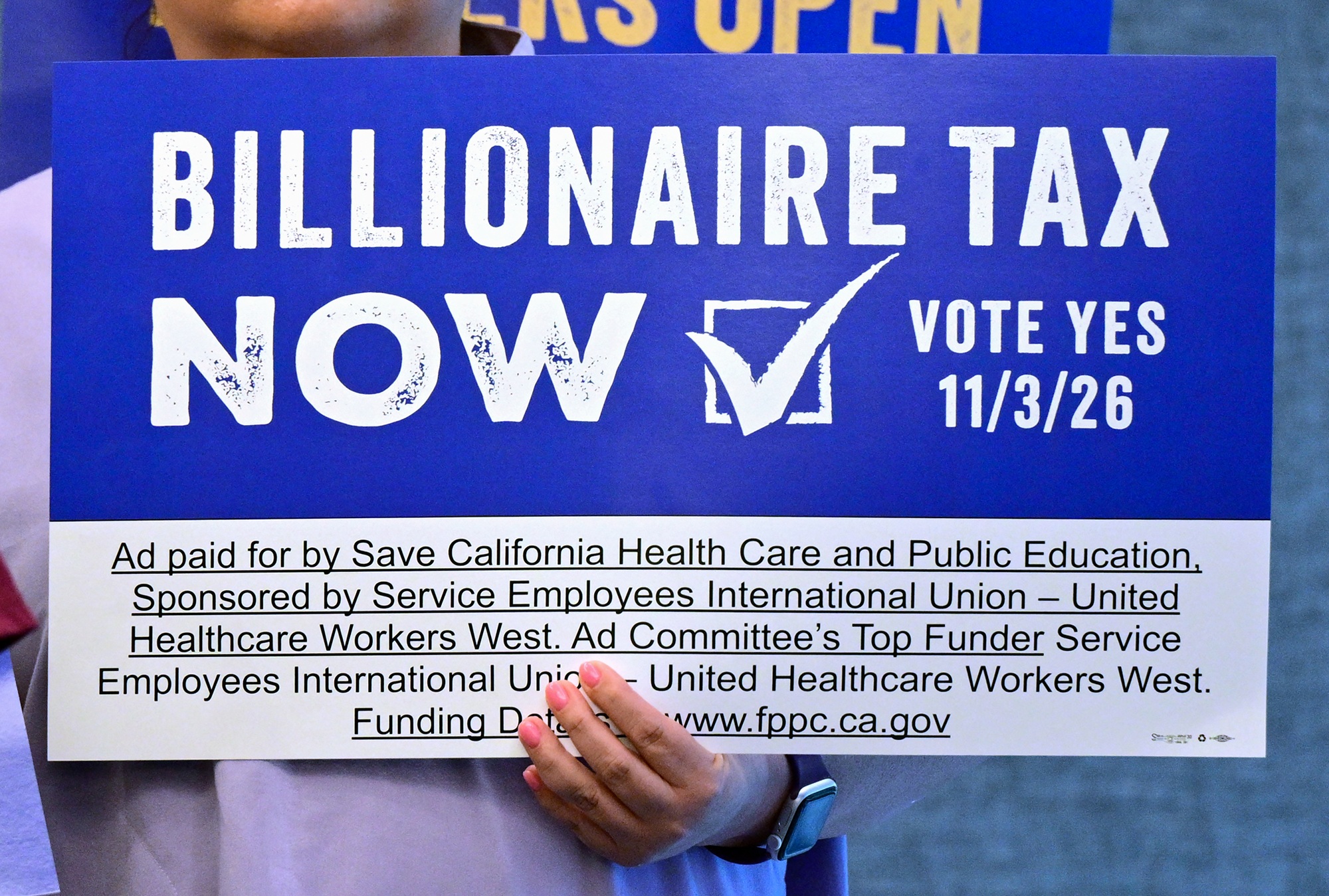
Proposition 40 would impose a one-time tax of 5% on the net worth of people who were California residents on January 1, 2026 with more than $1 billion in assets; 90% of the resulting revenue would be directed toward healthcare services.
About 200 billionaires would be affected by Proposition 40, and they hold over $2 trillion in total assets.
Taxpayers could spread their Proposition 40 payments over five years, although doing so would cost more.
Distinct publishers with included, body-backed reporting in this cluster.
fortune.com
1 article · September 2, 2026
Follow any of these and your For You feed starts watching them — no settings page required.
invest
A 5% one-time tax on paper wealth turns a valuation into a wire transfer2 distinct publishers
invest
Brin's $102m Doesn't Fight Prop 40. It Funds Two Measures That Would Void It1 distinct publisher
invest
California's 5% billionaire levy draws strong under-30 support amid slipping overall backing1 distinct publisher
invest
California's billionaires are spending about 1% of their tax exposure to kill Proposition 401 distinct publisher
Evidence-backed comparisons of source perspectives and observed adoption signals. Read the methodology
Which Builder, Operator, and Investor concerns the observed source mix emphasized—not a truth score.
Evidence, demonstrated adoption, hype gap, incentives, and confidence are assessed independently, each on its own current evidence. How these are measured.
Borrowed numbers strong, the headline number bare
The figures that do the work here mostly belong to someone else: the rate, the healthcare earmark, the tens-of-billions range, the sub-$1 billion leakage ceiling and the collection costs all come from the Legislative Analyst's Office, and the 48-41 split carries Berkeley's name. Against that, the detail our own framing rests on — six billionaires already gone — appears in one sentence with no names, no dates and nothing to check it against. One outlet, one unsourced pillar, and a legal conclusion about Proposition 42 that no cited authority signs.
Money has moved; most of the base has not
Two things have already happened rather than been predicted: $118 million is committed and six residencies are reportedly ended. That is real behaviour, and it is also 3% of the affected headcount — 194 people are still in place with a January date approaching. The spending is the firmer of the two observations, because contributions to a ballot committee leave a trail while an unnamed relocation does not.
Our compression, not Fortune's
Fortune's own reporting is restrained — it carries the analyst's 'very hard to predict' language and labels the leakage figure a ceiling. The stretching happens in the summary layer, ours included: 'twelve basis points' treats a $100 billion liability as though it were collectible, and calling six departures the votes already counted dresses an unnamed, unfiled count as settled fact. The arithmetic is honest; what it implies about outcomes is not yet earned.
No disinterested voices in the room
Everyone quoted has a position on the ledger. The union that would see 90% of proceeds flow to healthcare put the measure on the ballot. The funders of the two counter-measures would each owe roughly 5% of their net worth if it passes, and Larsen's extra $10 million is a fraction of that exposure. Cuban and Luckey argue liquidity while holding the assets in question, Khanna and Newsom are running on opposite readings of the same politics, and the local party that broke ranks changed its own bylaws this summer to make the break possible.
One account, and the vote hasn't happened
Confidence is capped three ways: a single newsroom, an outcome that depends on a November ballot plus two counter-measures whose legal effect is asserted rather than adjudicated, and a revenue picture the state's own analyst refuses to pin down. What we can say now is narrow and durable — the design, the coalitions, the money already spent. Everything about how much California actually collects is a range with an unpublished wealth distribution inside it.