Product1 publisher3 min readPublished
The Valkyrie's real test was the control handoff, not the flight
Kratos' XQ-58A flew electronic warfare with Marine F-35s in April and changed hands between two separate ground control systems mid-mission. The second part is the harder problem.
The Product Desk · Product desk
Drafted by a language model from the sources cited here and checked against its claim ledger before publication. How we use AISend a correction
What happened
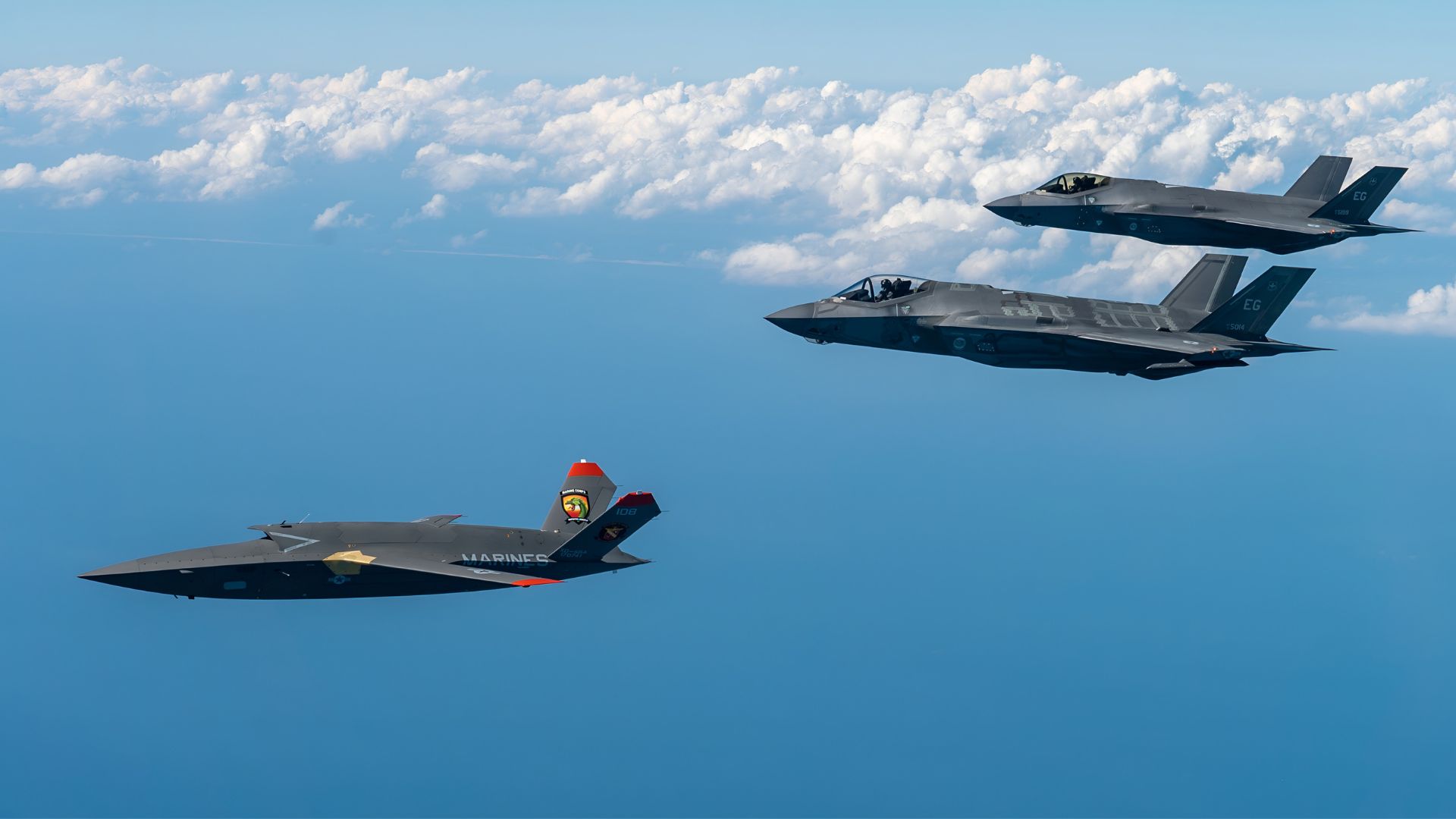
- During an April flight test in Southern California, Kratos' missionized XQ-58A Valkyrie collaborative combat aircraft tested electronic warfare capabilities and beyond-line-of-sight command and control alongside Marine Corps fighters.
- The aircraft launched from a zero-length launcher, connected with operators over a long-range datalink, and later transitioned between separate control systems during the mission.
- After the control transition, the Valkyrie flew alongside multiple Marine Corps F-35s and an F/A-18 for coordinated electronic warfare testing before autonomously returning to its designated recovery location.
- Control initially came through Kratos' ground control station before the team transferred the aircraft to another interface developed by Autonodyne.
- The Autonodyne system complies with the Autonomy Government Reference Architecture, allowing a Marine Corps operator to control the Valkyrie over the beyond-line-of-sight datalink.
Compiled by The Product DeskSomething wrong?How this is made
Why it matters
During an April flight test in Southern California, Kratos' missionized XQ-58A Valkyrie tested electronic warfare capabilities and beyond-line-of-sight command and control alongside Marine Corps fighters [1]. The part worth noting is not that a jet-powered drone flew next to manned aircraft, but that partway through the mission control of it moved from one company's software to another's [4].
The sequence: the aircraft launched from a zero-length launcher, connected to operators over a long-range datalink, validated and characterised that beyond-line-of-sight link, and later transitioned between separate control systems [2][7]. Control began in Kratos' own ground control station and was then transferred to an interface developed by Autonodyne [4]. That interface complies with the Autonomy Government Reference Architecture, which allowed a Marine Corps operator to fly the Valkyrie over the beyond-line-of-sight datalink [5]. According to the account of the test, the handoff was meant to show that operators could manage different autonomous systems through common interfaces rather than proprietary control architectures [6].
That is the constraint that decides whether collaborative combat aircraft are usable at scale. A fleet in which each vendor ships its own console is a fleet that needs a separate trained operator, a separate laptop and a separate supply chain per airframe type. A government-owned reference architecture that a second vendor's interface can satisfy is the difference between buying aircraft and buying ecosystems.
After the transition, the Valkyrie joined multiple Marine Corps F-35s and an F/A-18 for coordinated electronic warfare testing, then flew autonomously back to its designated recovery location [3]. Kratos said the aircraft achieved its planned objectives [8]. The Expeditionary Maritime Aviation-Advanced Development Team led the integrated effort, with Marine Corps and Navy test squadrons participating alongside Kratos, Northrop Grumman and Autonodyne [9].
This was not a first attempt. The Marine Corps has tested four different mission system configurations on its Valkyrie aircraft over the past three years, each pushing further into integration between the air vehicle, its onboard systems and its communications links [10]. Steve Fendley, president of Kratos' Unmanned Systems Division, said the platform's open architecture could speed integration of new mission capabilities, and that "the Valkyrie team continues to pave the way and demonstrate critical unmanned technologies" [11].
The commercial context: the test follows the Marine Corps' selection of Northrop Grumman and Kratos for its MUX TACAIR Collaborative Combat Aircraft programme [13]. The two plan to combine Northrop Grumman mission systems with open-architecture autonomy software on the existing Valkyrie airframe, a route the companies present as faster to an operational aircraft [14][15]. The first MUX TACAIR prototype is still scheduled for completion in summer 2026 [16]. Kratos expects to build more than 150 Group 5 unmanned aircraft during 2026 and is scaling Valkyrie output toward roughly 40 a year [12], which would be around a quarter of that Group 5 total [17].
Three things to watch. Whether the same reference architecture handoff works on an airframe from a different manufacturer, which is the actual test of the standard. Whether fighter crews, not a ground operator, can task the aircraft in a later configuration. And whether the summer 2026 prototype date holds [16].