Product1 publisher3 min readPublished
Cleora's real test is not the printer: 65 homes, 55 acres, one metro district
A Salida, Colorado development plans more than 65 robotically printed homes and runs its own metro district. One model shell is due this month; the rest is a throughput and utilities problem.
The Product Desk · Product desk
Drafted by a language model from the sources cited here and checked against its claim ledger before publication. How we use AISend a correction
What happened
- A 55-acre development in Salida, Colorado, called Cleora, is described as one of the world's largest planned 3D-printed residential communities.
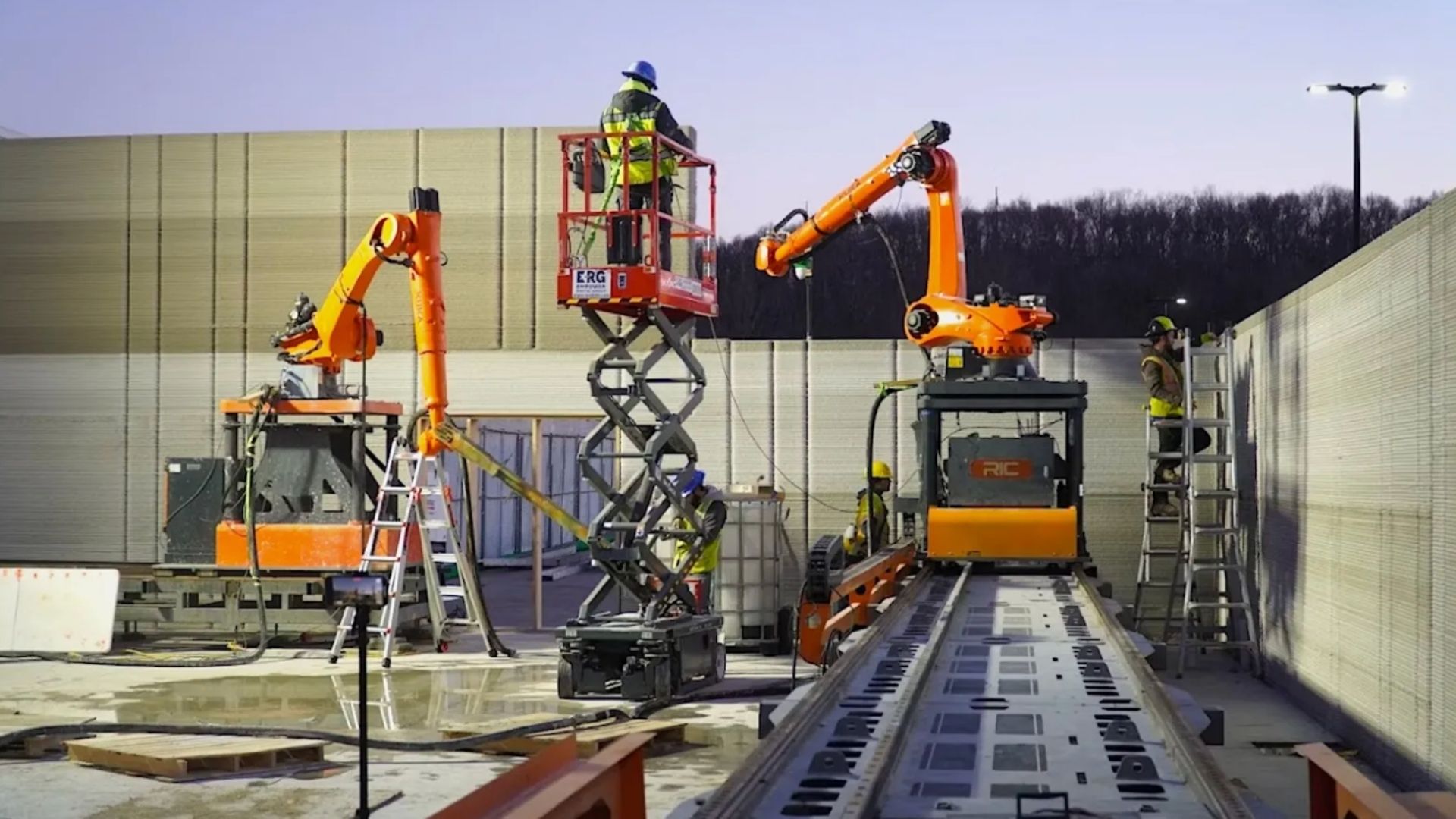
- Two autonomous RIC printing systems are currently operating across the Cleora site.
- The project will feature more than 65 robotically constructed homes alongside infrastructure managed through its own metropolitan district.
- Most 3D-printed housing projects to date have involved standalone residences or small demonstrations.
- The project is developed by Cleora with 3D-printing contractor True North and technology provider RIC Robotics.
Compiled by The Product DeskSomething wrong?How this is made
Why it matters
A 55-acre development called Cleora in Salida, Colorado has two autonomous RIC printing systems working on site and plans more than 65 robotically constructed homes, with infrastructure managed through its own metropolitan district [1][2][3]. That pairing, not the printing, is the part with consequence: standalone printed houses and small demonstrations have been done repeatedly, while a printed neighborhood has to survive permitting, buried utilities and district-level service delivery [4].
The team is Cleora as developer, True North as 3D-printing contractor and RIC Robotics as technology provider, chosen after nearly seven years of research and an evaluation of several technology providers [5][6]. What exists physically today is narrower than the headline count: True North's first model home is under construction with its shell expected to be finished this month, and production is to expand gradually as the developers assess how the systems perform at community scale [7][8]. So the site is one shell and two machines against a 65-home program [9].
The arithmetic is worth sitting with. Sixty-five homes across 55 acres is roughly 1.2 homes per acre, a large-lot pattern [10]. Road length, trenching and buried utility runs scale with lot geometry, not with how fast a gantry extrudes a wall, and those are exactly the costs a metropolitan district exists to carry. Two printers against 65-plus homes is about 33 shells per machine [11], and a shell is one trade. Roofs, mechanicals, finishes and inspection cycles are conventional work, and the source says nothing about how those are staffed or sequenced [12].
The district language deserves scrutiny. Cleora has established what the article calls the county's first 3D-printed metro district, which will support water treatment, utilities, recreation, commercial facilities and other essential services [13][14]. Water treatment plants are not printed. What is being created is a governance and service vehicle whose obligations run for decades after the novelty of the construction method stops mattering to residents.
The workforce piece is the most candid signal in the announcement. Cleora will act as a training hub with Colorado Mountain College, giving students hands-on time with construction robots, printing systems and digital design software, with the collaboration expected to support future training programs and certifications [15][16]. A training pipeline is also an acknowledgment that certified operators for this equipment are not sitting idle in Chaffee County.
Greg Kenny, Managing Partner at Cleora, says the aim from day one was to prove robotics could change how entire communities are designed and delivered, not simply to build printed homes [17]. Dr. Ryan Cox, CEO of RIC Robotics, frames the project as a step past demonstration projects toward integration at meaningful scale [18]. The stated test is whether autonomous systems can be folded into a functioning community while keeping architectural variety and controlling costs [19].
Notably absent from the announcement: per-home prices, a delivery schedule for the 65-plus units, and any count of permits issued or homes completed beyond the single model shell [20].
Watch the model home shell land this month, then watch the interval to the second and third homes [7]. Watch whether the two machines stay printing or sit waiting on inspections and utility hookups, since utilisation is where printed-wall economics are won or lost. Watch whether the Colorado Mountain College track issues actual certifications rather than tours [16], and whether the promised architectural variety holds once the printers are running against a schedule [19].