Product2 publishers3 min readPublished
SoftBank puts $200M behind a box on the roof, not a new excavator
Gravis Robotics says its retrofit autonomy kit works on Caterpillar, Deere, JCB and Hitachi machines. The productivity number is still the company's own.
The Product Desk · Product desk
Drafted by a language model from the sources cited here and checked against its claim ledger before publication. How we use AISend a correction
What happened
- Gravis Robotics AG said it has raised $200 million in funding from SoftBank Group Corp., described as the largest-ever Series A round for a construction robotics startup.
- Gravis Robotics was founded in 2022 after being spun out of the Swiss Federal Institute of Technology Zurich.
- The Gravis Rack is an autonomous control system that can be retrofitted onto existing machines from Caterpillar Inc., John Deere & Co., JCB International Co. Ltd. and Hitachi Ltd.
- According to the startup, Gravis Rack enables a 30% boost in productivity compared with driving the machines manually.
- The system also acts as a copilot for human operators, in addition to operating machines fully autonomously.
Compiled by The Product DeskSomething wrong?How this is made
Why it matters
Gravis Robotics AG said on August 17, 2026 that it has raised $200 million from SoftBank Group Corp., which the company calls the largest Series A ever raised by a construction robotics startup [1][14]. The money is not going into a new machine: it is going into a roof-mounted appliance that retrofits autonomy onto excavators contractors already own, so the biggest first round in the category is a bet on software distribution rather than new iron [1][3][16].
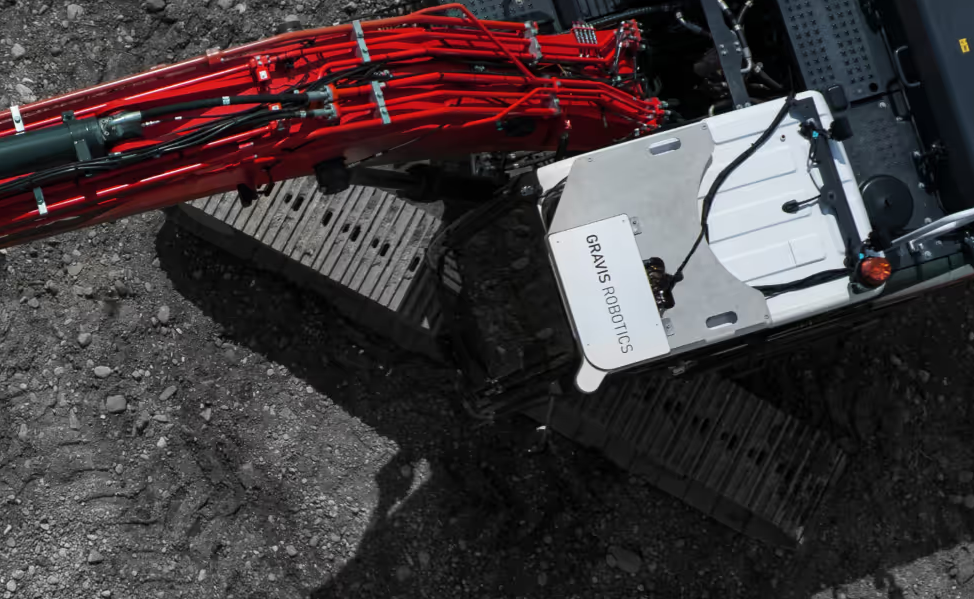
The product, the Gravis Rack, is a flat rectangular computing appliance that sits on the excavator roof and holds the chip running the AI software plus cameras and a lidar sensor, with additional cameras and lidar on a pair of included rear masts [6]. Those masts also carry a GPS module, and Gravis says it uses a technique it calls GNSS RTS to correct location errors, in some cases to under an inch [7]. A Wi-Fi transmitter syncs the rack to a companion tablet called Slate, which lets an operator work the machine remotely from live sensor video with overlays marking water pipes and other buried infrastructure to avoid [8].
The retrofit decision is the commercially interesting part. Gravis says the Rack fits existing machines from Caterpillar Inc., John Deere & Co., JCB International and Hitachi Ltd., which means adoption does not wait on fleet replacement cycles or on an OEM agreeing to ship autonomy from the factory [3]. It also means the company is selling into a market it describes as one of the world's least automated and still heavily dependent on humans in the cab, where an aging workforce and labor shortages leave firms missing project timelines [9][10].
The headline performance figure deserves the usual discount. The 30% productivity gain over manual operation is the startup's own claim, with no third-party measurement, site count or named customer attached [4]. The same announcement notes the Rack can also run as a copilot alongside a human operator rather than fully autonomously, which is the honest tell: assisted operation is what usually ships first, and it is also easier to sell without settling who is liable when an unmanned machine hits a gas line [5].
On the technical argument, Gravis says excavation is unlike the physical AI problems already solved, because autonomous vehicles and robotic arms work in what it calls static environments while an excavator's job is to disturb the terrain [11]. Co-founder and CTO Dominic Jud says the models were trained in simulation built to reproduce the feedback human operators rely on, including engine sound, machine vibration and hydraulic resistance [12]. "Our AI takes that same physical input and grounds it in machine telemetry, responding to varying subterranean forces and soil mechanics at microsecond speeds," Jud said [13].
Gravis was spun out of the Swiss Federal Institute of Technology Zurich and founded in 2022, so this is roughly four years from lab to a nine-figure first round [2][15].
Watch for the first named customers and how many machines each one fits, since a retrofit thesis lives or dies on install counts rather than pilots. Watch whether the 30% figure survives independent measurement on real sites, and whether revenue skews to copilot mode instead of unmanned work [4][5]. And watch the four OEMs named as compatible hosts: their response to a third-party autonomy box on the roof of their machines will shape how long the retrofit window stays open [3].