Invest1 publisher3 min readPublished
Residential construction has raised productivity 0.45% a year since 1993
The measurable robotics gains in homebuilding are in floor layout printing and factory work, and the $11 billion a year that labour shortages cost builders is the market those tools sell into against a shortfall of 1.2 million homes.
The Investor · Invest desk
What happened
- The National Association of Home Builders' 2026 Housing Outlook puts the United States roughly 1.2 million homes short of what it needs.
- The NAHB estimates the industry must attract about 740,000 workers a year to cover growth, retirements and people leaving the trade.
- Dietz says labour shortages alone cost homebuilders about $11 billion a year in higher costs and lost production, and add roughly two months to the average construction timeline.
- Michigan professor Vineet Kamat says the clearest robotics results are in layout, factory automation and task-specific work such as drilling, fastening and material handling.
Compiled by The InvestorSomething wrong?How this is made
Why it matters
- cost A vendor selling into the labour gap has about $9,200 a year per missing home to argue over, and that figure sets what a per-project tool can charge.
- constraint Dietz's other constraints, land availability and financing among them, mean a tool that fixes information errors cannot lift national output on its own however many builders buy one.
- decision Money put behind humanoid site work funds a capability Murphy places years out, and it is money not going into factory capacity or layout tools that already have measured cases.
- contradiction Kamat reports gains on structured tasks while CNBC judges the scale too narrow to reduce the shortage, so the same evidence supports a firm-level purchase and a national no.
Put the $11 billion a year that labour shortages cost homebuilders next to the shortfall itself: 11 billion divided by 1.2 million homes is about $9,200 for every home the country does not have, each year [5][1][1]. The $9,200 is a builder's operating cost, not the value of the missing houses. It is also the size of the market an error-prevention vendor sells into.
Robert Dietz's productivity number does more damage than his dollar one. A 16% gain over the 33 years since 1993 compounds to roughly 0.45% a year, and the wider economy's better-than-50% works out near 1.2%, so residential building has improved at a bit over a third of the national rate [4][2]. Nearly 300,000 construction jobs stood open at the end of 2025, about 41% of the workers the NAHB says the industry has to attract in a single year [2][3][3].
Vineet Kamat, who studies construction robotics at the University of Michigan, put the screening test in commercial terms. "The key question is not whether a robot can work in a pilot," Kamat said, "but whether it can do so reliably across varied conditions with a positive business case." [10]
Tessa Lau, who founded Dusty Robotics, said factories are relatively easy to automate because a robot repeats the same task in a fixed environment, while on a site the robot's workplace is being transformed around it [13]. Patrick Murphy, chief investment officer at Coastal Construction, said the lack of uniformity across designs, soil conditions, architects, subcontractors, materials and owner requirements makes repetitive automation difficult [12]. On the humanoid version, Murphy said: "The biggest misconception is people imagining humanoid robots walking around job sites hanging drywall and painting. We're years out before we're in that world." [11]
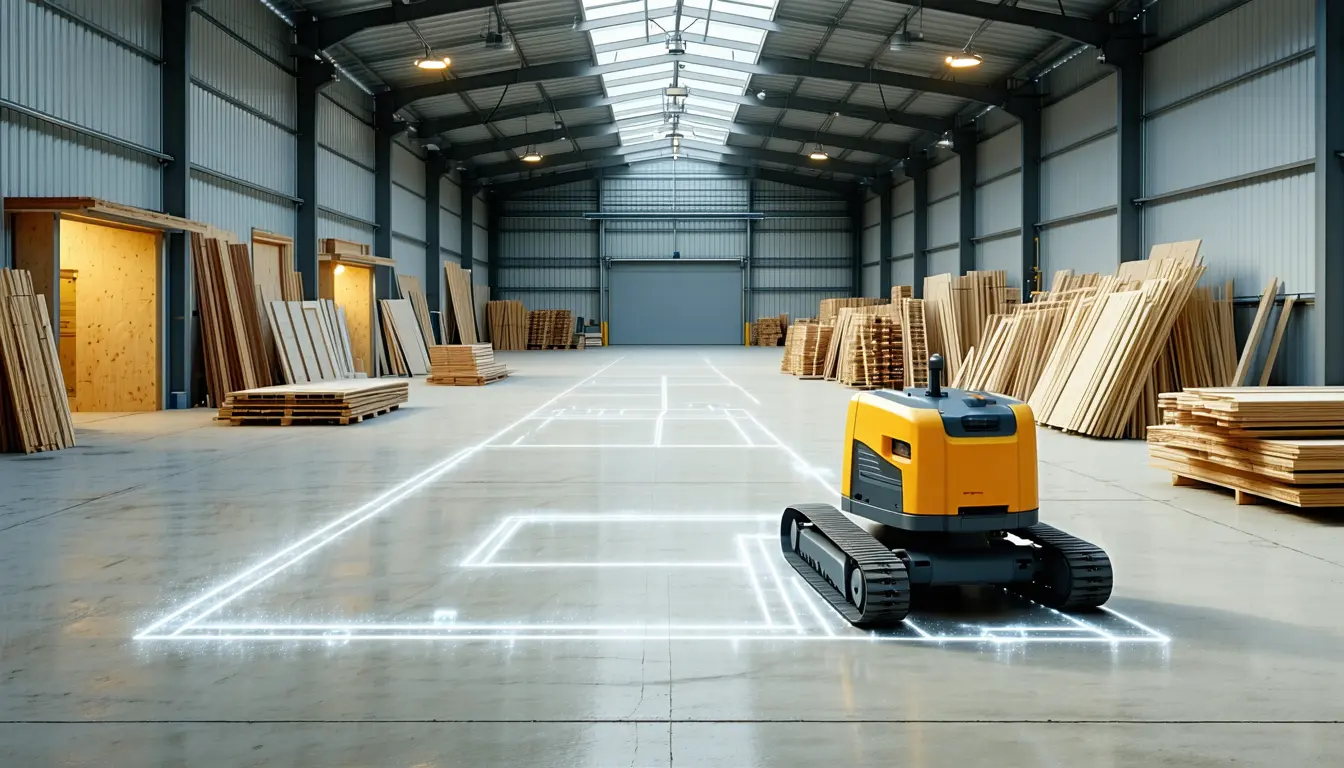
Dusty's product is narrow by design. The FieldPrinter takes digital building plans and prints them onto the floor, marking walls, plumbing, electrical and mechanical locations along with text, images and QR codes, so several trades read the same instruction [14]. Lau built it after a plumber installed the wrong fixtures in her two bathrooms, a mistake she found only after the tubs had been tiled; workers chipped out the tile, removed the fixtures, reinstalled them and retiled [15]. "That's an information mistake," Lau said [16]. "If you're not thinking about it very deeply, the shallow take is that labor replacement is the solution," she said [19].
The reallocation case is strong on where gains are measurable and weak on what they reach. Dietz said "There's no single, simple, scalable solution," pointing to labour, regulatory costs, land availability, supply chains and financing [7], and a printer on the slab does not touch land or a construction loan. CNBC's assessment is that the gains so far are real on individual projects and too narrow in scale to materially reduce the national shortage [17]. Against that, the two months labour shortages add to the average build is a carry cost [5]. A builder who takes that back on every house books the saving whether or not the national series moves off 0.45% a year. Movement in that series is the reading that would show these tools reaching further than this evidence supports [2]. Asked whether robotics is already improving homebuilding productivity, Dietz said, "It's too early." [6]
What to watch
- The next NAHB reading on open construction jobs against the 740,000-a-year hiring requirement.
- Whether Dusty Robotics or a rival reports adoption across a builder's full book of homes instead of single projects.
- Whether a large builder such as Coastal Construction moves capital into factory capacity for components.