Science1 publisher3 min readPublished
One oxygen atom sets the temperature at which RNA turns into droplets, then gel
A Buffalo-led team reports RNA condenses about 10 degrees Celsius below matched DNA, and traces it to the 2'-hydroxyl. That gives the RNA-world story a compartment without a membrane.
The Scientist · Science desk
Drafted by a language model from the sources cited here and checked against its claim ledger before publication. How we use AISend a correction
What happened
- The study was published July 31 in Nature Communications under the journal's early access guidelines.
- Priya R. Banerjee, PhD, Twentieth Century Club Professor in the University at Buffalo Department of Physics, is lead corresponding author; the study was led by the University at Buffalo.
- The study was done in collaboration with Jerelle Joseph, PhD, assistant professor of chemical and biological engineering at Princeton University.
- The work was supported by the National Institutes of Health, the National Science Foundation and the Hypothesis Fund.
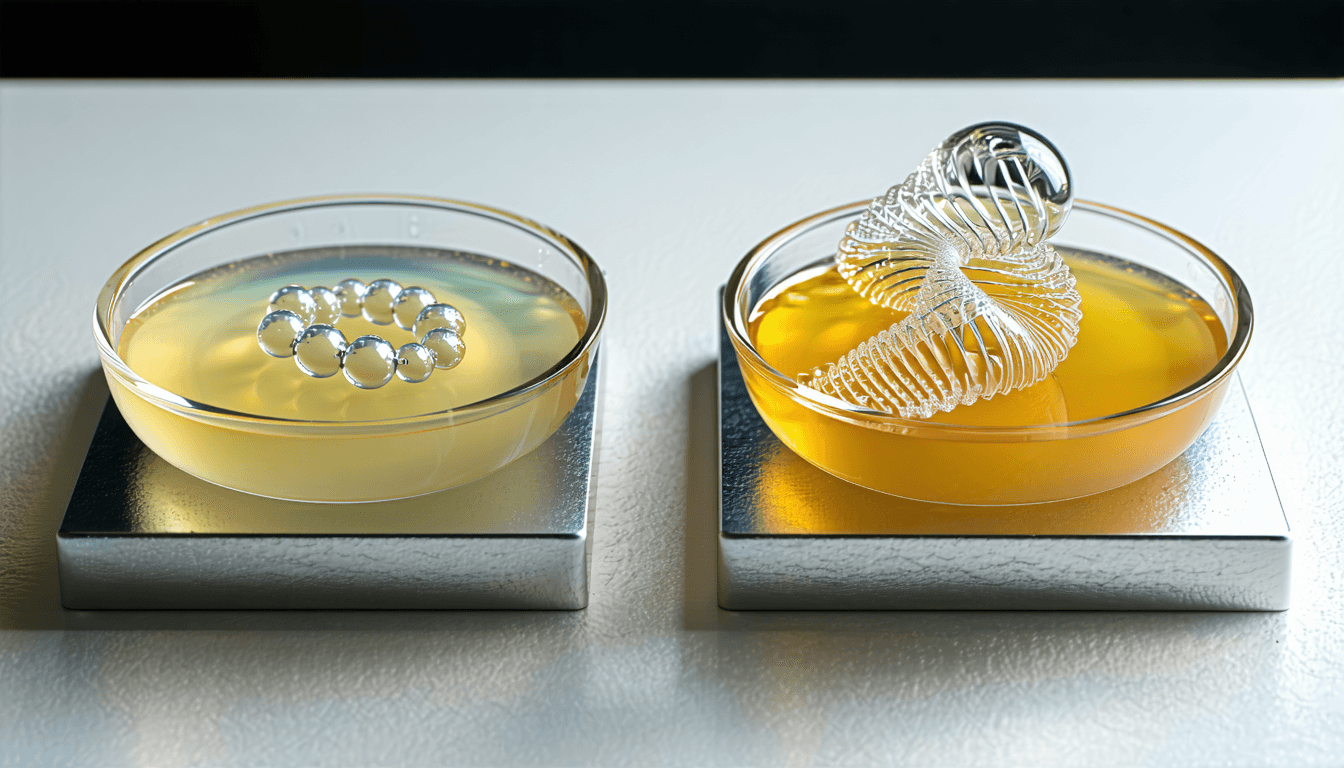
- In experiments, Banerjee's group showed RNA began forming droplets at temperatures roughly 10 degrees Celsius lower than the corresponding DNA, indicating RNA had a stronger tendency to condense.
Compiled by The ScientistSomething wrong?How this is made
Why it matters
A group led by the University at Buffalo reports that RNA begins forming liquid-like droplets at temperatures roughly 10 degrees Celsius lower than single-stranded DNA of essentially the same sequence, and that the RNA droplets more readily knit into interconnected networks that shift the material from fluid to gel [5][6][7]. The chemical difference they hold responsible is one oxygen atom per sugar unit: the 2'-hydroxyl group that RNA carries and DNA does not [8].
The study was published July 31 in Nature Communications under the journal's early access guidelines [1], with Priya R. Banerjee of UB's physics department as lead corresponding author and Gable Wadsworth, a postdoc in the lab, as first author [2][15]. Molecular dynamics work came from Jerelle Joseph's group at Princeton [3][12]. Funding was from the National Institutes of Health, the National Science Foundation and the Hypothesis Fund [4].
The consequence is for a specific gap in the RNA-world hypothesis, which holds that RNA both carried genetic information and catalysed reactions before DNA, proteins and cells existed [9]. That account has to explain how a fragile molecule stayed concentrated and intact without a cell to hold it [10]. Membraneless condensates are the proposed answer: droplets that concentrate RNA, raise the odds of molecules meeting, and potentially shelter them from a hot, acidic environment [11]. A 2023 study from the same lab had already found RNA tends to organise into droplets at high temperature [13]; the new work asks what in the chemistry does it.
Using temperature-controlled microscopy, small-angle X-ray scattering and the Princeton simulations, the team found that the 2'-hydroxyl appears to make RNA bind magnesium ions more strongly and hold fewer water molecules around its backbone than DNA does, which the authors say lets RNA chains come together more readily as temperature rises [12]. The cleaner part of the argument is the perturbation: chemically converting the 2'-hydroxyl to 2'-O-methyl, a modification found in many natural RNAs, weakened the tendency to condense and changed whether the resulting condensate stayed fluid or arrested into a gel [14]. According to Wadsworth, that single group has a "surprisingly powerful effect on whether these molecules come together, remain dynamic or become arrested into a gel-like material" [16].
Two things about the framing are worth keeping in view. The reported temperature effect is a 10 degree offset relative to DNA, not an absolute threshold, so it constrains the comparison rather than pinning the chemistry to any particular early-Earth condition [5][6]. And the mechanism runs through magnesium [12], which means the prebiotic reading depends on ionic conditions the announcement does not specify. Banerjee's own claim is appropriately hedged: the findings show how small changes in molecular chemistry control the emergence of larger self-organised structures, and could eventually let researchers ask whether condensates bridged simple molecules and the earliest life [17].
What to watch: whether the gel transition is shown to preserve RNA or catalytic activity under acidic, high-temperature conditions rather than merely to occur; whether the 10 degree gap holds across sequences and salt regimes; and whether the 2'-O-methyl result gets read the other way, as a mechanism cells use to keep RNA condensates from setting.