Science1 publisher2 min readPublished
Epithelial cells use their E-cadherin adhesion machinery to swallow dying cells in fish and mouse embryos
Verena Ruprecht's team found that epithelial cells in zebrafish and mouse embryos use the E-cadherin complex to engulf dying cells while staying sealed. The release links this to chronic inflammation, but every experiment it describes was done in embryos, so that link goes beyond the work.
The Scientist · Science desk
Drafted by a language model from the sources cited here and checked against its claim ledger before publication. How we use AISend a correction
What happened
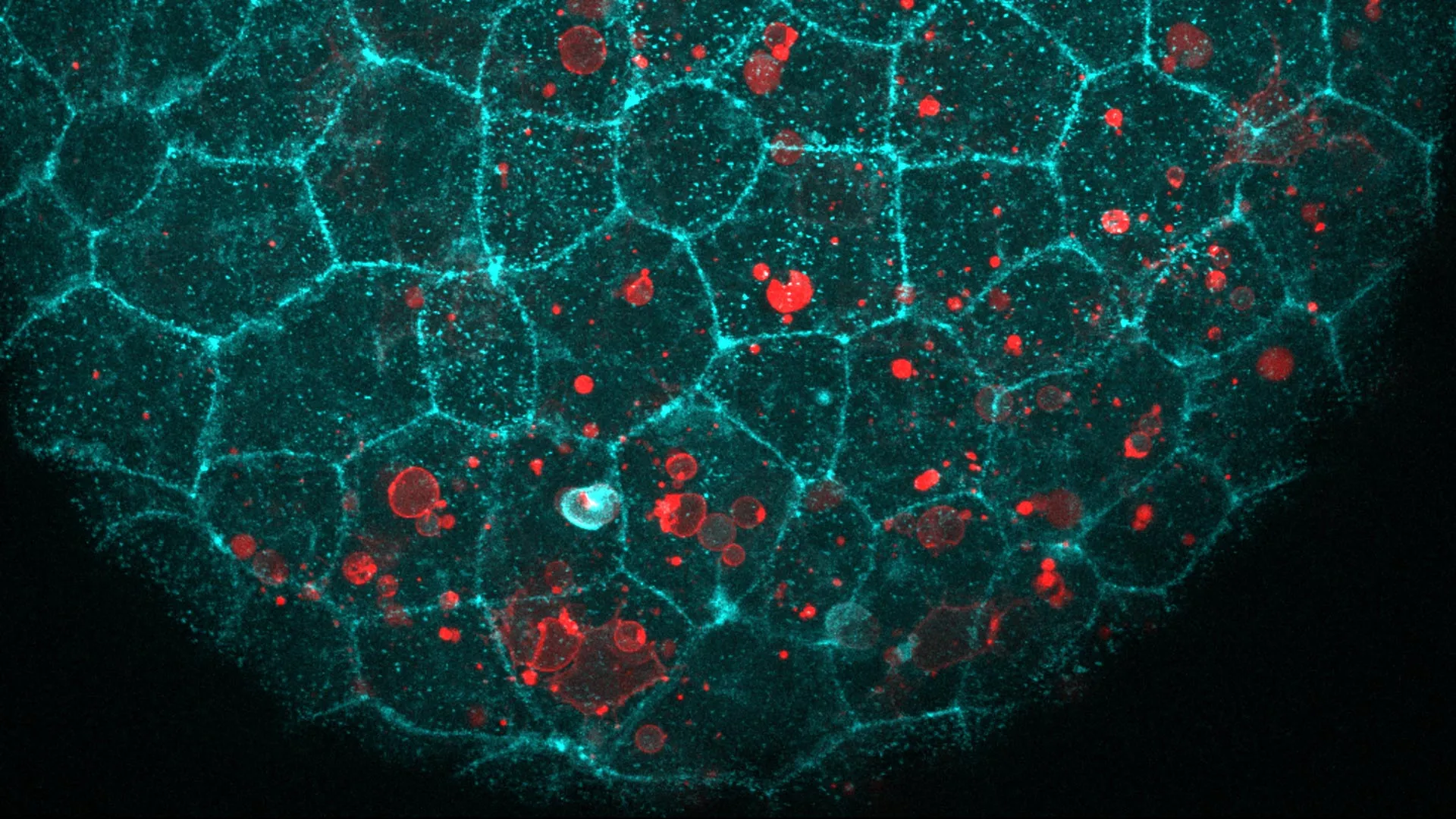
- In live embryos, the E-cadherin complex gathered at the exact spot where a dying cell made contact with the epithelial tissue.
- Dying cells stripped of their own E-cadherin were removed by the tissue just as effectively as normal dying cells.
- Fat droplets containing no protein, carrying only a signal that dying cells normally display, were engulfed as well.
- Live imaging showed the area of each cell's upper, barrier-facing surface barely changed during engulfment, while its lower surface deformed heavily.
Compiled by The ScientistSomething wrong?How this is made
Why it matters
- constraint The same complex both seals the sheet and powers the uptake, so knocking out its proteins to study barrier strength will also disable debris clearance, and studies will have to separate the two effects.
- decision Anyone trying to speed clearance in these cells should not push contractility harder: releasing the brake made the cells so stiff that cleanup failed.
- capability A protein-free droplet carrying only the dying-cell signal gives labs a defined synthetic target for measuring how well an epithelium clears debris.
- constraint Tying this route to chronic inflammation will take adult tissue and disease models, because the work so far covers fish and mouse embryos.
The two clearance tests were built to answer one question. Ruprecht's group, reporting in Nature Communications [2], wanted to know whether the complex grips a dying cell the way it grips a living neighbor, E-cadherin to E-cadherin [15]. A dying cell with no E-cadherin and a droplet with no protein should both have defeated that kind of grip. Neither did [6][7]. So the uptake does not depend on cadherin binding on the target. The dying-cell signal is enough to start it [1]. In my view the droplet test is the stronger of the two, because the target carries no protein at all and the epithelium still engulfs it [7].
For a cell packed into a sealed sheet, engulfing something about the size of another cell is a hard mechanical problem [16]. The complex is E-cadherin plus three other proteins [4]. One protein in it acts as a tether to the cell's internal skeleton and carries force across the surface of whatever is being swallowed. Cells that lacked it, or lacked only the region that attaches it to the skeleton, could not swallow dead cells [9].
A second component works as a brake on the cell's contractile machinery. Taking the brake away did not make cleanup more effective. The cell became too stiff and lost its ability to properly remove dying cells [10].
Ruprecht compares the tissue to a row of dancers with linked arms. When a dying cell appears, their upper bodies stay steady while their feet move [17]. "It's the same dancer with a different choreography," she said [13]. "We were intrigued to find out that epithelial cells repurpose their molecular adhesion machinery -- the 'glue' that normally holds them together -- to engulf dying cells," Ruprecht, an ICREA research professor and the study's senior author, said [12][2].
The University of Liverpool's release ties the work to chronic inflammation. It notes that debris from dying cells is a major contributor to inflammatory responses [11][14]. Every experiment it describes was in zebrafish and mouse embryos [3]. The release does not report how many embryos were imaged or how large the surface changes were. The thing this doesn't tell you is whether adult skin, gut or airway linings, the tissues the complex holds together [4], clear debris this way, or whether the route fails in people with chronic inflammation.
What to watch
- Whether the same E-cadherin-driven uptake appears in adult epithelia, such as mouse gut or airway lining.
- Experiments that block this cleanup route and then measure inflammation, which would test the release's suggested link directly.
- Which dying-cell signal the droplets carried, and which complex proteins act as the tether and the brake, as specified in the Nature Communications paper.