Science1 publisher2 min readPublished
Wavefront-shaped focus through scattering layers fluctuates several times more than theory predicts
Physicists at Saint Louis University and CNRS found that focusing gain through opaque layers swings several times wider than correlation-free theory predicts. The average still matched theory, so the excess spread is the part that reports on the medium.
The Scientist · Science desk
Drafted by a language model from the sources cited here and checked against its claim ledger before publication. How we use AISend a correction
What happened
- Hasan Yilmaz of Saint Louis University led the work with Gregory Schehr of CNRS and Sorbonne Universite, and it was published in Nature Communications.
- The yardstick was finite-size Laguerre-Wishart random-matrix statistics, which predict mean and spread with no free parameters when long-range correlations are negligible.
- The scattering sample was a layer of zinc oxide nanoparticles, similar to the particles that make paint look white, according to Yilmaz.
- Simulations showed the oversized fluctuations becoming more pronounced as the scattering medium gets thicker.
Compiled by The ScientistSomething wrong?How this is made
Why it matters
- decision Groups that record only mean enhancement throw away the part of each focusing run that, on this evidence, carries information about correlations inside the sample.
- constraint Reproducibility budgets built on a correlation-free model will understate run-to-run swings in strongly scattering samples, even where that model fits the mean.
- capability A wavefront-shaping setup gains a way to characterise the material it focuses through from the way its own focus fluctuates.
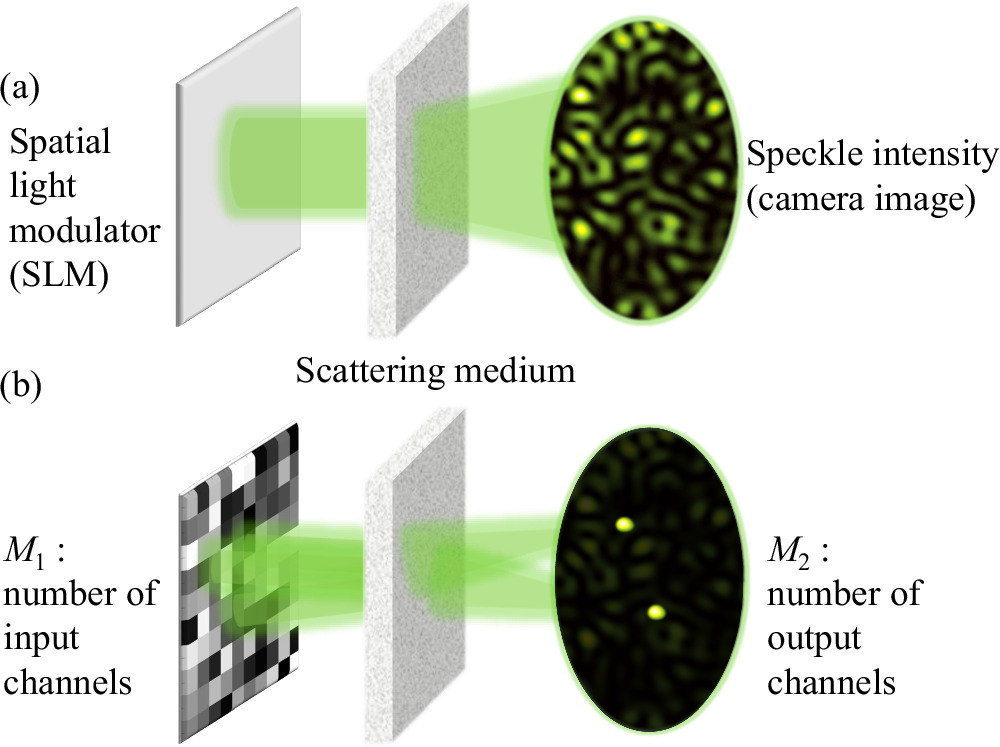
Light that passes through a strongly scattering material comes out as a random-looking speckle pattern. Wavefront shaping adjusts the incoming light so the scattered waves add up at one chosen spot [13]. The enhancement factor is how much brighter that spot gets than the diffuse background, and it is the usual score for whether focusing worked [2]. How much it varies from one realization or target position to the next has had much less attention, according to the phys.org account of the work [3].
The design choice that makes the result persuasive is the parameter-free reference [4]. Nothing in it can be adjusted, so a departure from it cannot be absorbed by fitting a constant. "What surprised us is that the average enhancement can agree remarkably well with theory while its fluctuations become giant," Yilmaz said [8]. I think the agreement on the mean is the strongest part of the case. A wrong reference or a badly calibrated setup would be expected to move the average as well. An excess confined to the spread points at the one thing the reference assumes away: long-range correlations [4].
Physicists call these long-range mesoscopic correlations. When light scatters many times, its paths are not independent, because interference ties what happens along one set of paths to what happens along others, even widely separated ones [9]. The same correlations are connected to universal conductance fluctuations, highly transmitting open channels and Anderson localization [10]. "Agreement between theory and experiment is always gratifying, but it is often when experiments depart from theoretical predictions that new physics becomes visible," Schehr said [11].
Yilmaz described why thickness should matter. "The stronger the scattering or the thicker the material, the more light wanders through this maze before it escapes," he said [14].
The thing this doesn't tell you is whether tissue behaves the same way. The account lists biological tissue among the opaque media that wavefront shaping focuses through [13], but the reported experiments used a nanoparticle layer [7]. The phys.org report gives the excess only as "several times larger" than the correlation-free prediction, and it does not state the number of realizations or the layer thickness [5].
Measuring the spread means repeating the optimization across realizations or target positions [3] and comparing the resulting distribution with the Laguerre-Wishart reference [4].
What to watch
- Measurements of enhancement-factor spread in biological tissue or tissue-like samples, which would test whether the zinc oxide result carries over.
- An experimental test of the simulated thickness trend, using scattering layers of different, stated thicknesses.
- Whether the size of the excess spread can be turned into a quantitative estimate of thickness or scattering strength for an unknown sample.