Science1 publisher3 min readPublished
Swiss glaciers lost 5.5% of their ice in 2026, the second-largest melt on record
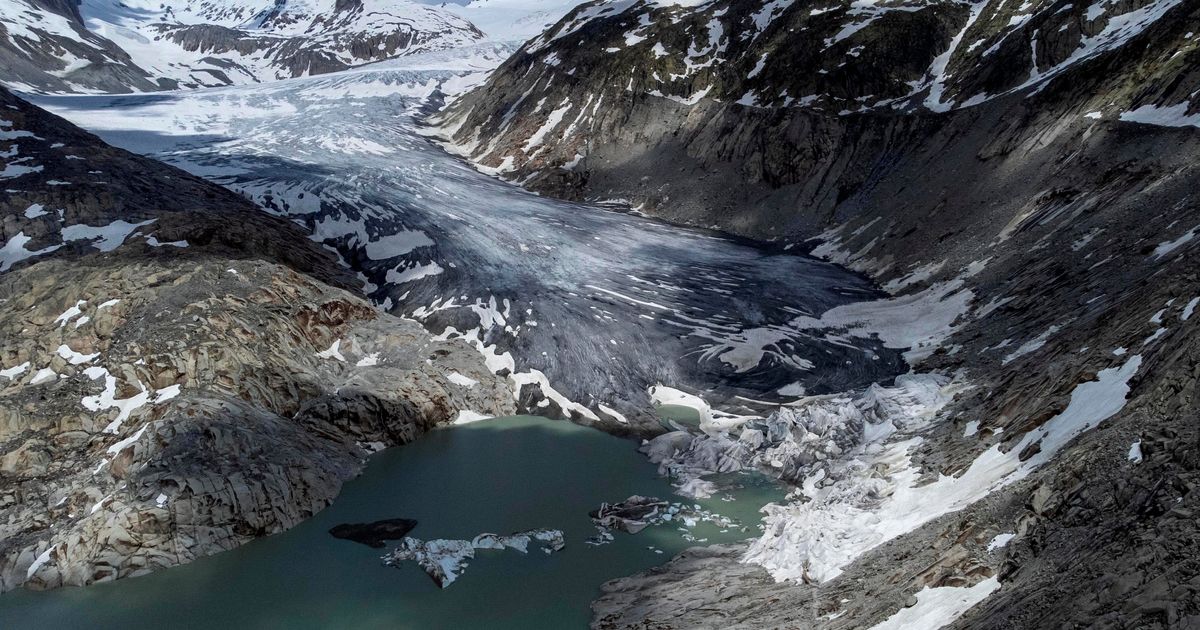
Switzerland's GLAMOS network found the country's glaciers lost 5.5% of their volume in 2026, bringing the five-year loss to nearly 20%. Their meltwater eased summer shortages this year, and the network says that relief is dwindling as glacier area shrinks.
The Scientist · Science desk
What happened
- GLAMOS reports that the 2022 to 2026 melt rate was more than twice as high as in any five-year period it had monitored before.
- Summer heat waves kept the freezing level above 4,000 meters for 76 days, more than double the average and a Swiss record.
- Average ice thickness on some glaciers fell by 2.5 to 4.0 meters, and exposed glacier tongues lost up to 10 meters over the summer.
- Several small glaciers melted away completely and permanently, including Bella Tola in Valais and Griessfirn in Glarus.
Compiled by The ScientistSomething wrong?How this is made
Why it matters
- constraint Each dry summer drawn down this way leaves less ice for the next one, so the meltwater cushion that eased 2026's shortages will be smaller when the next drought arrives.
- decision Water and infrastructure timelines that assume the 1990s rate of loss now understate how fast the ice goes, by close to a factor of three in share terms.
- constraint A melt forecast keyed to summer temperature alone would have overshot this year, so winter snowpack and surface dust have to sit in the model beside the heat.
- constraint Year-on-year comparisons now rest on stake sites that have to move as the ice beneath them goes, so keeping the record consistent gets harder each season.
On the Scex Rouge glacier, at nearly 3,000 meters, GLAMOS chief Matthias Huss dismantled a four-meter aluminum stake that had been fully buried when it was installed in late July. By September more than three meters of it stood clear of the ice [15]. "This is a glacier that isn't surviving," he said. "There will be probably no ice in 10 or maybe 15 years." [16] He called 2026 "a catastrophic year." [24]
The decade figures show the acceleration most plainly. Switzerland lost 10% of its glacier volume between 1990 and 2000, and 27% in the past ten years [5]. That is a 2.7-fold rise in the share lost per decade [1]. Both numbers are shares of a stock that keeps shrinking, so the rise in the raw volume of ice lost is smaller than 2.7-fold [1].
The two windows can be checked against each other. If the past decade left 73% of the ice and the past five years took nearly 20% [1], the five years before that took roughly 9% [2]. That agrees with the report's five-year comparison [4]. Compounded, a loss of nearly 20% over five years averages a little under 4.5% a year [3]. This year's 5.5% [2] ran above even that recent average, in what GLAMOS ranks as the second-largest melt on record [3].
Every national figure here is an extrapolation. GLAMOS measured 23 reference glaciers in September and scaled the results to the nearly 1,300 glaciers left in Switzerland [6]. That sample is under 2% of the glaciers by count [4]. This year the teams had to move stakes uphill, even on the highest glaciers, after the ice at the original sites melted away [17].
The comparison with 2022 is the useful one for anyone forecasting melt. June, July and August 2026 were each the hottest in Switzerland since measurements began in 1864, according to the Swiss Federal Office of Meteorology and Climatology [7]. The preceding winter was among the ten least snowy on record [9], and by September no snow was left even at 3,500 meters [25]. Yet many glaciers had entered the summer with more snow than in 2022, and less Saharan dust settled on them, so more sunlight was reflected [10][11]. That kept the national total under the 2022 record. Individual glaciers did set records: four major ones, among them the Rhone, Aletsch and Clariden, had their largest melt yet measured [13][12].
Between July and September the glaciers released about 2.2 trillion liters of water [19], roughly 2.2 cubic kilometers [5]. "It's more than four times the annual freshwater consumption of Swiss households," Huss said [20]. The findings appear in the Swiss Academy of Sciences annual report [23]. Its summary says the melt eased summer water shortages but that this relief is dwindling as glacier area shrinks irreversibly [21]. Neither published account says how much of that runoff hydropower operators and water planners already budget for, and neither addresses hydropower output or alpine hazards.
"Alpine glaciers have no chance of surviving in the long term under such conditions," GLAMOS said in a statement [22].
What to watch
- The 2027 GLAMOS mass balance: another low-snow winter followed by heat like 2026's would test whether the 2022 record holds.
- Uncertainty ranges in the full GLAMOS report for scaling 23 measured glaciers to roughly 1,300; those determine whether year-to-year differences are statistically meaningful.
- Whether Swiss water utilities or hydropower operators publish revised glacier-runoff assumptions after a second near-record melt in five years.