Science1 publisher3 min readPublished
Ultrasound drove iron powder and water to spinel oxide nanoparticles in 24 hours
Researchers at Tohoku University grew spinel iron oxide nanoparticles from iron powder and water under ultrasound alone. The most informative comparison in the paper is the control run without ultrasound.
The Scientist · Science desk
What happened
- Researchers dispersed 1.0 gram of iron powder in water and treated it with ultrasound at 23 or 43 kHz, varying the reaction temperature and the treatment time across trials.
- At 43 kHz over 24 hours, estimated conversion of iron to spinel-type oxide was 36.1% at 30 degrees C, 68.5% at 40 degrees C and 63.7% at 60 degrees C.
- Under one set of conditions the particles averaged about 32 nanometres, with a magnetization of 85.6 emu per gram at the maximum applied field.
- Iron left alone rusts over months or years; the team reports the same metal-to-oxide reaction completed in hours with ultrasound as the only added input.
Compiled by The ScientistSomething wrong?How this is made
Why it matters
- cost The route drops the reagent list and runs on electricity instead. Energy consumption per unit of product is on the team's list of things still to be quantified, so the swap cannot yet be priced.
- decision Anyone designing a reactor around this cannot buy conversion by heating harder: the series peaked at 40 degrees C and lost 4.8 points by 60.
- constraint With the pathway unconfirmed, size and conversion have to be tuned empirically; there is no validated account of how the oxide forms at the iron-water interface to design against.
- capability If the route holds at scale, fine iron powder and iron scrap become candidate feedstock for oxide products, which the authors say has not been demonstrated.
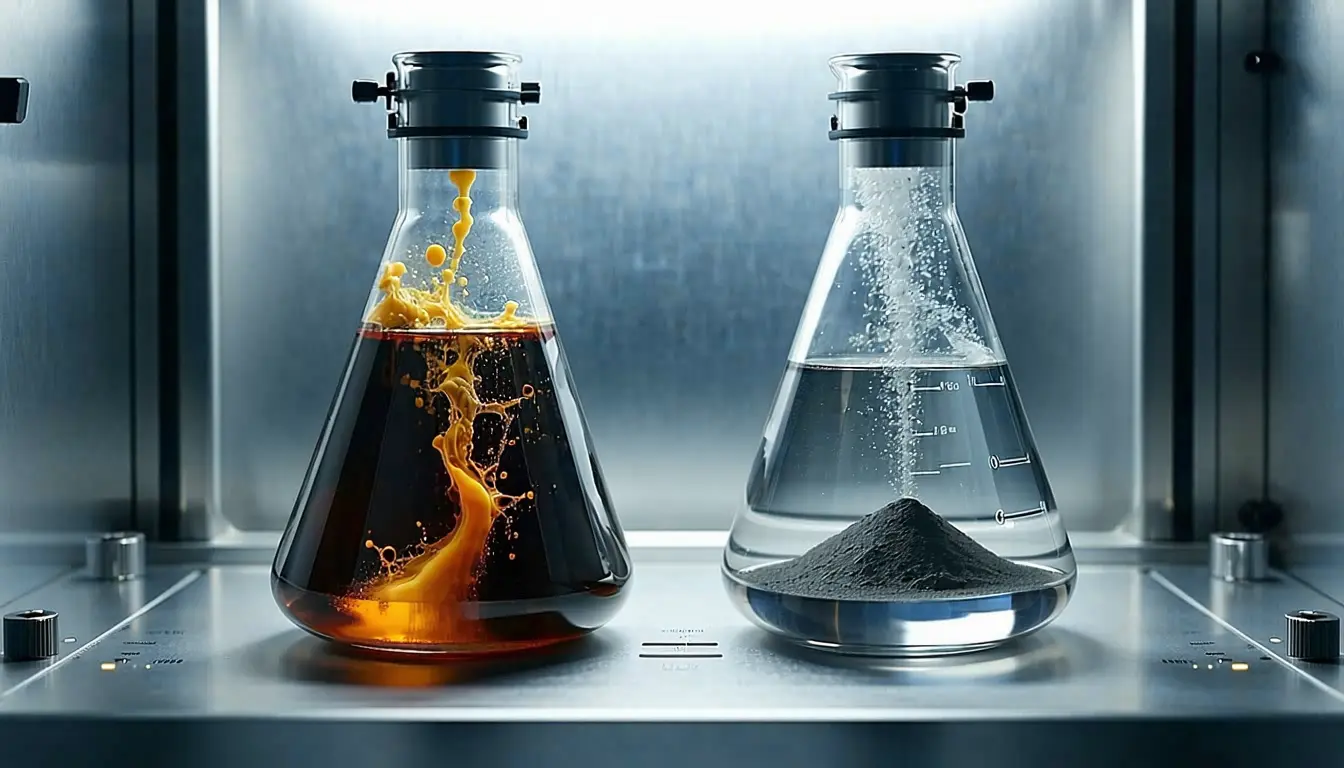
Mechanical stirring of the same iron-and-water mixture at 40 degrees C also oxidised the iron [7]. That control ran for 72 hours, three times the length of the 24-hour ultrasound trials [2], and the oxide mostly stayed on the metal as submicrometer particles [7]. With ultrasound, much smaller particles came off the surface and dispersed into the surrounding water [8]. Warm water will rust iron powder without any acoustic help; what the ultrasound contributed in these trials was the size of the oxide and its release from the surface [7][8].
The paper, in Ultrasonics Sonochemistry, attributes that difference to acoustic cavitation, the rapid formation and collapse of tiny bubbles [1][9]. Collapsing bubbles can throw microjets and shock waves that break apart and renew the iron surface, and they create brief localised zones of high temperature, high pressure and reactive chemical species [9]. The precise reaction pathway has not yet been confirmed [10].
"The core finding here is not simply a reagent-free synthesis route," said Yamato Hayashi, an associate professor at Tohoku University's Graduate School of Engineering who helped lead the study [11]. What the work demonstrates, Hayashi said, is a direct solid-liquid transformation from metal to oxide, with ultrasound activating the interface between metallic iron and water and nanoscale oxide particles forming directly at that boundary [12].
The whole experiment ran on one gram of iron. Characterisation was by X-ray diffraction, electron microscopy and magnetic measurement [3]. At the best point in the temperature series, 68.5% conversion at 40 degrees C, the 1.0 gram charge of iron powder works out to about 0.685 g converted and roughly 0.315 g left unreacted [1]. Ten degrees mattered a great deal at the low end and very little at the top: conversion rose 32.4 percentage points between 30 and 40 degrees, then gave back 4.8 points by 60 [3]. Particle size barely moved between 40 and 60 degrees, which the team takes as temperature governing the extent of oxidation and not the size of what forms [6].
The saving is in the reagent list. The process runs without soluble iron salts, precipitation agents or chemicals for pH adjustment, and the study included no washing step [14]. Conventional synthesis of these particles starts from soluble iron salts and converts them using ammonia or sodium hydroxide [13]. What replaces those inputs is electricity into a transducer at 23 or 43 kHz [2]. Spinel-type iron oxide nanoparticles are used in magnetic materials, adsorbents, catalysts, magnetic separation and biomedical research [15], and the authors suggest fine iron powders or iron scrap could be converted into higher-value oxide by this route, an application they say remains to be demonstrated [18].
What to watch
- The planned time-resolved measurements of dissolved Fe2+ and Fe3+, hydroxyl radicals and hydrogen peroxide, which would settle the reaction pathway.
- An energy-per-gram figure and a particle recovery number, the two results that would let anyone compare this with salt precipitation.
- Whether the reaction runs on real iron scrap rather than graded iron powder, and whether it transfers to other metal-oxide systems.