Science1 publisher2 min readPublished
Graphene oxide beneath the monolayer lifts HZB's all-perovskite triple junction to 27.3%
The buried interface beneath the tin-lead bottom cell has capped these stacks for years, and HZB's answer is a graphene oxide sheet that makes a monolayer contact behave itself, with the single-junction control carrying most of the evidence.
The Scientist · Science desk
What happened
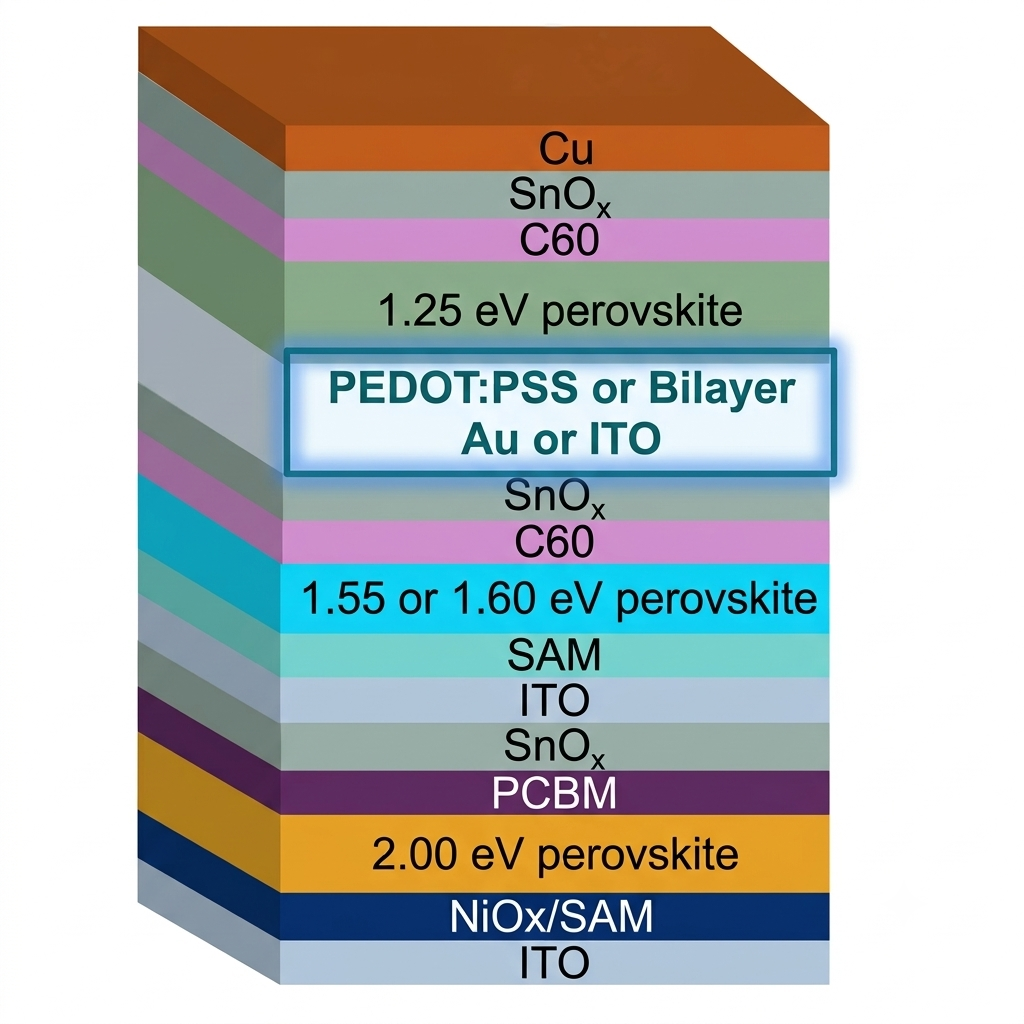
- A Helmholtz-Zentrum Berlin team led by Steve Albrecht reported an all-perovskite triple-junction cell reaching 27.3% power conversion efficiency, with sub-cells tuned to 2.00, 1.60 and 1.25 eV.
- PEDOT:PSS, the layer the field has relied on to extract charge from the tin-lead bottom sub-cell, absorbs near-infrared light that cell needs, and its acidity and water affinity degrade the perovskite.
- Fast-hysteresis and bias-assisted charge extraction measurements traced the failure of carbazole-based monolayers on tin-lead to massive ion accumulation that blocks charge separation and extraction.
- In single-junction tin-lead cells the bilayer delivered 22.1% against 12.0% for monolayer-only equivalents, a gap the team attributes almost entirely to recovered charge extraction.
Compiled by The ScientistSomething wrong?How this is made
Why it matters
- constraint With no PEDOT:PSS device measured alongside, nobody outside HZB can size what the bilayer is worth against the contact currently in use, so the work argues for a mechanism more strongly than for a swap.
- capability Pulling gold and a parasitic absorber out of the interconnect changes the optical budget of the bottom sub-cell, a gain other groups can pursue at the interconnect instead of reformulating the absorber.
- decision Groups that had written monolayer contacts off for tin-lead now face a different call, because the failure is pinned on ions at the interface rather than on the molecule itself.
The 12.0% monolayer-only cell functions as the anomaly under investigation rather than a baseline for a working contact [12], because the same chemistry behaves well on pure lead perovskites and misbehaves only where it meets tin-lead [7]. The bilayer's margin over it, 10.1 percentage points or a factor of 1.84 [19], is therefore a measure of how completely a bare monolayer fails on this material. It confirms the diagnosis rather than ranking the bilayer against the contact the field has actually been using [6].
Two changes arrive together when the graphene oxide goes down first. Chemically, the phosphonic acid head groups of MeO-2PACz bond to the oxygen groups on the sheet, and the resulting molecular reorientation deepens the work function and raises conductivity [9][10]. Physically, the hydrophilic surface acts as a nucleation template, so the perovskite crystallises evenly and the films come out without the nanovoids seen in the monolayer-only devices [11]. HZB's optoelectronic characterisation attributes the improvement almost entirely to reduced electronic and ionic extraction losses [13], which is consistent with either route, since a void-riddled film also extracts badly. The account reports no graphene-oxide-only device that would separate the two [17].
In the stack, the gain is optical as much as electronic. Gold and PEDOT:PSS came out of the interconnecting layers and indium tin oxide plus the bilayer went in, so fewer near-infrared photons are absorbed before they reach the 1.25 eV bottom sub-cell [14][2]. The finished triple junction sits 5.2 points above the bilayer's own single-junction tin-lead device [20]. That subtraction is not a clean attribution (the two are different devices with different band-gap budgets), but it is the scale of what the upper junctions bought in this build, and passing the single-junction ceiling is the only reason to stack at all [21].
The durability half of the claim is thinner. Physics World reports the strategy improving operational stability without a retention figure or a test protocol [15], and gives no device count, cell area or outside calibration behind the 27.3% [18]. That gap matters more here than in most efficiency reports, because the case against PEDOT:PSS was never only its parasitic absorption; it was acid and water working on the perovskite underneath [6]. A contact that improves extraction while the layer below it still degrades solves half the problem. The portable part today is the measurement recipe: fast hysteresis plus bias-assisted charge extraction will tell another group whether ions at the buried interface are what is costing it charge collection [8].
What to watch
- Whether an ultrathin graphene oxide film stays uniform at cell areas larger than the lab devices reported here.
- A tin-lead cell that keeps the graphene oxide but swaps MeO-2PACz for another phosphonic acid, testing whether head-group anchoring is the active ingredient.
- Reproduction of the ion-accumulation signature in another group's tin-lead cells, which would make the diagnosis general rather than local to one process.