Product1 publisher3 min readPublished Updated
Quantinuum brings in Quanta, and concedes the bottleneck is packaging, not qubit count
The trapped-ion company signed a joint development deal with contract manufacturer Quanta Computer for hardware infrastructure. No new processor, no volumes, no timetable, and that is the tell.
The Product Desk · Product desk
Drafted by a language model from the sources cited here and checked against its claim ledger before publication. How we use AISend a correction
What happened
- Quanta Computer and Quantinuum signed a collaborative development agreement to jointly develop hardware infrastructure for future generations of Quantinuum quantum computers, with the goal of making the systems more modular, manufacturable and scalable.
- Rather than announcing a new quantum processor, the companies are focusing on the industrial machinery and hardware ecosystem needed to turn quantum processors into deployable systems.
- Quantinuum's machines use trapped ions as qubits; its H2 system stores quantum information in ytterbium ions and uses precisely controlled laser-based operations to manipulate them.
- The H2 architecture uses a quantum charge-coupled device (QCCD) approach, in which ions can be moved between different regions of the processor.
- The architecture gives Quantinuum all-to-all connectivity, meaning any pair of qubits can be brought together for operations.
Compiled by The Product DeskSomething wrong?How this is made
Why it matters
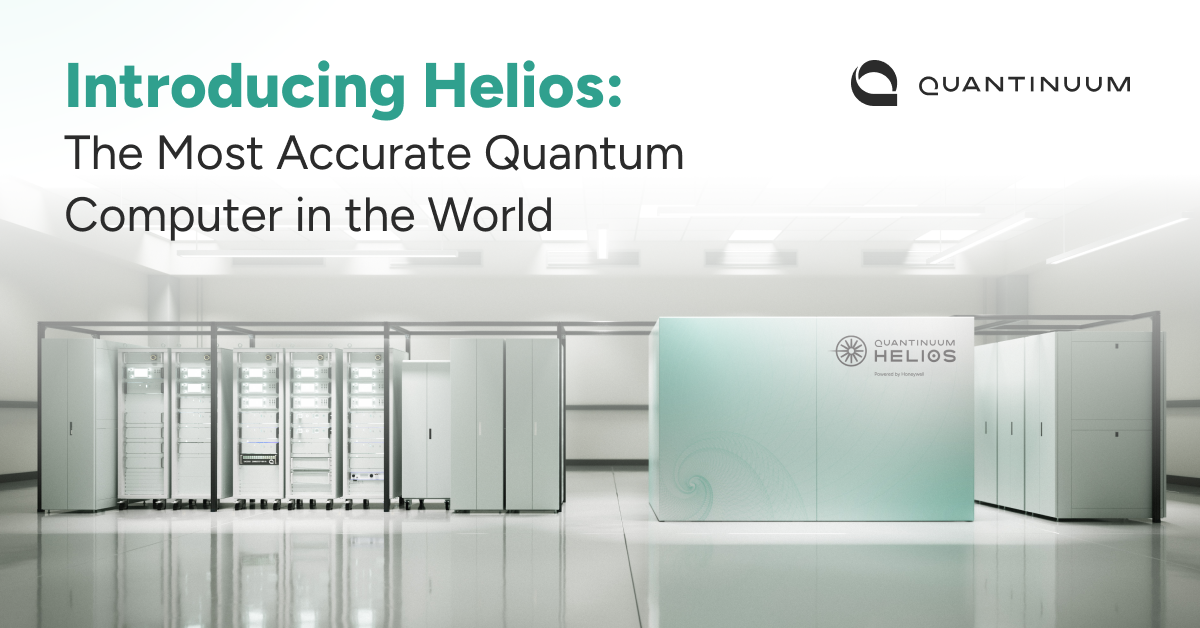
Quantinuum and Quanta Computer have signed a collaborative development agreement to jointly develop the hardware infrastructure for future generations of Quantinuum's quantum computers, aimed at making the systems more modular, manufacturable and scalable [1]. There is no new processor attached to the announcement [2], which is the most informative part of it: the work being handed to an outside manufacturer is the machinery around the qubits, not the qubits.
The physics side already reads reasonably well. Quantinuum's H2 stores quantum information in ytterbium ions and manipulates them with precisely controlled laser operations [3], using a quantum charge-coupled device architecture in which ions are shuttled between regions of the processor [4]. That shuttling buys all-to-all connectivity, so any pair of qubits can be brought together for a gate [5]. H2 is quoted at 56 fully connected qubits with two-qubit gate fidelity above 99.9% [6], which is an error rate below one in a thousand two-qubit gates [7].
What does not scale on that basis is everything else. Larger trapped-ion machines require lasers, vacuum systems, control electronics, cooling and very precise mechanical and electrical infrastructure, all of which have to coexist without injecting errors that swamp the computation [8]. Quanta's relevance here is mundane and real: it is a large electronics manufacturer whose business spans servers and cloud infrastructure [9]. This is a supply-chain and tolerance-stack problem being given to a company that does supply chains and tolerance stacks.
The sequencing detail matters more than the logos. The companies say engineers are already working on the next generation of hardware infrastructure, and that the intent is to establish manufacturing processes and supply chains alongside the technology rather than waiting for a more advanced processor and industrializing it afterwards [10]. Anyone who has shipped hardware knows the alternative outcome: a working lab instrument that requires enormous bespoke engineering effort per unit, which is a different object from one that can be built, installed and maintained repeatedly [11].
The roadmap explains the urgency. Quantinuum is targeting hundreds of logical qubits and eventually fault tolerance [12], and its Helios architecture adds junction-based ion transport and multiple quantum-logic zones to improve routing and scaling [13]. Going from a 56-qubit physical machine to hundreds of logical qubits is a large multiple in every subsystem, not just the trap [14]. It also pairs with the company's June collaboration with Hewlett Packard Enterprise on connecting quantum processors to high-performance computing and AI environments [15]: one deal at the classical interface, one at the physical layer, both about deployability rather than qubit records.
The limits of the announcement are worth stating plainly. Per Interesting Engineering's reporting, no detailed specifications, production volumes or timetable have been disclosed, and there is no guarantee the collaboration yields commercially scalable machines [16].
Watch whether Quanta's scope stays at racks, enclosures and control electronics or reaches into the optics and vacuum subsystems, where trapped-ion yield actually lives. Watch for the first Helios-class or later system described with build time or unit counts rather than fidelity alone. And watch whether the parallel supply-chain claim produces a second site capable of building the same machine, which is the only real test of manufacturability.