Product1 publisher3 min readPublished
Puerto Rico is rationing water on an island that gets up to 169 inches of rain a year
The utility loses about 60 percent of its drinking water to leaks, and the territory mandates no rainwater catchment. The cheapest available capacity is sitting on roofs.
The Product Desk · Product desk
Drafted by a language model from the sources cited here and checked against its claim ledger before publication. How we use AISend a correction
What happened
- Puerto Rico is experiencing a historic drought that has led to water rationing, following the driest month on record in July.
- Anywhere from 30 to 169 inches of precipitation falls on the territory of Puerto Rico annually.
- The government does not require US citizens in Puerto Rico to install catchment systems, unlike some other island states.
- Fernando Abruna, a partner at local firm Abruna & Musgrave Architects, says: "One of the best unused reservoirs of water in Puerto Rico are the roofs of the houses."
- The drought has exacerbated a water crisis that was already in motion due to ruptured water pipes and other decrepit infrastructure.
Compiled by The Product DeskSomething wrong?How this is made
Why it matters
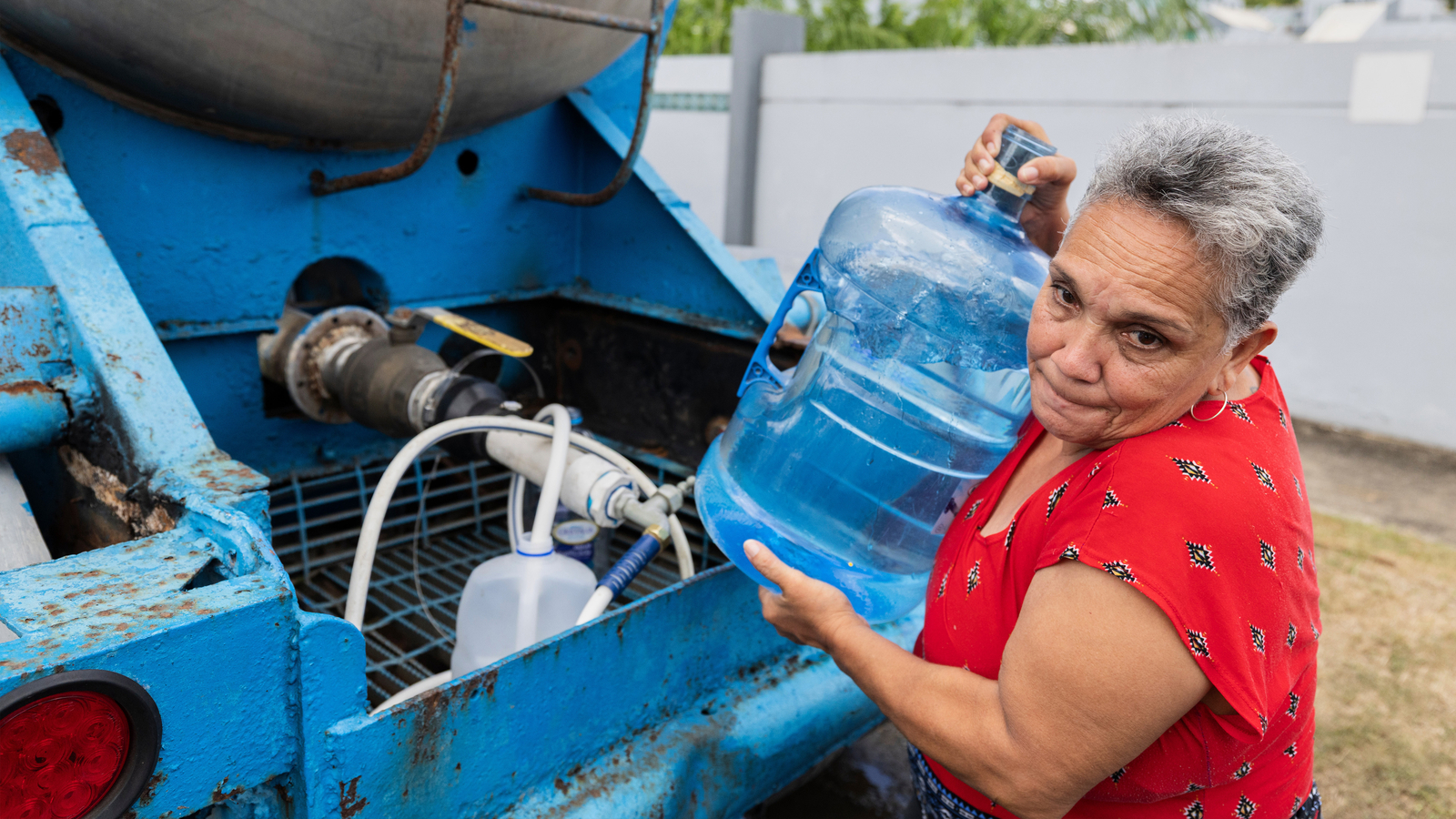
Puerto Rico's governor, Jenniffer Gonzalez, has spent the past week ordering municipal governments to shut off water two days at a time in the northeast, leaving 180,000 households with limited access [6]. The trigger was the driest July on record and a historic drought [1], but the shortage sits on top of ruptured pipes and decrepit distribution infrastructure that was already failing [5], and many families had gone more than 100 days without consistent water before the rationing order [7].
The supply-side numbers are the ones worth reading. The Puerto Rico Aqueduct and Sewer Authority loses about 60 percent of the island's drinking water before it reaches a customer's home, to leaks and failing infrastructure [13]. The current emergency was caused in part by a series of ruptures in the 72-inch Superaqueduct, a main artery serving major cities on the northern coast [14]. Meanwhile, between 30 and 169 inches of rain falls on the territory each year, and the government does not require residents to install catchment systems, unlike some other island jurisdictions [2][3]. Environmental lawyer Ruth Santiago, who works with Comite Dialogo Ambiental, says the core problem is not scarcity but the government's mismanagement of water [8], and that even with drought the island still has abundant supply [9].
The decentralized option is unglamorous and mostly gravity-fed: gutters divert roof runoff to a canister plumbed into a faucet or showerhead [10]. Fernando Abruna of Abruna & Musgrave Architects, who calls the roofs of houses one of the best unused reservoirs on the island [4], estimates that 1 million households with collection technology would gather 30 billion gallons a year [11]. Against residential demand of just over 72 billion gallons annually, at 62 gallons per resident per day [12], that is roughly 42 percent of household use [1]. Per household it works out to about 30,000 gallons a year [2], or the annual consumption of about 1.3 people at the stated per-capita rate [3] - a supplement, not a substitute.
The capital math is the part procurement teams should sit with. Plenitud Puerto Rico, a nonprofit in the mountain municipality of Las Marias, has donated and installed 73 systems since 2010 [22]; codirector Owen Ingley puts the hardware at $500 to $2,000 for small simple units and up to $5,000 for larger ones with electric pumps [23], plus maintenance after storm damage and water-quality monitoring [24]. Extrapolated to Abruna's million households, that is $500 million to $5 billion [4]. The nonprofit's 73 units represent about 0.007 percent of that scenario [5], which is the shape of a policy vacuum rather than a program.
Other island governments have already made the choice. About 90 percent of homes in the US Virgin Islands have a cistern, and building codes there require the infrastructure in many new developments [16]; Barbados has similar codes [17], and Honolulu County offers a limited number of free rain barrel installations [18]. Puerto Rico offers no incentives and no financial assistance [21]. Farah Nibbs of the University of Maryland Baltimore County says nothing can help the Caribbean region as quickly or reliably as rainwater harvesting, and that governments should treat it as part of the national water supply [19] and cover costs so the burden does not land on households [20].
Two things to watch. First, whether the rationing order in the northeast is lifted or extended, and whether Superaqueduct repairs hold [6][14]. Second, whether any building-code or subsidy mechanism appears; Santiago's own ranking is that fixing the distribution system is most urgent, with harvesting as the fast, cost-effective addition [15]. Without a mandate or a rebate, the catchment capacity stays in the hands of nonprofits installing a few units at a time [22].