Science1 publisher2 min readPublished
Methane best predicts microbial makeup along 2,000 km of Greenland's ice margin
Researchers including a Charles University team sequenced glacial runoff from the west Greenland margin, where dissolved methane ranges over five orders of magnitude, and found it tracked community composition better than any other variable they measured.
The Scientist · Science desk
What happened
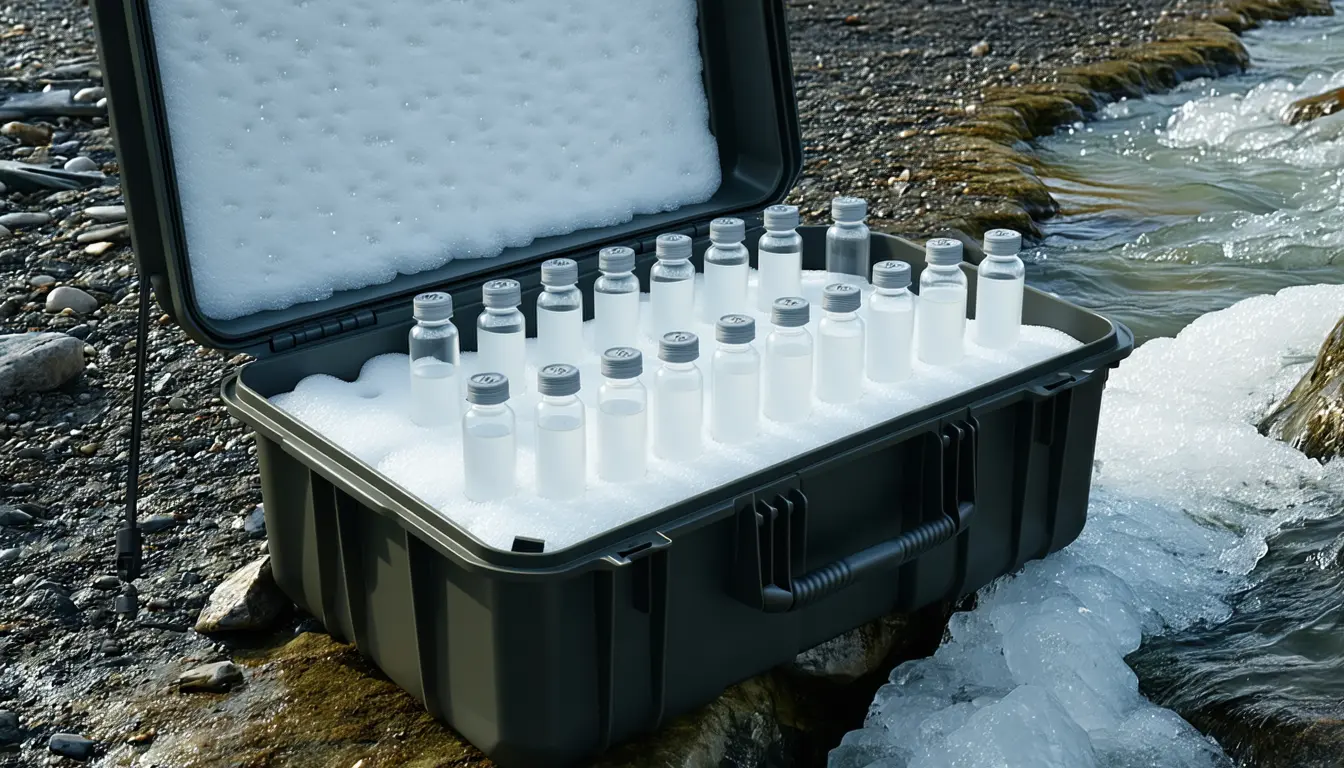
- A team including researchers from the Faculty of Science at Charles University in Prague sampled microorganisms in glacial runoff along an approximately 2,000-kilometer transect of the western Greenland Ice Sheet margin.
- Dissolved methane in that runoff ranged from about 0.4 to 50,000 nanomolar between sites, five orders of magnitude of variation along a single ice margin.
- Above roughly 4.9 nanomolar of dissolved methane, communities showed a stronger signal of homogeneous selection, with environmental conditions shaping which organisms thrived.
Compiled by The ScientistSomething wrong?How this is made
Why it matters
- constraint Community composition is not a rate, so this work does not give an Arctic methane budget a source or sink term; the measurements on the record are sequence data and dissolved concentrations.
- precedent If methane supply helps select the community rather than only recording its activity, models of the ice margin have to put gas delivery upstream of biology, and that is a hydrology problem before it is a microbiology one.
- decision At the low-methane end, where drift and dispersal limitation dominated, a single sample per site will not generalize the way it may at high-methane sites. That changes how a follow-up campaign should allocate replicates.
The threshold the authors report sits low in the range. Across sites, dissolved methane ran from about 0.4 to 50,000 nanomolar [3], a spread of roughly 125,000-fold [14], and the breakpoint they identify is 4.9 nanomolar [7]. That is about 12 times the lowest measured value and some 10,000 times below the highest [15][16]. So the sites where chance dominated are crowded into the bottom decade of methane concentration, and nearly the whole sampled range sits above the line.
Homogeneous selection, the pattern the authors find above that line, is a statement about how communities assemble: similar conditions produce more similar communities than chance would. In the study's wording, environmental conditions played a greater role in determining which microorganisms could thrive [7]. Below the breakpoint, more of the pattern is attributed to ecological drift and to microbes not reaching one site from another [8].
The paper also ties together two groups often studied apart. "The results also revealed a link between microorganisms involved in the degradation of complex organic matter and those participating in methane cycling. This suggests that interconnected microbial processes beneath the ice indicate an active carbon-processing network in this environment," said Lia C. P. Wentzel, the corresponding author, from the Faculty of Science at Charles University [9][10].
Sequencing counts who is present. The account of the work describes 16S rRNA gene sequencing and dissolved methane concentrations, and does not report methane oxidation or production rates [18]. Finding Crenothrix, a genus able to use methane, among the dominant taxa [4][5] is evidence that the capacity is there, at whatever abundance the sequencing found.
Methane here is both substrate and product, so a correlation across sites is compatible with the communities setting methane concentrations as well as with methane setting the communities. The authors argue for the second direction, writing that methane availability is not merely a consequence of microbial activity beneath the ice but also an important factor shaping the communities themselves [11]. The ordering is what I would carry forward: along this section of the margin, dissolved methane was the strongest identified predictor of community composition [6]. The comparison is between sites in glacial runoff [2], so that direction rests on the assembly statistics and not on an experiment that changed the methane supply. The paper appears in Applied and Environmental Microbiology under DOI 10.1128/aem.00875-26 [13].
What to watch
- Whether follow-up work pairs the sequencing with measured methane oxidation and production rates, or isotope tracing, at the same sites.
- Whether metagenome or transcript data show Crenothrix and Methylotenera actively cycling methane in these runoff waters.
- Whether a second transect, on another ice margin, reproduces the same ordering of methane above other environmental predictors.