Product1 distinct publisher2 min readPublished
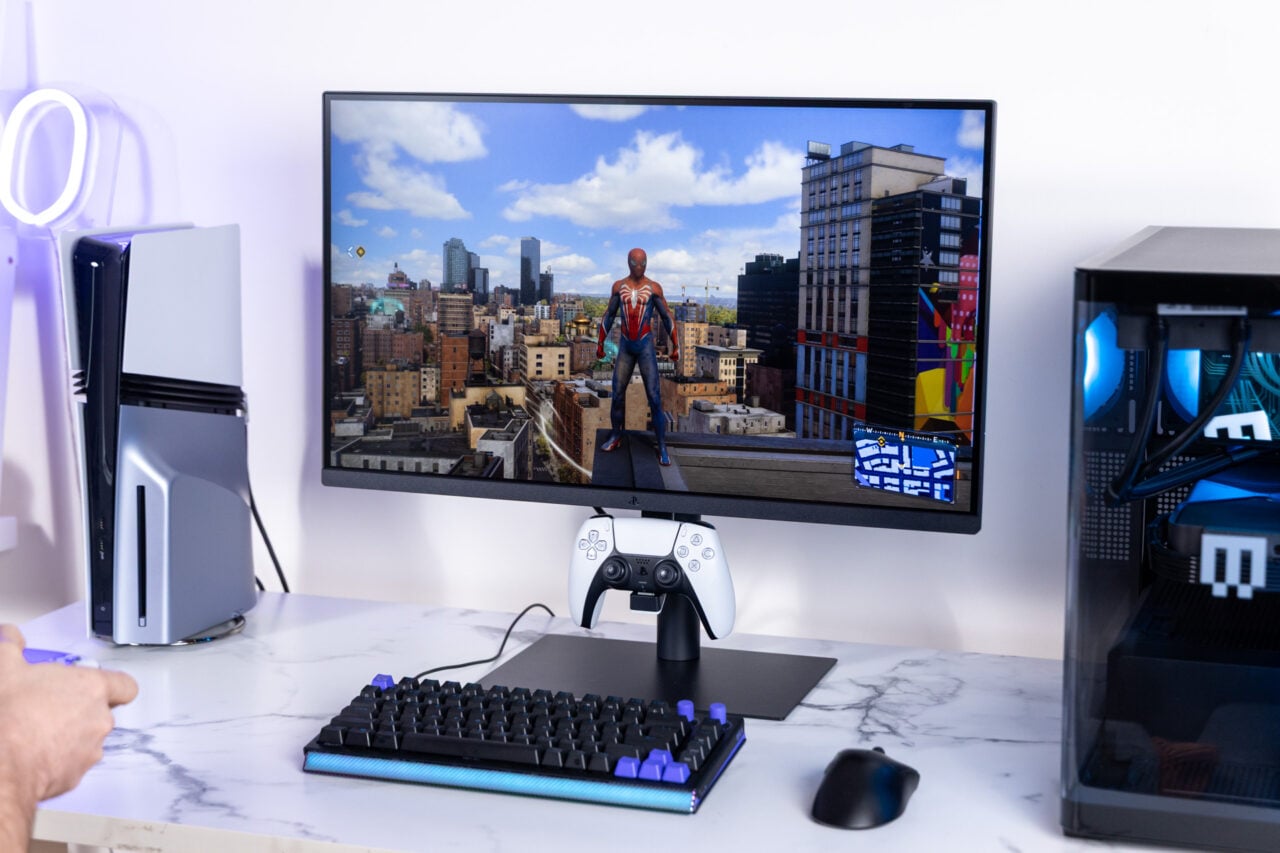
The PlayStation 27-inch monitor's only console-specific hardware duplicates a $30 Sony accessory. The rest is a commodity 1440p panel with a logo on it.
The Product Desk · Product desk

Compiled by The Product DeskSomething wrong?How this is made
The reason to buy this thing is a battery problem. Gizmodo's reviewer reports about five hours of play from the DualSense that shipped with his launch PS5, and barely three from the pricier DualSense Edge, whose battery is smaller [11]. That is roughly two fewer hours per charge on the newer pad [18]. A cradle that keeps a controller topped up is genuinely useful on a desk, and that usefulness is the entire product. Sony has not fixed the controller, so it is selling furniture around it.
It already sold that furniture. The $30 DualSense Charging Station uses the same pin contacts and handles up to two controllers [10]. Set against $350, the standalone price of the function the hook performs is under nine percent of the monitor [17]. The rest is a 27-inch 1440p IPS panel with extra ports, a sturdy base and a set of backup speakers [2][6], from the company that launched the PS5 six years ago as its 4K machine [4] and has now shipped a screen that sits a tier below that number [19].
The hardware shows how late the PlayStation part arrived. The Pulse Elite headset carries the same charging pins as the controller, but the monitor will not rise high enough for a headset to reach the hook [13]. Two Sony accessories share a connector and not a height budget. The cradle has no magnet or latch, so the controller sits loose and a reach across the desk dislodges it [12]. Connect HDMI and the arm has to be tucked up behind the panel to the right, out of the cables' way [8]. None of that is a panel problem. It is what happens when a branded feature is bolted onto an off-the-shelf chassis.
The strategy around it is stranger. The pitch, per the review, is that this monitor plus the Pulse Elite and the other accessories adds up to a gaming desk serving both console and PC [16], and Sony spent years pushing formerly exclusive titles to the PC before rapidly backing away from that expansion [14]. The desktop speakers still land on Nov. 12 [15]. The desk is being furnished while one of the reasons to sit at it is being withdrawn.
An integrated play would need the console to know the screen is there. Sony's does not: no lighting sync, no link beyond the 120Hz mode any monitor can advertise [5]. What the product has instead is a hook, and a hook is cheap to license.
Ranked by verification strength, evidence, and original report placement.
For $350 the monitor offers a fast IPS LCD 1440p 27-inch display with an arm that swings down so players can plant PS5 controllers in it to charge when not in use.
The review's cons are that the charging hook feels underbaked, there are no tilt capabilities, cable management is ugly, and the switch to change level is annoying.
Sony sells a $30 DualSense Charging Station with the same pin connections for up to two controllers.
Combining the monitor with existing accessories such as the Pulse Elite headset would supposedly give a full gaming desk setup for console and computer.
The product is named "PlayStation 27-inch Gaming Monitor with DualSense Charging Hook".
The monitor is Sony's first screen since it pushed the 3D Bravia TV.
Follow any of these and your For You feed starts watching them — no settings page required.
Evidence-backed comparisons of source perspectives and observed adoption signals. Read the methodology
Which Builder, Operator, and Investor concerns the observed source mix emphasized—not a truth score.
Evidence, demonstrated adoption, hype gap, incentives, and confidence are assessed independently, each on its own current evidence. How these are measured.
Single first-hand review, specific but unmeasured
Every claim traces to one hands-on review that is concrete and internally consistent: named product, $350 price, panel and refresh specs, arm lock positions, the $30 charging-station overlap, and observed controller runtimes. What caps the score is the absence of corroboration or instrumentation: one publisher, no lab measurements for the display claims, and battery figures drawn from the reviewer's own aging units rather than a controlled test.
Shipping product, no uptake data
Adoption evidence is limited to availability: the monitor exists at retail and has been reviewed, and Sony has a further desk accessory dated Nov. 12. There is no sales figure, attach-rate, retailer, or installed-base disclosure anywhere in the supplied material, so uptake beyond 'it ships' cannot be established.
Ecosystem framing overstated versus delivered integration
The product and its 'full gaming desk setup' positioning promise PlayStation ecosystem value, but the delivered console-specific hardware reduces to a hook that replicates a $30 accessory, charges at ordinary speed, has no retention mechanism, and cannot service the Pulse Elite that shares the same pins; there is no PS5 link beyond aesthetics, 120Hz support and HDR tone-mapping. The gap is positive but moderate rather than extreme, because the panel specs and the hook's practical benefit for a real battery-life problem are both genuine.
Visible vendor accessory-monetization incentive, undisclosed review-side incentives
One incentive is plainly visible in the material: Sony has a commercial interest in extending PlayStation-branded desk hardware, selling a $30 charging station, a Pulse Elite headset, a monitor at $350 and speakers on Nov. 12, and the 'full desk setup' framing serves that accessory monetization. On the publishing side the supplied source discloses nothing about review-unit provenance or commerce arrangements, so those incentives can be neither confirmed nor ruled out, which holds the score mid-range.
Verifiable consumer-hardware facts, one publisher
The factual spine (product name, price, panel, refresh rates, accessory prices, ergonomic behavior) is easy to verify and unlikely to be wrong, which supports moderate confidence. But every claim comes from one outlet and one reviewer, the strongest analytical points depend on anecdotal battery observations and unmeasured display performance, and no adoption or incentive disclosures exist to triangulate against.
product
Every Console Now Costs More Than At Launch, And US Hardware Spend Fell 29%1 distinct publisher
product
At $280 with no ANC, Ozlo's Sleepbuds 2 show the form factor is solved and the price is not1 distinct publisher
product
MSI's $1,300 gaming laptop shows where 2026 laptop budgets get cut: memory and storage1 distinct publisher
product
No disc, no buy: Sony's 2028 disc cutoff is being argued in its own livestream chats1 distinct publisher
Distinct publishers with included, body-backed reporting in this cluster.