Science1 publisher3 min readPublished
Amniotic membrane wraps halved time to first erection in one surgeon's prostate patients
Sanjay Razdan's 2560 prostate operations using amniotic membrane nerve wraps averaged seven days to first erection, against 14 in his earlier patients. His comparison patients all predate 2014, so improvements in his own technique could account for part of the gap.
The Scientist · Science desk
Drafted by a language model from the sources cited here and checked against its claim ledger before publication. How we use AISend a correction
What happened
- Three months after surgery, 75% of men given the wraps had erections sufficient for penetration, against 60% of the surgeon's earlier patients.
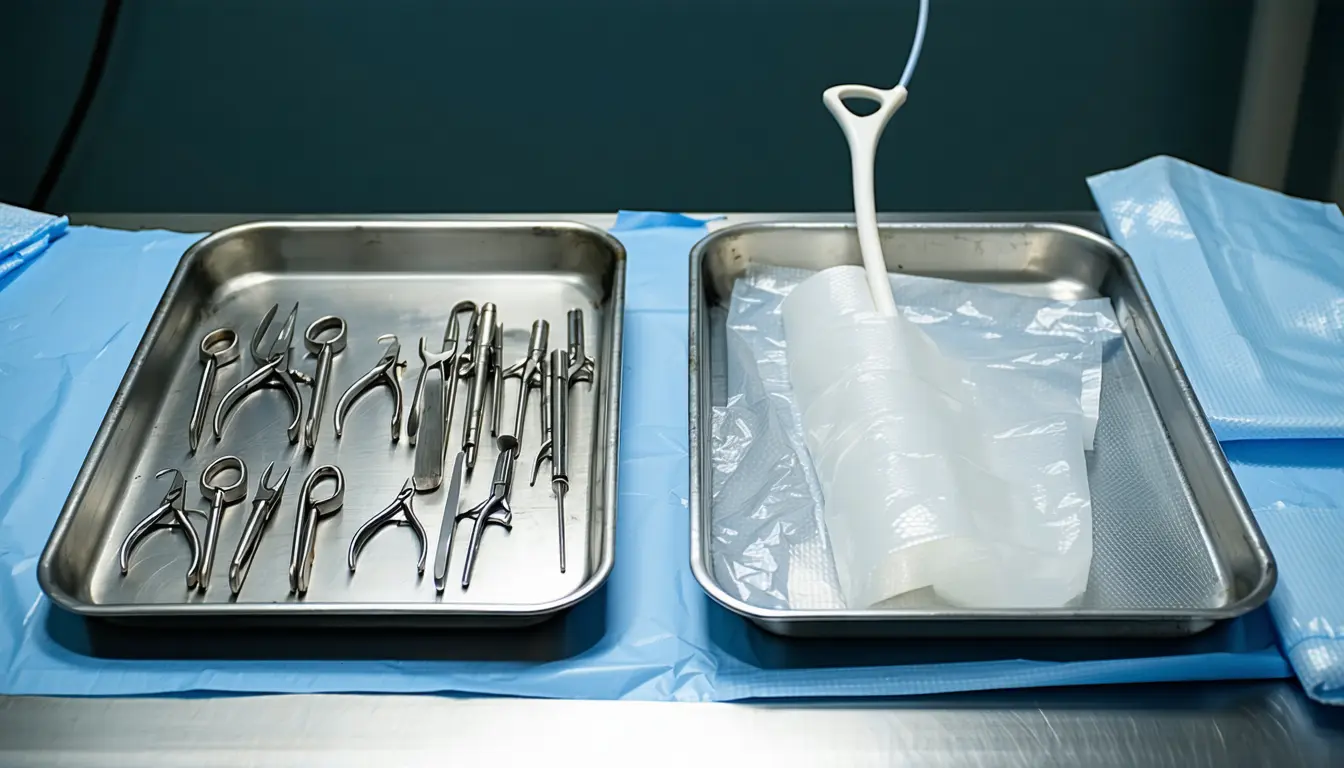
- Each 4 by 6 cm sheet of dried membrane was laid on the cavernous nerves on both sides of the prostate and wetted with saline so it would cling.
- The review found no difference in cancer outcomes between the two groups after an average follow-up of eight years.
- Shirin Razdan now uses the wraps in her own prostate removals and is trialling them in surgery for Peyronie's disease.
Compiled by The ScientistSomething wrong?How this is made
Why it matters
- constraint The only comparison is the surgeon's own pre-2014 patients, so the seven-day gain cannot be credited to the membrane with any confidence over improvements in his technique.
- capability If the three-month gap holds up in a randomised trial, roughly one additional man in seven would regain usable erections within three months of surgery.
- exposure Men wrapped late in the series carry the theoretical growth-factor cancer risk with the least follow-up, so the safety reassurance is weakest for them.
- decision Urologists who adopt the wrap now would be taking up a technique that, by Burnett's account, nobody else uses routinely, on the strength of one surgeon's records.
The 1495 men who went without wraps were also Sanjay Razdan's patients, operated on before 2014 [3]. The men who got wraps had surgery between 2014 and 2024 [1]. Using the same surgeon holds one large variable fixed. It also means anything else that changed in his practice over those years gets counted as an effect of the membrane.
The study is a retrospective review of one surgeon's operations. The New Scientist report raises the obvious alternative explanation, refinements in his surgical technique since 2014 [7]. Shirin Razdan, his daughter and colleague at HCA Florida Kendall Hospital in Miami, says she doesn't believe refinement alone would be enough to explain the improvement in erectile recovery [c8, c18].
The idea has some biology behind it. Surgeons try to spare the cavernous nerves because they signal the muscles of the penis to relax so blood can flow in [15]. Surgical tools stretch and heat those nerves, and the area tends to become inflamed [14]. Robotic equipment is commonly used for precision [19], but Shirin Razdan said that "even when you do the most beautiful nerve-sparing surgery, there is usually still some damage to the nerves" [13]. The amniotic membrane, the fetus-facing inner layer of the placenta, is packed with growth factors and immune-modulating proteins known to promote healing [12]. Her father got the idea more than a decade ago from a conversation in the hospital cafeteria with neurosurgeons who were testing the membranes for nerve healing [17].
On the study's own numbers, the wraps took seven days off the average wait for a first erection [3]. In my view the three-month result matters more to patients than the speed of the first erection. The gap at three months is 15 percentage points [1]. If all of it were due to the membrane, about one extra man in seven would have usable erections by then [2]. The report does not say how the time to first erection was recorded, or whether the average is a mean or a median.
The growth factors that make the membrane plausible also raise the safety question. Growth-promoting tissue placed in an area just cleared of cancer might spur further cancer growth [6]. The reassuring cancer result rests on follow-up that averages eight years [5], and the wrapped series includes operations as recent as 2024 [1].
Arthur Burnett at Johns Hopkins Medicine wants randomised clinical trials before the effect is treated as confirmed [9]. "I'm pleased to see that they're trying to think outside the box here, but nobody else is doing this routinely yet. It still needs to be further investigated," he said [10]. A trial that randomised men treated in the same years by the same surgeons would separate the effect of the membrane from changes in technique. Until one reports, the evidence is one surgeon's records of 4055 men across two periods [4].
What to watch
- A randomised trial of amniotic membrane nerve wraps in radical prostatectomy, the test Arthur Burnett says is required.
- Cancer outcomes for men wrapped in the final years of the 2014-2024 series as their follow-up lengthens.
- Results from Shirin Razdan's trials of the wraps in Peyronie's disease surgery.