Science1 publisher3 min readPublished
Ribosomes run nearly twice as fast on ac4C mRNA, putting the platform default in play
Johns Hopkins and NIH researchers report faster, cleaner translation from an alternative mRNA modification than from the chemistry used in COVID-19 mRNA vaccines. Dose economics is the open question.
The Scientist · Science desk
Drafted by a language model from the sources cited here and checked against its claim ledger before publication. How we use AISend a correction
What happened
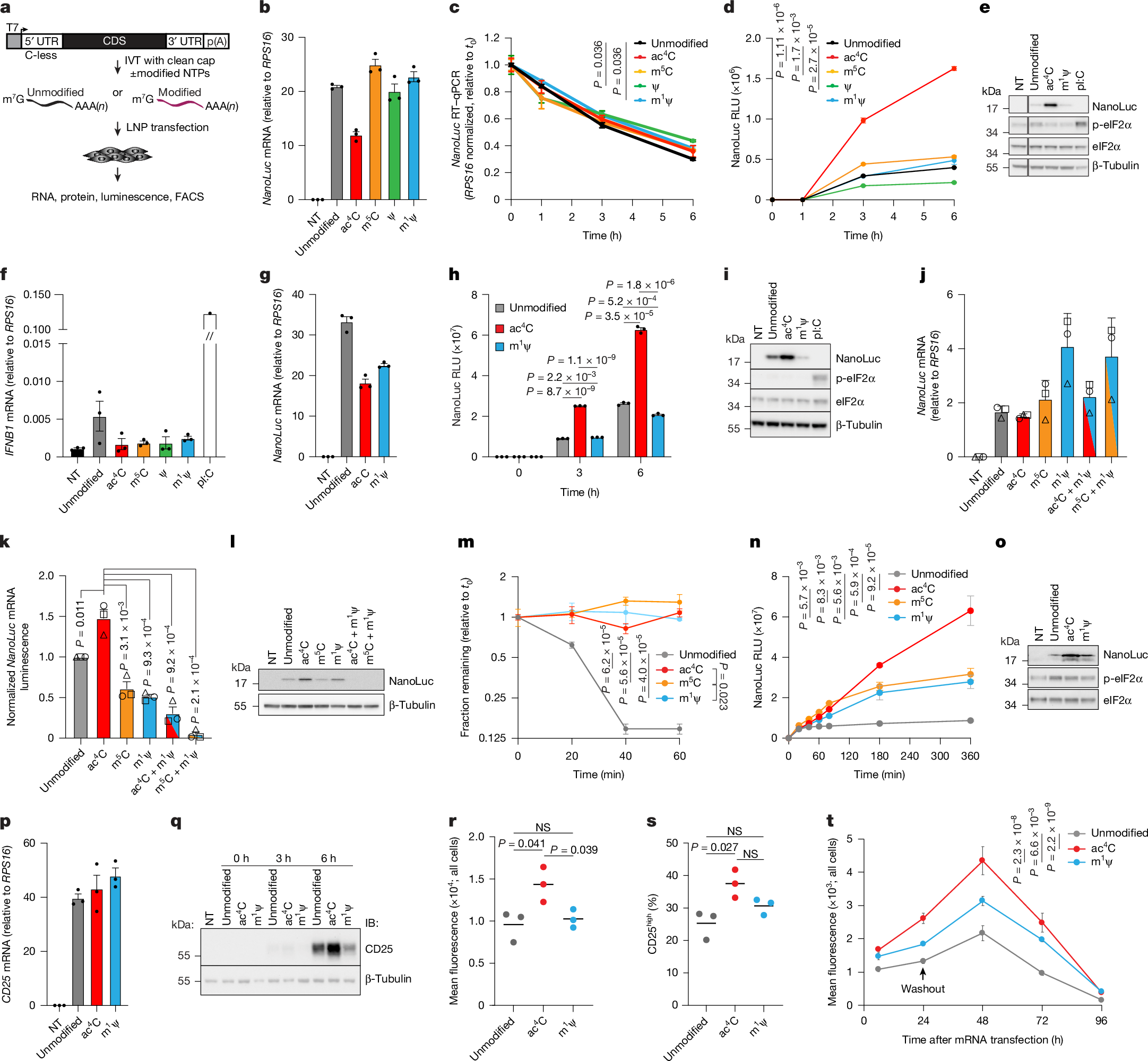
- In experiments with cells from people and mice, researchers at Johns Hopkins Medicine and the National Institutes of Health compared an experimental mRNA platform, N4-acetylcytidine (ac4C), with the industry-standard mRNA platform, N1-methylpseudouridine (m1Psi); imaging revealed that ribosomes travel nearly twice as fast on the ac4C-modified mRNA, preventing the ribosomal traffic jam seen with the industry standard, according to Bin Wu.
- N1-methylpseudouridine (m1Psi) is the chemical modification used in COVID-19 mRNA vaccines and is being widely studied for delivering potential cancer and autoimmune disease vaccines.
- The study was published July 1 in Nature as Sarah Schiffers et al, "N4-Acetylcytidine enhances synthetic mRNA translation yield and fidelity," DOI 10.1038/s41586-026-10729-8.
- The scientists used lipid nanoparticles to mimic how vaccines work, inserting mRNA with the ac4C and m1Psi modifications into cultured human dendritic cells derived from monocytes and into mouse liver cells.
- The comparison used an imaging technique developed by Wu's lab called single-molecule imaging of nascent peptides, plus an advanced microscope, to track individual mRNAs as they produced therapeutic proteins inside cells.
Compiled by The ScientistSomething wrong?How this is made
Why it matters
Scientists at Johns Hopkins Medicine and the National Institutes of Health report that ribosomes travel nearly twice as fast along mRNA carrying N4-acetylcytidine (ac4C) as along mRNA carrying N1-methylpseudouridine (m1Psi), the chemical modification used in COVID-19 mRNA vaccines [1][2]. If that speed advantage survives contact with animals and manufacturing, the industry's default nucleoside becomes a decision rather than a given, and the first place it would show up is dose size [7].
The paper, "N4-Acetylcytidine enhances synthetic mRNA translation yield and fidelity," with Sarah Schiffers as first author, was published July 1 in Nature [3]. The team packaged both mRNA versions in lipid nanoparticles to mimic how vaccines are delivered, then introduced them into cultured human dendritic cells derived from monocytes and into mouse liver cells [4]. Individual mRNA molecules were tracked with single-molecule imaging of nascent peptides, a technique developed in the lab of Bin Wu, associate professor of biophysics and biophysical chemistry at the Johns Hopkins University School of Medicine [5][6].
The mechanism is the load-bearing part of the story. According to Wu, the imaging shows ribosomes on m1Psi-modified mRNA slowing down and forming traffic jams, with irregularly translating ribosomes causing premature termination or frameshifting and therefore fewer or compromised proteins [8][9]. The ac4C version, Wu says, translated more smoothly and yielded more and better protein [10]. He is explicit that the collision account is a proposal: "We propose this ribosome collision as a model for why the industry standard may produce fewer proteins," Wu says [11].
Two things keep this from being a procurement memo. First, the researchers themselves describe m1Psi as a safe and effective delivery mechanism [12], so the comparison is against a working product, not a failure. Second, the dose claim is framed as a possibility, not a measurement: ac4C "may eventually lead to more efficient drugs that require smaller doses," Wu says [7]. All of the reported evidence sits in cultured human dendritic cells and mouse liver cells [13]; the source describes no antibody titers, no potency-per-microgram figure, and no cost of goods.
The context worth holding onto is how little of the chemical space has been examined. There are more than 170 known RNA modifications, and only a small subset has been studied for mRNA therapeutics, according to Wu [14]. ac4C is naturally occurring, and NIH scientists had previously shown it may enhance mRNA translation [15]. The collaboration itself is recent: co-corresponding author Shalini Oberdoerffer, a senior investigator at the National Cancer Institute's Laboratory of Receptor Biology and Gene Expression, gave a talk on ac4C at Johns Hopkins in 2024, after which Wu proposed working together [16] - roughly two years from seminar to Nature paper [17].
What to watch: whether the translation-yield gap reproduces in whole animals with immune readouts rather than protein output in dishes, since a faster ribosome is only interesting if it buys titers [1][13]. Watch also for a fidelity number, since the paper's own title puts fidelity alongside yield [3], and frameshifting products are a regulatory question as much as a potency one [9]. And watch whether anyone reports ac4C nucleotide supply at vaccine scale; the current result is a mechanism, and mechanisms do not have a bill of materials [11].