Product1 distinct publisher3 min readPublished
At $400 the Liane rope light is already selling on Hue's website, with the $320 Signe fixtures due in October. What a buyer is paying for is mostly a mounting decision, plus the app scenes that come with it.
The Product Desk · Product desk
Compiled by The Product DeskSomething wrong?How this is made
Follow any of these and your For You feed starts watching them — no settings page required.
product
Schlage's $400 UWB Lock Lands in a Category Aqara Already Priced at $2701 distinct publisher
product
Hue adds a natural-language AI behavior builder to the Bridge Pro1 distinct publisher
product
Philips Hue partners with Nanoleaf on wall panels, with a $39.99 connectivity module1 distinct publisher
product
Mova's $1,300 V70 Ultra bets that reach, not suction, is the robot vacuum's remaining gap2 distinct publishers
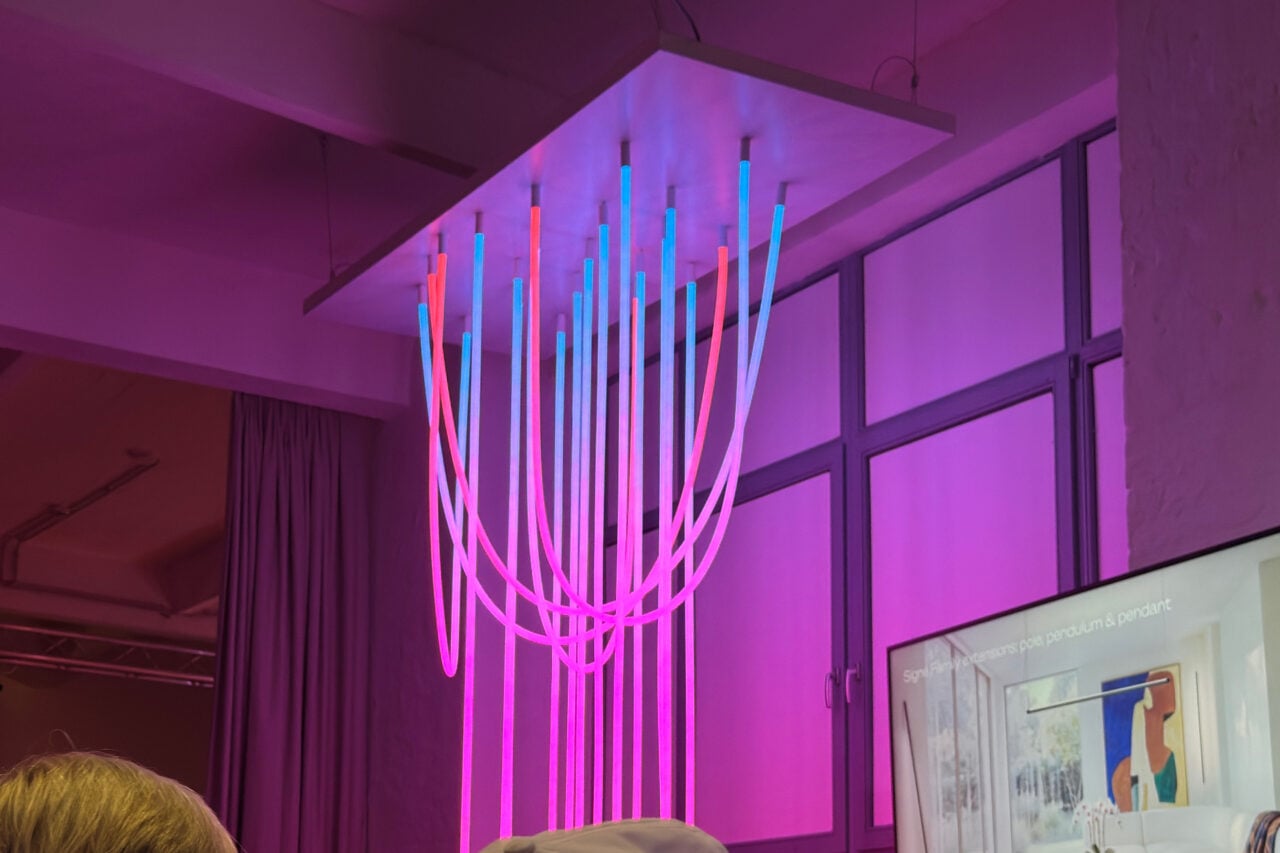
The clips are where this gets decided. A Liane goes up with clips that hold the tube in a loop or a serpentine curve, so the purchase happens on a ladder, with one wall in front of you and $400 of flexible tube in your hands [1][2]. Nothing in the pitch turns on protocol. The nearest thing to an interoperability claim in the whole announcement is that the Festavia pieces will play the same scenes together if you set them from the Hue app [10].
Buyers here are not picking an ecosystem and then furnishing it. They are finding a spot ordinary lighting cannot solve and buying the thing that fits it. Which app it wants is a discovery for later. Hue has priced for that buyer. The Liane at $400 is 1.6 times a $250 Festavia piece [2], and one Liane plus one Signe Pole comes to $720 [3]. At that number the comparison set stops being other smart bulbs and becomes the pendant aisle of a lighting shop, where nothing has an app and nobody expects one.
Gizmodo's reviewer says the Liane's gradients look smooth and its colour stays unsaturated even at deep fuchsia [16], which is a claim about the fixture rather than the software, and that is the right way round for this category. A launch like this carries no retention or usage-depth evidence, and there is no sense pretending otherwise. What it carries is a sequence: the $400 item is collecting real buyers now while the $320 ones stay renderings until October [3][6].
The part that will generate support tickets is the automation story. Hue's representative said the company keeps conditional rules out of its menus not because the hubs cannot run them but because it would make things too complicated for customers, and the examples he offered (backyard lights that come on only when ambient light drops below a level, living room lights that dim when the TV goes on) are the kind Gizmodo notes Aqara and Apple Home already expose in menus [13][14][15]. In October those rules arrive on the Bridge Pro through a chatbot [12], and fixing one you dislike means asking the chatbot again rather than opening the rule yourself [17]. The complexity moves into a text box; it does not disappear.
Two questions sort the fixture decision: would you buy this shape at $250 to $400 if it only did warm white, and is the automation you want already on today's menu? If the answer to the first is yes, you are buying furniture, the app is a bonus, and the fair comparison is a plain dimmable pendant. If no, then colour and scenes are carrying the entire price, and the fair comparison is the cheapest strip that will sit in the same spot. On the second question, if it is already on today's menu, the Bridge Pro chatbot is not part of this purchase and the demo should not price itself in. If it is not, the fixture is the smaller half of the bill and the hub is the thing you are actually buying.
Ranked by verification strength, evidence, and original report placement.
The Philips Hue Liane 360-degree rope light starts at $400.
The Liane is a flexible rope light meant to be hung from a ceiling or along a wall, fixed with clips so that it loops back on itself or appears to be in a serpentine curve.
Philips Hue has already started selling the Liane 360-degree rope light on its website.
The lights were shown at an event following the first press day of IFA 2026 and announced the next day.
The three new Signe lights (Pendant, Pendulum and Pole) are all cylindrical with a strip of colourful lighting on one side; the Pendant is suspended between two rings on cables that let it rotate to face down, sideways or up.
The Signe Pendulum and Signe Pole both start at $320 and go on sale in October.
Distinct publishers with included, body-backed reporting in this cluster.
gizmodo.com
1 article · September 3, 2026
Evidence-backed comparisons of source perspectives and observed adoption signals. Read the methodology
Which Builder, Operator, and Investor concerns the observed source mix emphasized—not a truth score.
Evidence, demonstrated adoption, hype gap, incentives, and confidence are assessed independently, each on its own current evidence. How these are measured.
One reporter's evening, one vendor's numbers
Split the story in two and the sourcing quality splits with it. What the Liane looks like lit, how the Pendant's rings swivel, what a Hue representative said out loud — that is direct observation and it is solid. The $400, the $320, the October dates and the free Bridge Pro update are announcement text repeated once, with Hue's own storefront as the only corroboration offered for the Liane being buyable today.
On the shelf, nobody's living room yet
Shipping is the whole of it. Three Festavia lights are orderable today and a Liane page is live, which is more than a press render — but there is not one buyer, install, or hour of runtime anywhere in this reporting, and the software everyone will judge Hue on does not exist outside a demo until October.
The pitch outruns the feature
The overstatement belongs to Hue, not to the byline. A representative sold Custom AI Behaviors as unlocking capabilities the menu workflow cannot reach, then illustrated it with lights that dim when the TV comes on — a trick Aqara and Apple Home users have had for years — and separately conceded the hubs were always capable. Stack that against $400 for a rope you clip into a curve and $250 for a net light Govee got to first, and the framing sits well ahead of the substance. Gizmodo's own scepticism is what keeps this from scoring higher.
Hue set the room and the schedule
The venue, the timing and the spokesperson all belonged to Hue: an event staged for press the night before the embargo lifted, with a company representative supplying both the demo and the reason the feature was withheld until now. Against that, the reporter names the catch-up dynamic, prices the fixtures uncharitably, and openly doubts the chatbot will survive contact with users. What we cannot see is anything about review units, travel, or commerce links, in either direction.
Firm on shapes, soft on promises
One publisher, one attendee, one night — so the ceiling is low no matter how good the reporting is. Take the physical descriptions and the colour read at close to face value. Hold the October dates, the unpriced Signe Pendant, and the claim that asking a chatbot is a workable way to fix a broken automation until something other than a launch briefing says so.