Product1 publisher3 min readPublished Updated
Schlage's $400 UWB Lock Lands in a Category Aqara Already Priced at $270
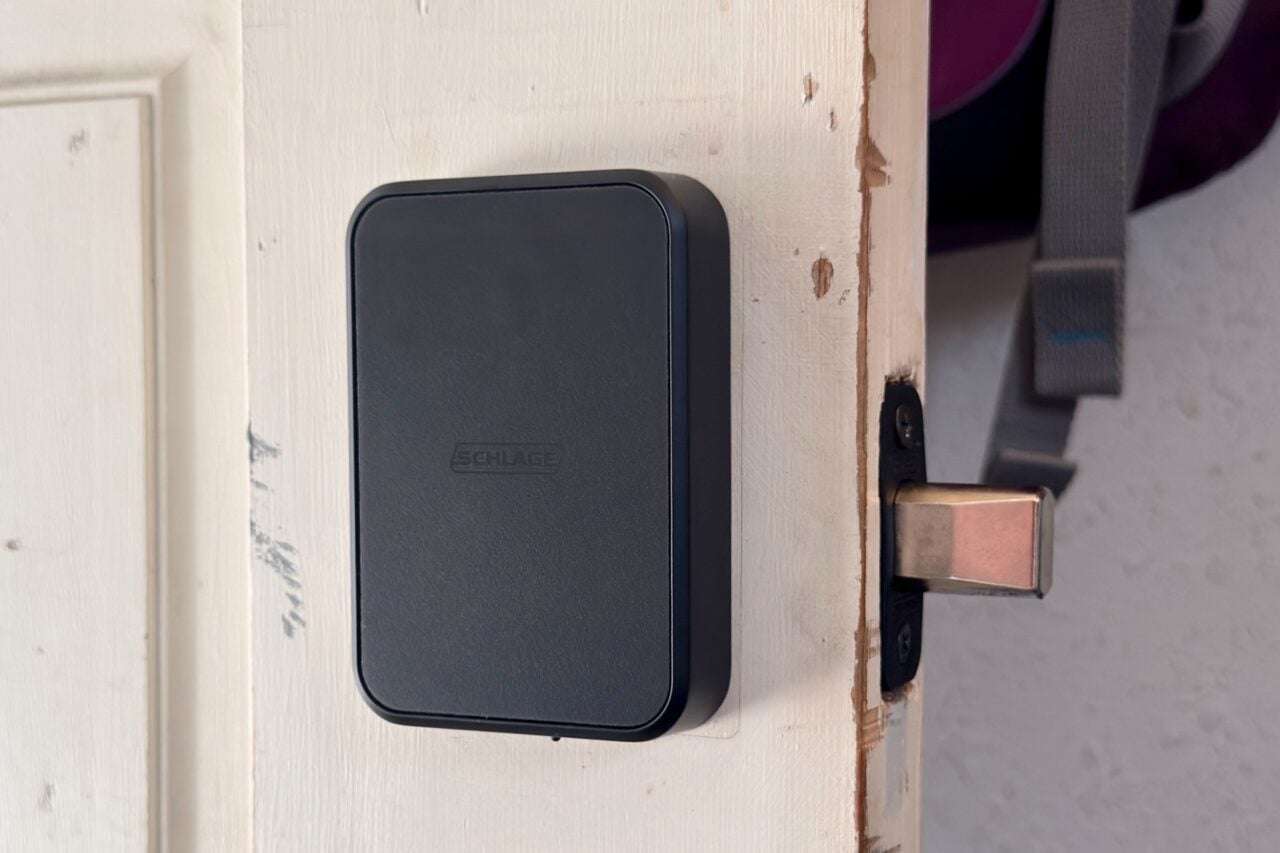
Hands-free ultra-wideband entry now has more than one vendor. The newer, pricier lock has fewer unlocking options, no fingerprint reader, and no physical key.
The Product Desk · Product desk
Drafted by a language model from the sources cited here and checked against its claim ledger before publication. How we use AISend a correction
What happened
- The Schlage Sense Pro is a smart lock with ultra-wideband (UWB) sensing that unlocks hands-free when the user approaches with a smartphone in a pocket; it has the same UWB-sensing capability as Aqara's lock.
- The Aqara U400 smart lock uses ultra-wideband to unlock hands-free when the user approaches with a smartphone in a pocket.
- Schlage's Sense Pro costs $400.
- Aqara's U400 costs $270.
- The Sense Pro costs $130 more than the Aqara U400.
Compiled by The Product DeskSomething wrong?How this is made
Why it matters
Schlage's Sense Pro is out, and it does the thing the Aqara U400 does: unlock the door over ultra-wideband as you walk up with your phone still in your pocket [1][2]. The Sense Pro costs $400 and the U400 costs $270 [3][4], which is the whole review in one line, and the reason hands-free entry has stopped being a single-vendor curiosity and started being a shopping decision.
The $130 gap [5] would be defensible if the more expensive lock did more. It does less. The Sense Pro has no fingerprint sensor and runs on four replaceable AA batteries rather than a rechargeable pack [6][7]. It has no physical keyway at all, which Gizmodo notes cuts both ways: nothing to pick, and nothing to fall back on [8]. Gizmodo's reviewer listed "few unlocking options" among the drawbacks and concluded the Sense Pro is a good UWB lock that is hard to recommend over the cheaper, more featureful U400 [9][10]. The one clear win the reviewer gave Schlage was the way it looks, particularly the exterior keypad [11].
The more interesting constraint is that neither lock's headline feature works for most phone owners. As of Gizmodo's writing, hands-free UWB unlocking is Apple-only; Samsung and Google plan to add support but have not shipped it [12]. UWB on the Sense Pro also requires a Thread border router such as a second-generation HomePod or HomePod Mini, with Wi-Fi or Bluetooth handling primary connectivity [13]. So the addressable buyer is an iPhone owner who already runs Apple smart home hardware and is willing to pay $400 for a door that opens itself. That is a narrow funnel, and it is the same funnel Aqara is fishing in for $130 less.
The field notes matter for anyone modelling support load. Installation took the reviewer about ten minutes, ending with a Matter QR code above the battery compartment [14]. UWB recognition needed a short break-in period: at first a few seconds of standing at the door, then reliable unlocks before reaching for the handle [15]. After a day away it could still leave the reviewer waiting a few seconds [16]. Apple Watch unlocking failed until the watch was unpaired and set up again, and even then a metal storm door blocked the signal often enough that the reviewer had to hold an arm out for line of sight [17]. The lock could not be triggered from inside the house, which rules out one obvious failure mode [18]. Pairing with Schlage's own app failed and the reviewer fell back on putting the Matter device into pairing mode through Apple Home [19].
Two things to watch. The first is Android: if Samsung and Google ship UWB unlocking [12], the category roughly stops being an Apple accessory market, and the price spread between a $400 and a $270 lock gets tested against a much larger buyer pool. The second is whether Schlage responds on price or on features, because right now it is asking a 48 percent premium [20] for a lock with fewer ways to open it.