Product1 publisher2 min readPublished
Outpost signs a Luxembourg drug-screening lab as its first space-factory customer
Outpost signed Exobiosphere's automated drug-screening lab as the first announced customer of its Space Factories platform, ahead of a 2028 mission. Its CarryAll spacecraft is still in development, so buyers get a reference customer before they get a flown return.
The Product Desk · Product desk
Drafted by a language model from the sources cited here and checked against its claim ledger before publication. How we use AISend a correction
What happened
- Exobiosphere, a space biotechnology company based in Luxembourg, is developing OHTS as an automated lab for disease modeling and drug screening in microgravity.
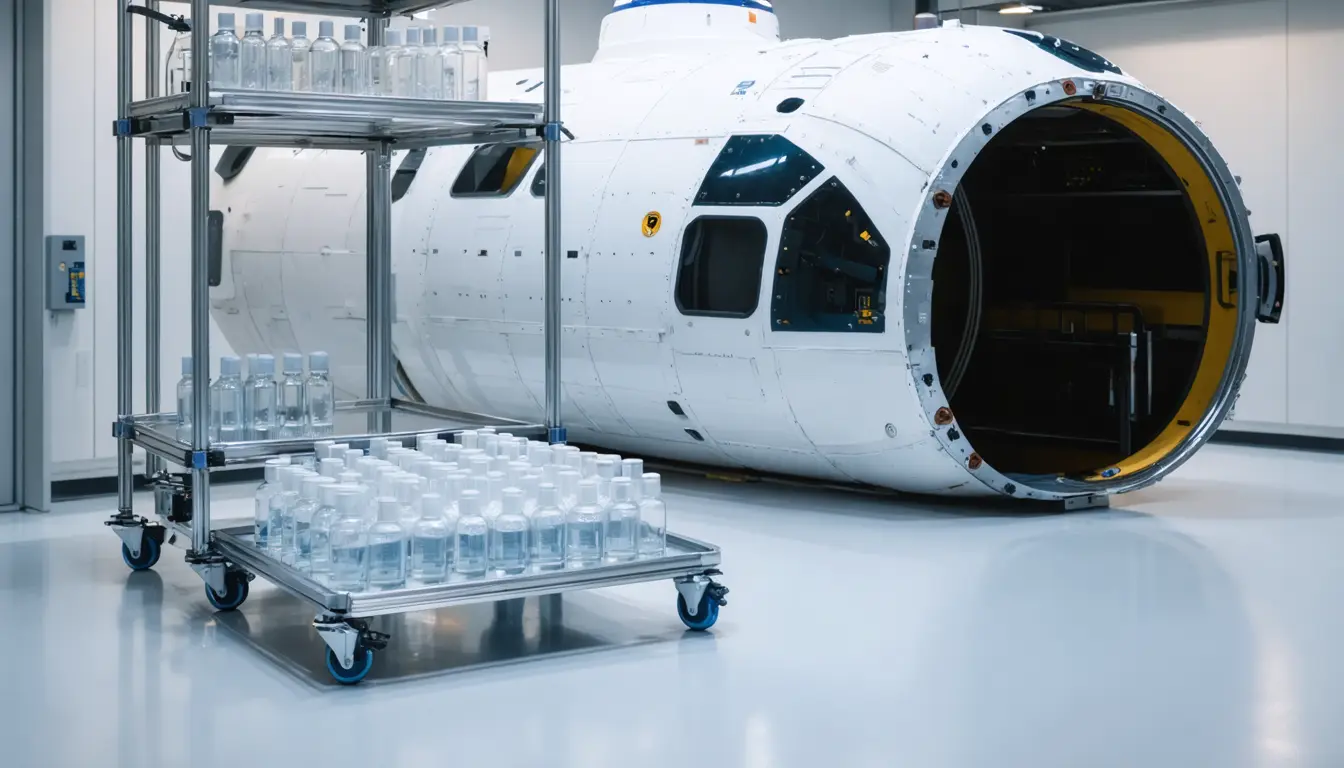
- Space Factories pairs reusable, free-flying CarryAll spacecraft with standardized containers and shared power, thermal, data and safety services.
- CarryAll is designed to return cargo from 200 kilograms to 10 metric tons in a pressurized, ISS-compatible environment.
- The International Space Station is approaching its planned decommissioning in 2030.
Compiled by The Product DeskSomething wrong?How this is made
Why it matters
- cost Outpost shares the spacecraft, but each customer builds its own inner module, so a pharma team following Exobiosphere has to pay to build its own version of OHTS.
- constraint Any slip in Outpost's 2028 mission shortens the period in which researchers can use both the ISS and CarryAll before the station retires.
- exposure OHTS flies only when CarryAll does, so Exobiosphere's lab schedule now depends on a spacecraft Outpost has yet to fly.
Space Factories is built for a biologist waiting for a container to land. A drug screen run in orbit has to come back to Earth before anyone can validate what it found [6]. Interesting Engineering's report on the deal says repeatable return could help Exobiosphere shorten its experimental cycles [14].
The pitch is a platform that takes a customer from a first experiment module up to larger manufacturing operations [12]. What has actually happened is smaller. Exobiosphere's OHTS will ride on CarryAll, and it is the first customer module scheduled to fly on Space Factories [2][5]. Outpost's phrase is "first announced commercial customer" [1]. The companies did not disclose terms [1].
Outpost describes reuse from its own side: the expensive, complex infrastructure is built once and reused across missions [9]. On the customer's side, the part that changes each flight is the lab itself, and Exobiosphere is the one developing OHTS [4]. Jason Dunn, Outpost's co-founder and CEO, described the split. "Exobiosphere brings the science, and we provide the standardized platform to fly it, operate it, and bring the results home," he said [10].
The demand claim comes from the customer. "Microgravity accelerates biology in ways we simply can't reproduce on Earth, and demand from researchers and pharmaceutical companies to run experiments in orbit already far exceeds the capacity of the International Space Station," said Kyle Acierno, co-founder and CEO of Exobiosphere [7]. That is one company's account. Its lab is built to run exactly those experiments [4].
For now, timing matters more than payload size. Outpost plans its orbital mission for 2028, and the ISS is due for decommissioning in 2030 [3][13]. If both plans hold, researchers get about two years in which the station and the new platform are both available [1].
A team deciding whether to plan around this can sort its case with two questions. The first is whether the result lives in the physical sample or in data sent down from orbit. The second is whether the program can wait for a vehicle Outpost is still developing [11]. Work that depends on the sample and can wait for 2028 is the case Outpost designed for, and OHTS is its reference module [5]. Work that depends on the sample and cannot wait has the ISS until its planned 2030 retirement [13]. Work that only needs data gets little from sample return, the service Outpost is positioning as core [15]. For work in the first group, I'd want a price per returned kilogram and one completed return flight before putting a program budget behind it.
What to watch
- A disclosed contract value or a price per returned kilogram from Outpost or Exobiosphere.
- A second named Space Factories customer, especially a pharmaceutical company buying directly.
- Any change to Outpost's 2028 mission date or to the ISS's planned 2030 decommissioning.