Invest1 publisher3 min readPublished
Cursor ships Origin to paying users as GitHub's outage count reaches 257
Origin keeps GitHub as the source of truth. That is both the reason engineering orgs can try it this quarter and the reason it is not yet an exit.
The Investor · Invest desk
Drafted by a language model from the sources cited here and checked against its claim ledger before publication. How we use AISend a correction
What happened
- Cursor opened Origin, its GitHub-interoperable code-hosting platform, to paying customers on Monday morning.
- About three and a half hours after Cursor's Monday morning rollout, GitHub's incident log listed a global degradation.
- GitHub's incident log recorded a 6h42m global degradation.
- GitHub logged 257 outages over the past year, a series of failures the report ties to a visible exodus of high-profile users.
- 257 logged outages in a year averages roughly one every 1.4 days.
Compiled by The InvestorSomething wrong?How this is made
Why it matters
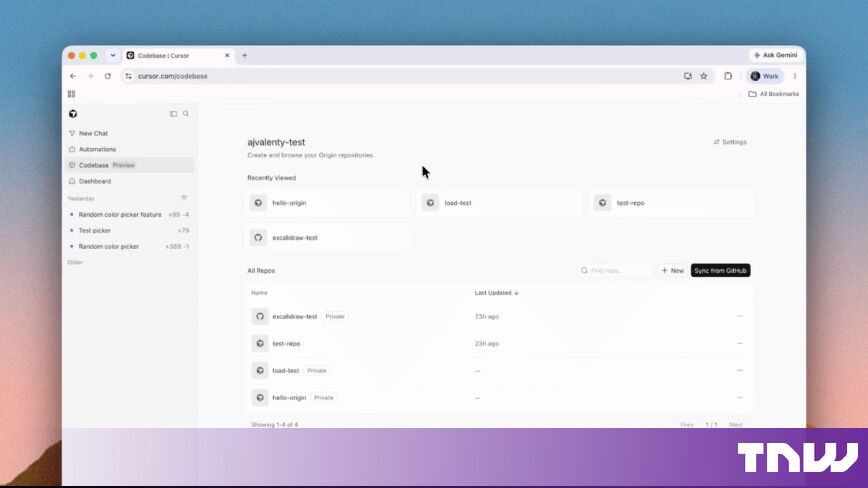
Cursor began shipping Origin, its GitHub-interoperable code-hosting platform, to paying customers on Monday morning [1]. About three and a half hours later GitHub's incident log opened a global degradation that ran 6h42m [2][3], which matters less as a coincidence than as a data point: according to Cryptopolitan, GitHub logged 257 outages over the past year [4].
That works out to a mean of roughly one logged incident every 1.4 days [5]. Monday's was not a mild one. Error rates across pull requests, issues and the API sat near 20%, pushing errors on archive and raw file downloads toward 50% [6], and it took down enterprise sign-on along with SAML, OIDC, SCIM provisioning, Team Sync and Copilot [7]. Identity and provisioning are the part enterprises actually price when they sign a hosting contract.
The interesting thing about Origin is how little it asks. Pushes still go to GitHub, which remains the definitive source for anything that originated there [8]. Permissions are identical to GitHub's read/write model [9]. Pull request comments sync both directions, so a comment written in Cursor shows up in GitHub and the reverse [10], and Cursor says GitHub-hosted repositories can sit alongside Cursor-hosted ones [11]. Existing GitHub Actions workflows run without rewriting [12], with Vercel generating a preview per pull request and Depot and Buildkite running builds [13]. The product pitch is agents, code and review in one place: send the agent a review comment and it edits the pull request [14].
Read that as a switching-cost strategy rather than a replacement. There is no migration, no permission remodelling, no CI rewrite, which is why a platform team can pilot it inside a sprint. It also means Origin does not route around a GitHub failure, because by design the writes still land there [8]. Guillermo Rauch, Vercel's chief executive, said on X that developers could host on Origin and deploy to Vercel, which was online unlike GitHub, then conceded he was making light of the fact that Vercel itself was stuck because of the GitHub outage [15]. Cursor's Matt Palmer quote-tweeted the launch and said the team had wanted to ship earlier, but GitHub was down [16]. Launches are booked weeks ahead and there is no evidence Cursor engineered the overlap [17].
The incumbent's scale is the counterweight. GitHub's Octoverse 2025 count reported 180 million developers, 630 million repositories and 43.2 million pull requests merged monthly, up 23% year over year [18], and it remains the largest source code host, owned by Microsoft [19]. Those merge volumes work out to about 1.4 million a day, meaning a 6h42m degradation covers a window in which roughly 400,000 merges would normally clear [20].
Cursor bought the code-review company Graphite in December 2025 at a price well above its $290 million Series B valuation [21], and Graphite co-founder Tomas Reimers now runs Origin [22], having first shown it at Cursor's Compile conference in June [23]. The stated premise leans on Google's 2025 DORA report, drawn from almost 5,000 professionals: writing code requires extensive reviewing [24].
Watch for the moment Origin offers to be the source of truth rather than a mirror, because that is when the switching cost stops being zero and the procurement conversation starts. Watch enterprise identity, since SSO and SCIM were what broke on Monday [7]. And watch whether 23% merge growth [18] or 257 logged incidents [4] is the number engineering leaders quote in their next renewal.