Science2 distinct publishers3 min readPublished
The BMJ study's range runs from 24.5% to 97.7% because 1,374 of those brains were never examined. That width reflects who donates, not how common the disease is.
The Scientist · Science desk

Compiled by The ScientistSomething wrong?How this is made
Work the lower bound backwards and you can see how it was built. Multiply 18.5% by the 1,712 deaths and you get roughly 317 brains, which is about 94% of the 338 examined [3] - the same pathology rate the authors reported among their donors [3]. The floor is that count of confirmed cases divided by every death in the era, on the assumption that all 1,374 brains never donated were free of disease [2].
Run the assumption the other way and the ceiling appears: 317 confirmed plus 1,374 assumed, over 1,712 deaths, is 98.8%, within rounding of the 98.7% the paper published for the full window [4] [7]. The 24.5% to 97.7% band for 2016 to 2021 is the same construction on a smaller slice, and it is 73 percentage points wide [5] [8]. Closing that gap depends on recruiting differently, for instance through a route that does not rely on families noticing symptoms; statistical refinement alone will not do it. Thayne Munce of the University of Kansas, who was not involved in the work, put the mechanism plainly: if the men who donated were largely those showing cognitive or behavioural changes while alive, the sample is heavily biased, and the width of the range is what that bias looks like when written down [12].
The pathology count and the impairment count are also different measurements. CTE is a degenerative disease attributed to repeated concussions and smaller non-concussive hits [21], and it was scored here in tissue: about 60% of donors with CTE-related changes also had a dementia diagnosis, so around 40% did not, though stage IV cases reached 90% [5] [6] [6]. About 30% of the donated brains were stage IV [4].
Then there is the calendar. Men who died between 2008 and 2021 did their playing in earlier decades, which is why Munce says the findings should not be pushed onto youth players or onto today's NFL, and why he offers the view that this is probably the safest time to be playing the sport [9] [10]. That is a statement about direction with no denominator attached, and worth reading as exactly that.
The Stat News historian objects to a different part of the coverage, and the objection is not about the arithmetic. Earlier studies had estimated similar prevalence among professional players, and a 1933 NCAA medical handbook already described concussion producing "punch drunk" [20] [18]. On that reading the new number re-quantifies a known problem, and safety decisions at the college and youth levels do not need the interval to shrink first [17]. The authors themselves call 25% the low end [14]. My own read: carry the 338-of-1,712 ratio [1] into any argument about this paper, and treat 25% as a floor for men whose careers are already over.
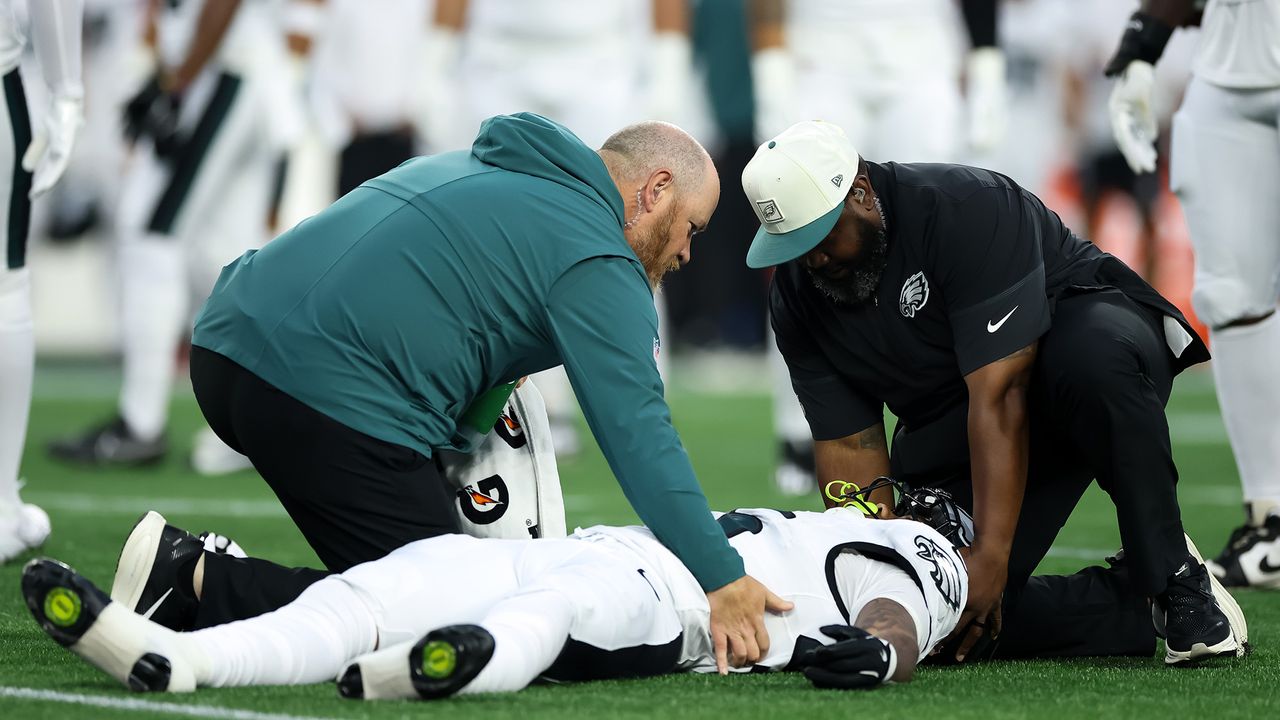
Ranked by verification strength, evidence, and original report placement.
A study published Aug. 25 in The BMJ examined donated brain tissue from 338 former NFL players who died between 2008 and 2021.
A total of 1,712 former NFL players died in that time frame, so the analysis included only about 20% of the brains that could theoretically have been examined.
Among the donated brains, over 93% showed physical signs of CTE, meaning an accumulation of abnormal proteins in specific places within the tissue.
About 30% of the donated brains had stage IV CTE, the most severe form.
Across the full study time frame, the researchers estimated that between 18.5% and 98.7% of the deceased players likely had CTE.
For 2016 to 2021, the period with the highest number of brain donations, the researchers estimated the CTE rate at between 24.5% and 97.7%, and determined that window was likely the more representative sample.
Distinct publishers with included, body-backed reporting in this cluster.
1 article · August 31, 2026
Follow any of these and your For You feed starts watching them — no settings page required.
leadership
One in four is a floor, not a finding: CTE research finally gets a denominator2 distinct publishers
leadership
Disney swaps raises for discounted stock and a full health-plan re-enrollment1 distinct publisher
invest
The Lakers deal now turns on trust law, not basketball1 distinct publisher
invest
Kalshi pulls sports mention markets, and the CFTC starts grading contract design1 distinct publisher
Evidence-backed comparisons of source perspectives and observed adoption signals. Read the methodology
Which Builder, Operator, and Investor concerns the observed source mix emphasized—not a truth score.
Evidence, demonstrated adoption, hype gap, incentives, and confidence are assessed independently, each on its own current evidence. How these are measured.
One paper, self-checking numbers, unresolvable middle
Every quantity in this story — 338 brains, 93% positive, 30% at stage IV, both intervals — comes from a single BMJ paper, and only Live Science reports the denominator that makes those numbers legible. What lifts it above ordinary single-source reporting is that the figures audit themselves: the 18.5% floor is the donor positives counted against all 1,712 deaths, the 98.7% ceiling is every unexamined brain assumed positive, and both reconcile to within rounding. The pathology in the examined brains is firm. The prevalence estimate is fenced by a question no amount of care can answer with these data.
Loud pickup, unchanged practice
The figure travelled fast — abuzz in media feeds within a week, per Stat News, and answered by a players' union statement relayed through ESPN. But a statement is the ceiling of what this reporting shows. No league rule, conference policy or youth program change appears anywhere in our coverage, and Stat News' historical spine is precisely that comparable evidence has been on the record since 1933 without producing one.
The headline number outruns its interval
'One in four' travels; '24.5% to 97.7%, depending on who chose to donate' does not. The overstatement sits in the framing both of our publishers inherited rather than in what they wrote — Live Science dismantles the donor bias, Stat News denies the finding is new — which is why this is a lean and not a chasm. Still, a bound whose upper end requires assuming 1,374 unseen brains were all diseased is being read as a settled rate, and nothing in the study can stop that.
Both sets of stakes are printed on the label
Live Science's reassuring expert sits on USA Football's medical advisory panel — disclosed in his own biography inside the piece — and his 'safest time to be playing' line arrives with an admission that no evidence supports it. Stat News' author is a historian advancing a thesis she has published since 2014, writing openly as a mentor to concussed undergraduates and a mother of children drawn to contact sports. Neither interest is concealed, and they pull in opposite directions, which is more useful to a reader than either piece alone.
Firm on the pathology, agnostic on the rate
Two outlets, one underlying paper, no independent reanalysis. We can restate what was found in the 338 brains and reconstruct how the bounds were built with little hesitation. The rate among NFL players of any era stays out of reach — as Live Science's expert puts it, you cannot sample living players for a disease diagnosable only after death — and Stat News offers nothing quantitative to cross-check against.