Product2 publishers3 min readPublished
Obama ties his AI framework for Democrats to a House majority decided on 3 November
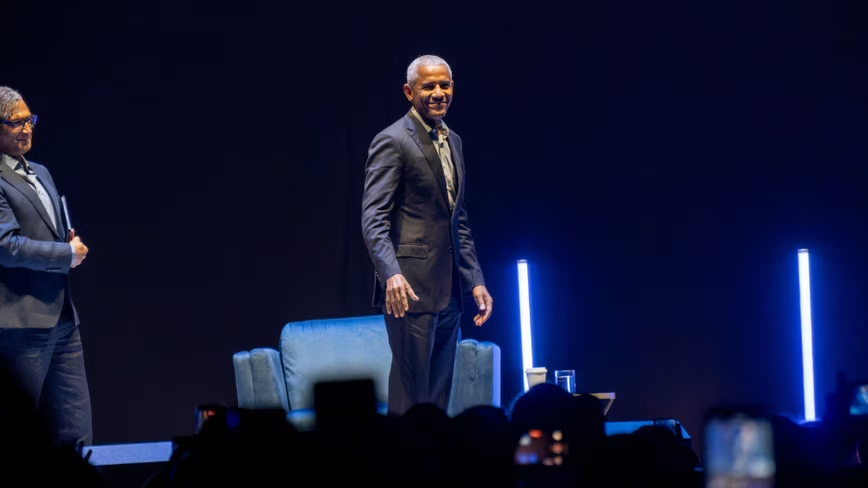
The former president told a Democratic fundraiser that AI belongs at the center of the party's agenda. He did not say what a framework would require. The week's one operational commitment came from OpenAI.
The Product Desk · Product desk
What happened
- Obama said Democrats need to make artificial intelligence one of their central agendas and have a very clear plan for its economic impact and safety, the New York Times reported.
- The remarks came at a closed Democratic fundraiser last Thursday, and reached the public because Obama's office released a partial transcript that the New York Times reported on Saturday.
- Anthropic CEO Dario Amodei outlined an approach he called pacing the frontier on Saturday, proposing independent safety evaluator access to leading companies and models plus common safety standards between them.
- Trump told reporters at an Irish golf event on Sunday that the US is the most sophisticated country in the world and he wants to keep it that way because whoever wins AI wins, Bloomberg reported.
- Jeffries said in a statement that Obama is correct that decisive action must be taken on artificial intelligence, and that Republicans have abdicated their responsibility to govern.
Compiled by The Product DeskSomething wrong?How this is made
Why it matters
- constraint A team trying to staff a compliance line item this quarter cannot scope the work off the former president's remarks, because the framework's first gate is an election result and its second is a platform fight.
- contradiction The administration is pushing a single national standard that preempts state rules and has asked the G20 not to build AI governance institutions, so a US vendor cannot prepare for both agendas with the same work.
- exposure The frontier review rules already in use are secret and the firms that have read them are the large incumbents. Smaller model vendors would learn the requirements last, after the incumbents have shaped them.
- decision A buyer drafting an AI addendum can now put third-party evaluator access in the terms and point at a vendor's own public words if it is refused.
One statement this week describes something a company would have to do differently. Sam Altman said OpenAI would commit to "having independent evaluators with employee-like access" [11]. That puts an outside party inside a pre-release path, with the access level defined by comparison to staff. Altman and Musk both responded positively to the Anthropic proposal in social media posts [12].
Obama's contribution was procedural, and he attached it to Jeffries winning the speakership. "Once you are speaker, I would strongly urge that the Democrats put together a framework for a very public conversation," Obama said [4]. He also said AI is "moving very fast in private hands, and if we don't get on top of it, I think it can be dangerous" [5]. According to The Next Web, the remarks did not include a regulatory mechanism or a position on jobs [6].
The timeline has two gates. Jeffries becomes speaker only if Democrats take the House, and that question is settled on 3 November [8]. Obama also wants AI written into the party platform and made central to the 2028 presidential campaign, with candidates carrying plans that address safety and economic disruption [7].
Count the governance mechanisms named across the week and you get two, both from AI company executives [23]. They are commitments, and the party offering them also drafts the access agreement. The New York Times reported that Obama has offered himself as a "sounding board" to AI executives and has spoken to Amodei and Altman [22].
The federal posture points elsewhere on substance. The administration's legislative framework earlier this year would preempt state laws and shift the child safety burden to parents [16]. Trump, discussing safety with reporters on Sunday, said "we can put guardrails" and that "you have a lot of negative forces that are bringing it up that shouldn't be bringing it up" [15].
The AI governance backlog sorts into two columns. Column one holds items a customer contract or a vendor commitment can already require this quarter: evaluation evidence, and a named third party in the release path. Column two holds items that need a statute, and labor-impact reporting belongs there.
The demands with dates attached are coming from inside the industry. An AI researcher resigned from Anthropic and said the leading companies are "racing straight to self-improving superintelligence and gambling with our lives" [13]. OpenAI has asked Congress for rules making national safety requirements mandatory before it adjourns [19]. More than a thousand people who work at AI companies signed a letter asking the US government for a way to slow the technology down [20]. House Democrats have separately been pressing OpenAI on whether it can shut its own systems off [21].
What to watch
- Whether Democrats take the House on 3 November, the condition Obama attached to his framework.
- Whether OpenAI's request for mandatory national safety requirements before Congress adjourns produces bill text.
- What an independent evaluator's employee-like access actually covers when the first agreement is written.