Security3 publishers2 min readPublished
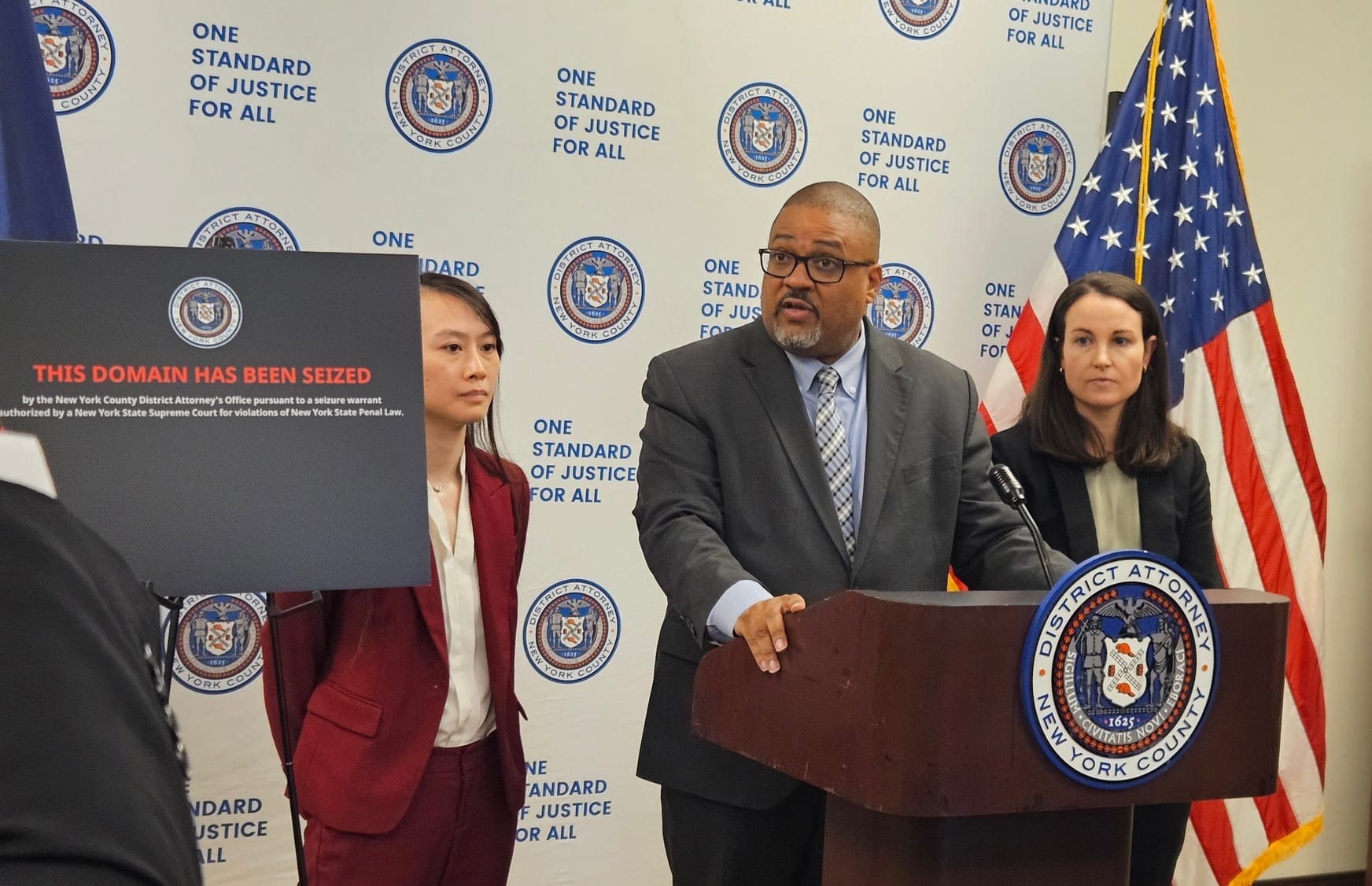
Bragg seized 12 deepfake porn domains on the theory that loading in Manhattan is enough
Alvin Bragg's office took the sites offline by court order and says about 1,200 people were depicted without consent. It will not say whether anyone will be charged, and the legal hook is a 2023 New York statute.
The Watch · Security desk
What happened
- The Manhattan District Attorney's Office seized 12 domains it says were used to create, sell and distribute AI-generated sexual videos of about 1,200 real people without their consent.
- Those depicted were overwhelmingly women and largely public figures, including actors, politicians, athletes, musicians, social justice advocates and social media influencers, according to the office.
- The office called the action the largest known seizure of websites dedicated to AI-generated celebrity deepfakes to date, and said the sites explicitly promoted AI-generated content.
Compiled by The WatchSomething wrong?How this is made
Why it matters
- exposure On the standard Bragg gave reporters, a deepfake site is reachable by a New York prosecutor if the site is reachable from Manhattan, whatever the location of the operators or the hosting.
- constraint Because the order reaches names rather than content, the office has committed itself to open-ended policing: each new domain the operators register is a separate piece of work.
- decision Bragg's framing invites a caseload beyond celebrities, and domestic violence victims threatened with synthetic images now have a stated route into the Cyber Crime Bureau.
- precedent Two seizures in the same year make taking the domain the opening move against these operations, with charging decisions deferred behind an ongoing investigation.
New York criminalized sexually explicit deepfakes in 2023, and Bragg pointed to that legislation when reporters asked which law his office was acting under [7]. The reach he described at the press conference does not depend on where the operators sit. "If you let us know that an image has been posted without your permission, without your consent, we can take action as long as that website is accessible from Manhattan," Bragg said [8]. He also said his office knows of domestic violence cases in which partners threatened to release deepfake images of victims [25].
The office did not release the names of the 12 sites [11]. Bragg declined to say whether arrests or charges will be pursued, telling reporters only that the investigation is ongoing [9]. Asked whether images of minors were among the material, he gave the same answer [10]. Assistant District Attorneys Lotus Ho and Katherine Ellis are handling the case [23].
The court order covers domain names [2]. Bragg said the office would keep monitoring the sites and try to take down any attempt to revive the platforms on new domains [12]. Revivals get found and removed one at a time. The largest site in this category, the hosting site and forum MrDeepfakes.com, shut down in May 2025 after an investigation by the Canadian Broadcasting Company, Der Spiegel and Bellingcat [13].
In June, the Justice Department and Homeland Security seized two domains publishing thousands of digitally forged images and videos depicting famous women without their consent [14]. Add Monday's 12 and the publicly announced US total across the two actions is 14 domains [15]. Spread evenly, the roughly 1,200 people Manhattan identified work out to 100 per site, and that assumes nobody appeared on more than one [16]. The Record reported more than 1,200 people; the D.A.'s office and 404 Media put the figure at approximately 1,200 [3][1].
Every enforcement action in this record aims at operators, developers or a tool provider. Microsoft sued six developers last year over the use of its Azure OpenAI services to create non-consensual intimate images of celebrities [18]. The European Commission opened an inquiry into X earlier this year after its Grok tool was used to create sexual images of a minor [19]. Earlier this month the first man convicted of violating the Take It Down Act was sentenced to 15 years, after investigators found more than 3,000 real and AI-generated abuse images on his devices [20]. Bragg's office asked people who believe they were affected to call its Cyber Crime Bureau at 212-335-9600 [21].
What to watch
- Whether the case is charged in New York or referred to federal prosecutors under the Take It Down Act.
- Publication of the 12 site names would let hosts and payment processors cut the operators off without a court order.
- Whether another state prosecutor uses Bragg's accessibility standard against a site hosted outside the United States.