Product1 publisher2 min readPublished
Groningen slows hot-electron cooling a thousandfold in tin perovskite
A Groningen lab measured hot carriers in a tin perovskite staying hot for nanoseconds instead of picoseconds, and its simulations trace the delay to two crowding effects that block the usual path down.
The Product Desk · Product desk
What happened
- A University of Groningen lab slowed the cooling of high-energy hot electrons in a tin-based perovskite by a factor of 1,000, stretching the window in which the extra energy survives from picoseconds to nanoseconds.
- On the group's account, the most energetic photons create hot electrons that normally cool within fractions of a trillionth of a second, dumping the bonus energy as waste heat inside the cell.
- The material has an unusually low electron mass, so charges move quickly and hold on to extra thermal energy for longer, according to the group.
- According to the report, commercial solar panels that harvest this lingering heat are still a ways off.
Compiled by The Product DeskSomething wrong?How this is made
Why it matters
- capability At nanosecond lifetimes, getting a hot carrier out of the material becomes a contact-design problem rather than a race against cooling, and Koster puts the loss squarely before the electron exits.
- constraint A carrier lifetime cannot be converted into watts, so nobody can move a line in a module cost model on the strength of this measurement.
- decision Groups holding a tin perovskite budget now have a specific next experiment to fund: collecting current during the nanosecond window. The team lists that among its open questions.
- precedent Designs that assume more than 33 percent from a single junction now have a measured lab result to cite in a proposal. Reviewers get a different starting point for what they will accept.
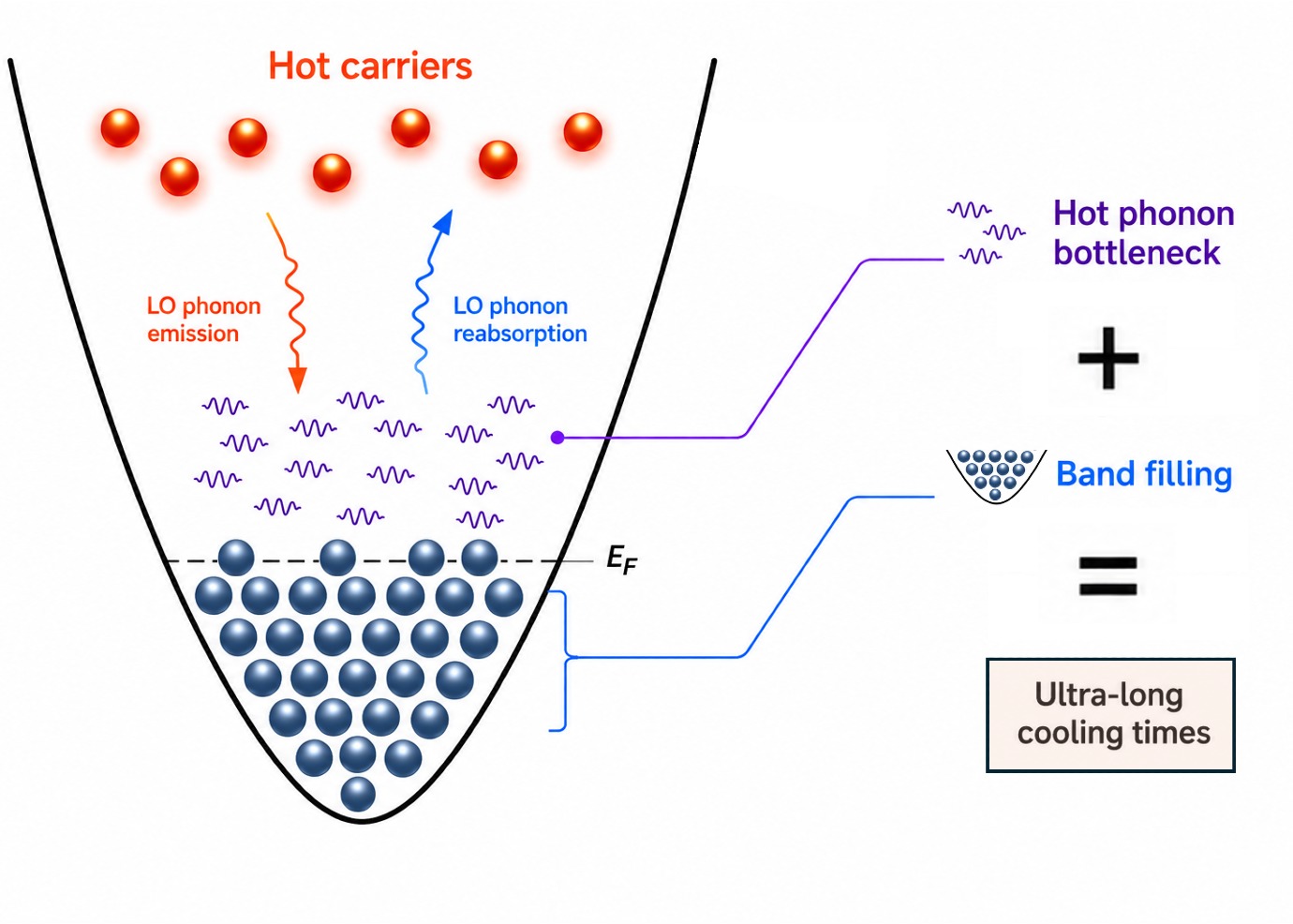
Two effects stall the cooling, and both depend on the material being crowded. In the hot-phonon bottleneck, the electrons shed heat into their surroundings so fast that the surroundings warm up and the electrons reabsorb their own lost thermal energy [6]. In the Burstein-Moss effect, the lower-energy states an electron would normally drop into are already occupied by excited electrons, so the path down is blocked [7]. Koster and PhD student Tim Faber built the simulations that found the pair [5].
The size of the claim checks out against the units. A picosecond is a trillionth of a second and a nanosecond is a thousand times longer, so slowing picosecond cooling by a factor of 1,000 lands you in nanoseconds, which is where the lab measurement landed [2][15]. The Ensemble Monte Carlo model reproduced the same nanosecond delay that the time-resolved photoluminescence work had seen [8][9]. Koster said of the early data: "We even started to doubt the measurements ourselves." [4]
The 33 percent figure is the pitch. "There are many other questions that still need answers, but in theory, this discovery could allow the creation of more efficient solar cells, beyond the theoretical limit of 33 percent," the team stated [10]. What has been done is a lifetime measurement on a tin-based perovskite and a model that explains it, and the group did not report a fabricated cell or an efficiency number [9][16].
So this is not yet a module story for anyone signing a supply contract. Interestingengineering.com described the slowdown as a feat many thought impossible [14].
Whether a hot-carrier result belongs in a plan depends on what was measured and under what light. Was it a carrier lifetime, or charge actually collected at a voltage the cooled carriers could not have produced? Groningen reports the lifetime [2]. Then there is the illumination it was measured under, since both described effects are crowding effects and a panel in a field sees a different excitation level from a bench measurement [6][7]. For a nanosecond number to mean anything in a device model, it has to come with that condition attached.
The step that is still open sits in Koster's own description of the loss. "This means that the energy is lost before the hot electron exits the solar cell material," said Koster, professor of physics of novel semiconductors and devices at the University of Groningen [3].
What to watch
- Whether a lab outside Groningen reports nanosecond hot-carrier lifetimes in the same tin-based perovskite family.
- Whether the Groningen group moves from film-level measurements to a fabricated cell with a reported efficiency.
- Whether follow-up work publishes how the cooling time varies with excitation density.