Loading today’s stories
Science1 distinct publisher3 min readUpdated
The Sun's real worst case is written in tree rings, not in the instrumental record
A carbon-14 spike of about 12 parts per thousand in AD 774-775 implies a storm roughly ten times Carrington. Planning against Carrington means planning an order of magnitude short.
The Scientist · Science desk
What happened
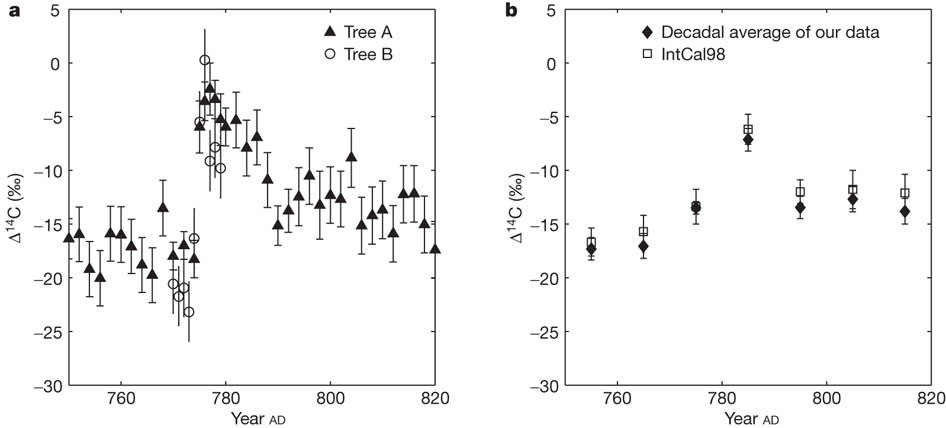
- Between AD 774 and 775 the proportion of carbon-14 in ancient Japanese cedar rings jumped by about 12 parts per thousand, roughly 20 times larger than the change expected from ordinary variation in the Sun.
- In 2012 Fusa Miyake was studying slices of ancient Japanese cedar taken from a tree felled in the 1950s that had grown on Yakushima Island, and spotted the carbon-14 jump.
- Tree rings are annual records of Earth's atmosphere, and the relative proportion of carbon-14 in each ring reveals how active the Sun was that year.
- Measurements of beryllium-10, another radioisotope, in ice cores confirmed Miyake's discovery.
- Other teams found the same AD 774 signal in trees from North America and Europe, addressing concerns that it was a laboratory artifact or something peculiar to Japanese cedars.
Compiled by The ScientistSomething wrong?How this is made
Why it matters
Two adjacent rings in a Japanese cedar record a carbon-14 jump of about 12 parts per thousand between AD 774 and AD 775, roughly 20 times the change expected from ordinary variation in the Sun [1]. That matters because the 1859 Carrington event, the benchmark for solar violence ever since it burned telegraph lines across Europe and North America, was not strong enough to leave a clear carbon-14 signature in tree rings at all [7][8][9].
The arithmetic is unkind. To mark the atmosphere the way AD 774 did, the Sun would need to produce a storm ten times larger than Carrington, a superflare [9]. So an organisation that has sized its contingency to Carrington has sized it to roughly a tenth of the largest event the paleorecord actually contains [21]. The instrumental era does not help here: nothing like the AD 774 storm has occurred during the space age, when the Sun has been watched up close by satellites [22].
The provenance of the signal is better than the phrase "tree rings" suggests. Rings are annual records of the atmosphere, and the proportion of carbon-14 in each one tracks how active the Sun was that year [3]. Fusa Miyake found the AD 774-775 spike in 2012 in slices of cedar felled in the 1950s on Yakushima Island [2]. Beryllium-10 in ice cores confirmed it [4], and other teams recovered the same signal from trees in North America and Europe, which rules out a laboratory artifact or a quirk of Japanese cedar [5]. A nearby supernova, a gamma-ray burst and a neutron star blast were all considered and rejected because the candidate sources were too distant [6], leaving the Sun.
Then the counting began. Miyake's team found a second spike the following year in cedar and cypress, confirmed in European oak and Siberian larch [13]. An AD 664 event was identified in 2017 from Greenland ice-core beryllium-10 and matching carbon-14 in Polish oak [14]. A 2022 study led by Nicolas Brehm swept a global tree-ring dataset spanning thousands of years and surfaced two more at once, pushing the phenomenon into prehistory [15]. In 2023 researchers reported the largest confirmed event of the set [16]. Five events have been added since Miyake's first, giving six known so far, at a rate of roughly one every 2,000 years [10][19] - on that recurrence, about a 5 percent chance in any given century [20].
Two consequences follow. First, these events are a problem for solar physics, not just for engineers: current models hold that stars like the Sun are not supposed to produce anything that energetic [11]. Second, and more operationally relevant, the source reports new evidence that lesser storms, still several times more powerful than Carrington, may occur far more often than previously thought [12]. A one-in-2,000-year superflare is a hard sell in a capital plan. A several-times-Carrington event with a shorter return period is not, and it is the one that sets realistic design margins for transformers, satellite electronics and high-frequency communications.
Worth watching: whether the sub-Miyake population firms up into a dated, quantified frequency distribution, because that is the number resilience planning can actually use.
Loading topic controls
Loading related stories