Science1 publisher2 min readPublished
Qualcomm's new audio chip puts always-on AI assistants in earbuds that work without a phone
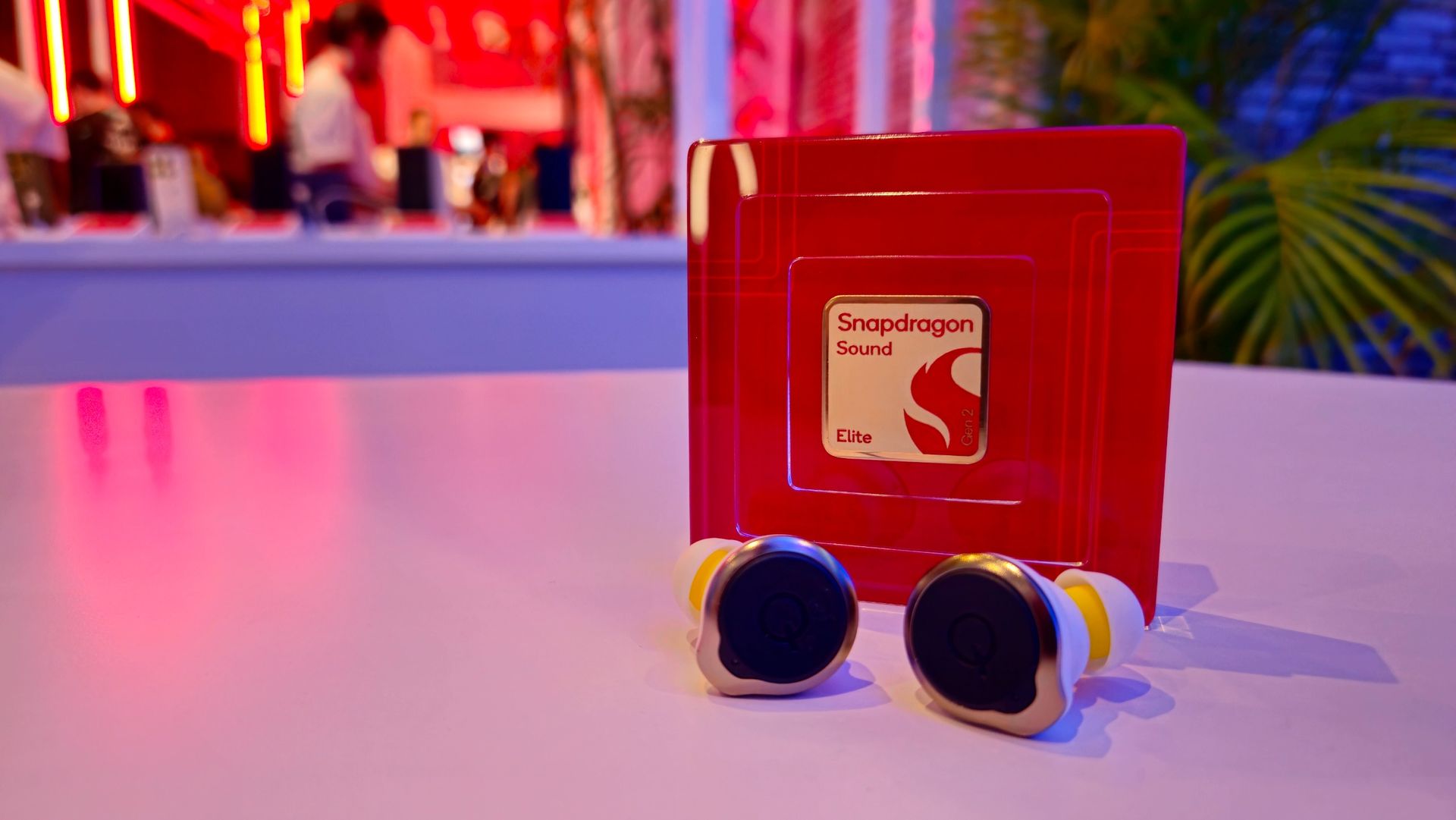
Qualcomm's Snapdragon Sound Elite Gen 2 chip lets earbuds and other wearables host apps and act on voice requests without a smartphone connection. Its always-on assistant also profiles the wearer's surroundings from audio and, on camera buds, video, at a battery cost Qualcomm has not quantified.
The Scientist · Science desk
What happened
- Qualcomm announced Snapdragon Sound Elite Gen 2, an AI audio chip for wearables, at its annual Snapdragon Summit in Maui, held Sept. 21-24.
- Devices built on it can host apps in their own memory and act on spoken requests, such as calendar entries or online purchases, without a smartphone connection.
- A feature Qualcomm calls contextual awareness would constantly monitor the wearer's surroundings and add what it gathers to a personal profile used to answer later queries.
- The chip is built to work with cameras, including earbuds with built-in lenses that passively capture footage as the wearer goes about the day.
- Qualcomm wants the chip in over-ear and open-ear headphones, audio glasses, camera buds and hearing devices, plus future AI pendants and clips.
Compiled by The ScientistSomething wrong?How this is made
Why it matters
- exposure People near a camera-bud wearer feed someone else's AI profile without choosing to, and whether they stay unidentified depends on the mask catching every person in frame.
- constraint Leaving the phone behind still ties cloud assistants to Wi-Fi, so the independence Qualcomm describes holds fully only where a network is in range.
- contradiction Battery life is where buyers will test the no-compromise pitch first, since Qualcomm's own product manager expects users to feel the drain of always-on use.
Every performance claim here is Qualcomm's, made at its own launch event [1]. By the company's account, two kinds of machine learning share the chip. Adaptive noise cancellation, the feature that can let a siren or a nearby voice through while blocking everything else, runs on standard machine learning algorithms, not the transformer-based large language models behind systems like ChatGPT [9]. The assistant, transcription, translation and the contextual-awareness profile run on an on-device accelerator Qualcomm calls an eNPU, part of what it markets as "always-on intelligence" [5]. Cloud services such as ChatGPT sync when the device is connected to Wi-Fi [3].
The radio link is a stated compromise. To reach a phone or computer, the chip adds micropower Wi-Fi alongside Bluetooth. That link draws much less power than standard Wi-Fi, at the cost of higher latency and lower peak speeds [10]. For music, Qualcomm representatives said, Wi-Fi generally improves playback quality because Bluetooth compresses data in transit [11], and a separate subsystem could carry lossless streams [12]. Latency costs little when a track is buffering. It costs more in a spoken exchange, where the wearer waits for each reply.
On privacy, the company's answer is about the camera. Qualcomm representatives said lenses on future earbuds would be low resolution and would not identify specific individuals, because an AI mask automatically obfuscates them [8]. That describes intended behaviour. A mask has to detect a person before it can hide one, so its protection depends on how often it misses, and Live Science's account of the summit does not include a miss rate or any test of the mask [8]. The assurance, as reported, concerns the lenses. The system that builds the profile is audio-centric [7].
Battery is where Qualcomm's messages diverge. Representatives said device makers will no longer need to choose between audio quality, AI features and battery life [14]. Andrew Laister, a staff product manager at Qualcomm, said in a media Q&A that there is likely to be an impact on how users experience battery drain [15]. He contrasted the new devices with conventional earbuds, which are used sporadically for calls and music playback [15].
What to watch
- Battery-life figures from the first shipping earbuds or glasses built on the chip, measured against conventional non-AI devices.
- Any published test of how often the AI mask on camera buds fails to obscure a person, and whether unmasked footage is stored anywhere.
- Which device makers adopt the chip for camera buds or audio glasses, and whether contextual awareness ships switched on by default.