Product1 publisher2 min readPublished
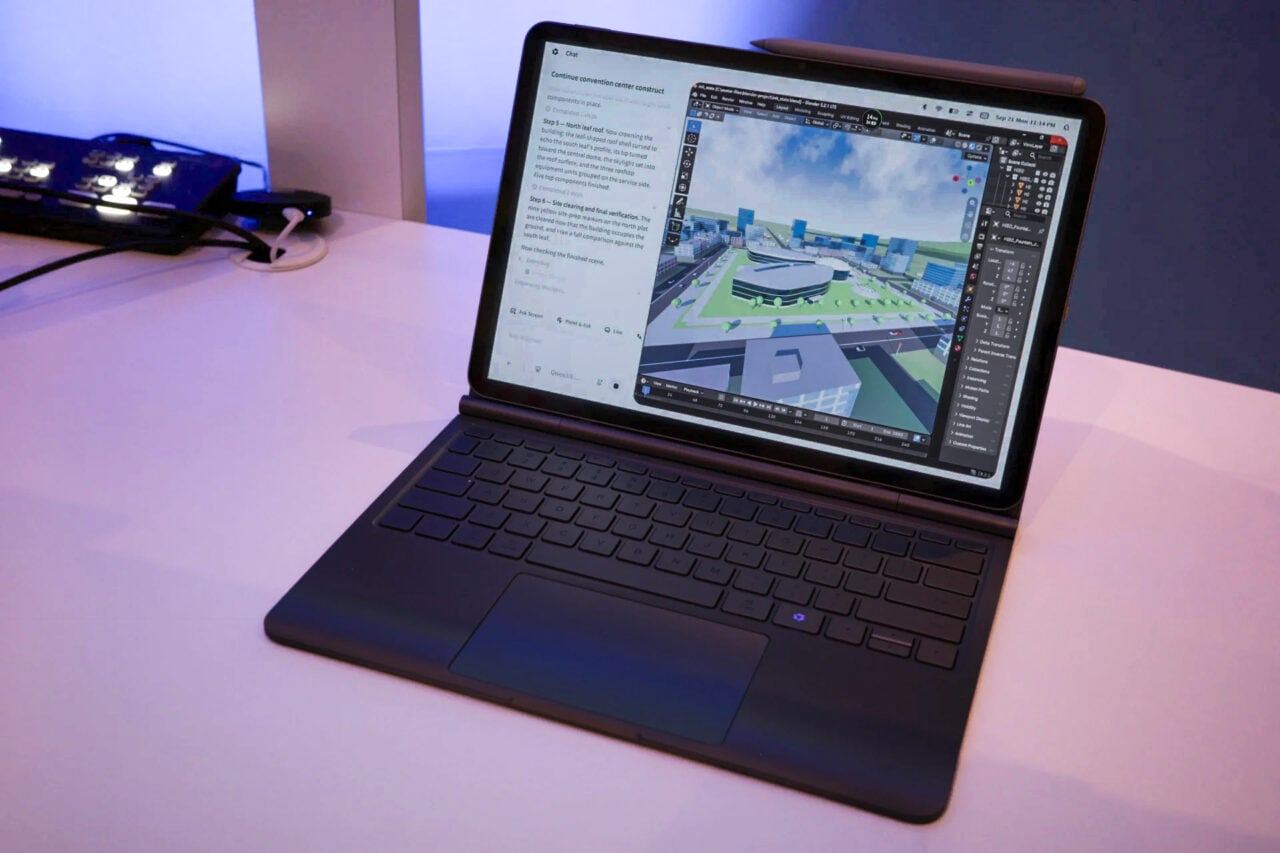
Alibaba's QwenBook routes Windows, Android and Linux apps through a chatbot
Qwen's chat interface is how you open apps on the QwenBook, whether they belong to Windows, Android or Linux. The staff demonstrating it at Snapdragon Summit could not say how the AI reaches those environments.
The Product Desk · Product desk
What happened
- Alibaba showed an AI-centric laptop called the QwenBook at Qualcomm's Snapdragon Summit, a tablet that magnetically attaches to a keyboard mount and ships with a stylus and a dedicated AI key.
- The chatbot interface is how users are meant to operate the machine and open apps, including Windows, Android and Linux apps running at the same time.
- Several models run on the device itself, while the largest, Qwen3.8-Max, is reached through the cloud; Alibaba puts that model at 2.4 trillion parameters.
- Gizmodo's hands-on came on a trip whose travel and lodging Qualcomm paid for, with no coverage guaranteed as a condition of going.
Compiled by The Product DeskSomething wrong?How this is made
Why it matters
- constraint When an app fails to appear on a machine like this, the person supporting it has to debug a model's decision, because there is no visible process running locally to inspect.
- decision Anyone shopping AI-native hardware now has a question to put to the sales engineer: how much direct control does a user keep over each environment. Alibaba's answer on the floor was that it could not say.
- precedent The Humain laptop set the pattern a year earlier, dedicated key and all, and then went quiet, so a summit demo of an AI-first PC is weak evidence that anything ships.
Alibaba's name for the design is "OS as a harness" [8]. In practice, Gizmodo's hands-on found no sign that the machine runs those environments in simultaneous emulation; the processing appears to happen on the backend, with the 2-in-1 displaying Qwen's output [7]. The people running the demo could not explain how the AI was reaching each separate OS environment, and Alibaba could not say how much direct control a user has over the Windows, Android or Linux side [7][8]. Gizmodo called the machine "equal parts intriguing, baffling, and exasperating" [3].
What is native is short and specific: a Linux terminal, plus a few calendar and camera apps [9]. Google's Googlebooks, by comparison, run a Linux terminal only as a virtual machine and cannot run Linux apps at all [15].
The silicon is a generation behind the summit it turned up at. Alibaba used Qualcomm's Snapdragon 8 Elite Gen 5, last year's flagship Android chip [10]. Qualcomm's newer Snapdragon 8 Elite Extreme Gen 6 is supposed to run midrange AI coding models directly on the device [11].
Alibaba described more than it showed. Vibe-coding new apps into the OS, agent tasks that keep running with the laptop closed, the small rear screen that signals a task in progress, and a phone app that starts tasks remotely were all talked about and not demonstrated [12]. None of those four was seen working, and they carry most of the AI-native claim [13].
Whether the apps your users depend on run on the hardware in front of you or on a server somewhere is the first thing to check. The second is what is left on screen when the model cannot be reached. Those two checks separate an AI-native pitch from a computer someone can support, and you can run both on a show floor. Alibaba's own staff had no answer to the first about their own device [7], and on the second the honest answer here is a terminal and a couple of small native apps [9].
Qualcomm brought a Humain laptop to last year's event, a Snapdragon X2 Elite machine whose selling point was a specialised Windows wrapper and a dedicated Humain key for an agentic chatbot, and Gizmodo has heard nothing about it since [14]. Gizmodo expects the QwenBook will not reach the US in any form [17].
What to watch
- Whether Alibaba publishes a price, a ship date or a target market for the QwenBook.
- Any documentation of how the Windows, Android and Linux environments are hosted, and whether a user can address them directly.
- Whether the vibe-coding and lid-closed agent features are ever demonstrated running rather than described.