Product1 publisher3 min readPublished
Qualcomm bets its 2nm Snapdragon chips on AI agents that run on the device
Qualcomm launched two 2nm Snapdragon 8 Elite Gen 6 phone chips in Maui and pitched them for on-device AI agents, with an NPU up to 35% faster. The standard chip's NPU gains 14%, so agents meant for the widest set of phones get the smaller jump.
The Product Desk · Product desk
What happened
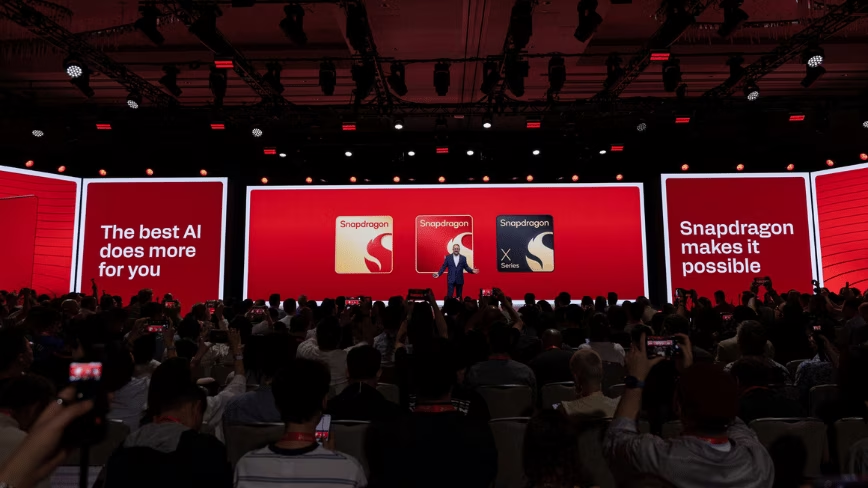
- Qualcomm launched the Snapdragon 8 Elite Extreme Gen 6 and 8 Elite Gen 6 at its Maui summit, both built on a 2nm process by TSMC.
- Qualcomm says the chips' NPU handles context windows of up to 32,000 tokens and mixture-of-experts models above 30 billion parameters, for agents that run on the phone.
- Phones with the new chips will come from nine brands, including HONOR, Motorola, OnePlus, OPPO, vivo and Xiaomi.
- Qualcomm also launched a chip for AI earbuds and glasses, plus START, a glasses chip package paired with phone and cloud software.
- Qualcomm's X2 laptop processors are getting Linux, with Debian support by the end of this year and Ubuntu certification targeted for the first half of 2027.
Compiled by The Product DeskSomething wrong?How this is made
Why it matters
- decision Phone makers now pick an AI tier model by model, and Xiaomi's plan to use both chips means one brand's lineup can carry two different agent ceilings.
- exposure Personal Scribe gathers messages, emails and conversations into one knowledge graph, so its privacy promise depends entirely on that graph never leaving the phone.
- constraint A forecast shipment drop shrinks the pool of new phones any Gen 6 agent can reach this cycle, whichever of the two tiers a developer targets.
- constraint Teams selling Linux software for Qualcomm laptops have no OEM Linux machines to ship on until 2027, months after Debian support arrives.
The most concrete thing in Qualcomm's agent pitch is a phone that reads your messages, emails and conversations and files what it learns. The feature is called Personal Scribe. It runs on a new Sensing Hub with two small NPUs and builds a private knowledge graph on the device, Qualcomm said [9]. Start-ups on stage showed variations: memories.ai demonstrated a visual memory that indexes a user's day locally, and AGI Inc. showed an agent that reads the screen and acts across apps [10].
"We're going into this transition from what is a very phone-centric model to now an agentic-centric model for new experiences," chief executive Cristiano Amon said, according to CNBC [11].
Here's what teams tell themselves users want: an assistant that knows their inbox and operates their apps for them. Here's what the summit offered as evidence: staged demos and benchmark runs [10][16]. Neither report includes a usage or retention figure for any on-device agent.
The benchmarks came from Gizmodo's Kyle Barr, who tested Qualcomm's reference phones at the event. They beat Apple's A20 Pro by 8% on multi-core Geekbench and by about 20% in 3DMark graphics tests [16]. Apple kept a lead of about 10% on single-core scores, and the test phones ran hot, Barr wrote [16].
For a team building an agent, the more useful numbers are the ones that separate the two chips. Against last year's Snapdragon 8 Elite Gen 5, Qualcomm gives the Extreme a 13% faster CPU, a 44% faster GPU and a 35% faster NPU, while the standard chip gets 10%, 35% and 14% [12]. On the NPU, the part that runs AI, the Extreme's gain is 2.5 times the standard chip's [1]. Only the Extreme gets Adreno Neural Fusion, the AI upscaling and frame generation that more than 20 game studios and partners are working with [13].
The two reports also place the agent figures differently. One lists the 30-billion-parameter capability under the Extreme chip [24]. The other presents the NPU's context window and model size inside a pitch aimed at both chips [3]. A developer shipping one agent across both tiers should measure those limits on the standard chip before promising them to anyone.
"By designing two innovative platforms, we're giving OEMs greater choice as we collectively shape the capabilities of the next generation of intelligent, personalized, mobile experiences," said Chris Patrick, Qualcomm's general manager of mobile handsets [15]. The first named Extreme devices are vivo's iQOO 16 and iQOO Pad Ultra and RedMagic's 12Pro+, and Motorola said it is putting the Extreme in its flagships for the first time [19]. They arrive as memory shortages push phone prices up. Counterpoint Research expects smartphone shipments to fall 14% in 2026 [17].
Laptops arrive on a different schedule. Dell and HP Googlebooks with the Snapdragon X Elite went on pre-order on 21 September [21]. Microsoft's new Surface Pro 12-inch and Surface Laptop 13-inch run the X2 Plus [26]. HP, ASUS and HUMAIN plan Linux devices in 2027 [7]. Chris Lattner, who joined Qualcomm through its Modular deal, presented Modular's AI software as a single layer across Snapdragon chips [22].
I would build for the standard 8 Elite Gen 6 as the floor and treat the Extreme's extra NPU gain and Neural Fusion as upgrades [12][13]. The tradeoff is that the best version of any feature then runs on only a subset of Gen 6 phones.
To place a single feature, apply two tests: whether it runs on the lowest tier of hardware you target, and whether that hardware ships before your next release. A phone agent that passes both gets built now. A Linux tool for X2 laptops passes the first test and fails the second, so prototype it and time the release to the 2027 machines [7]. A feature that needs the Extreme on phones already shipping gets priced as a premium tier. Anything that fails both stays on the roadmap.
What to watch
- Whether Qualcomm or phone makers publish the context window and model-size limits for the standard 8 Elite Gen 6 separately from the Extreme.
- Whether Canonical's Ubuntu certification for the X2 lands in the first half of 2027 as targeted, since customer-facing Linux releases wait on it.
- When High Bandwidth Compute, with Samsung and SK hynix stacking memory on the AI processor, reaches a Snapdragon phone or laptop, according to The Elec's account of Amon's plan.