Science1 publisher2 min readPublished Updated
Faults on Katalyst's LINK spacecraft end the attempt to save NASA's Swift observatory
NASA's Swift observatory, in orbit since 2004, will re-enter by year's end after the Katalyst spacecraft sent to boost it developed faults in orbit. NASA now presents the year-long effort as practice for fast commercial satellite servicing.
The Scientist · Science desk
What happened
- NASA hired Flagstaff-based Katalyst in September 2025, giving it about a year to design, build, test and launch a craft that would meet, grab and lift Swift.
- Katalyst's LINK spacecraft launched in July on a Northrop Grumman Pegasus XL from Kwajalein Atoll in the Marshall Islands.
- After initial checkouts in orbit, LINK began losing communications intermittently and developed problems controlling its orientation.
- After around-the-clock troubleshooting, NASA and Katalyst dropped the grab and boost and switched LINK to technology demonstrations.
- NASA ended its involvement on Sept. 3, and LINK itself re-entered the atmosphere on Sept. 25.
Compiled by The ScientistSomething wrong?How this is made
Why it matters
- cost Swift's science pays for the failure: an observatory that has studied gamma-ray bursts since its 2004 launch will close its mission when it falls.
- constraint LINK's three-arm capture design was never tried against Swift, so any future servicing bid built on it will begin with no data on capturing a real target in orbit.
- precedent NASA now has a tested path for deadline-driven work: a proposal call in a few months, SBIR concept studies, and fast approvals written with the vendor. It can reuse that path for the next satellite facing re-entry.
The deadline came from the atmosphere. Every spacecraft in low Earth orbit feels drag, and one without propulsion gradually loses altitude to it [6]. A period of increased solar activity made that effect worse for Swift [6]. NASA's predictions had the observatory sinking to its point of no return, about 300 kilometers up, in fall 2026, and the agency says all of its decision-making and risk acceptance hinged on that forecast [15].
That date set the pace for everything else. NASA had only a few months to issue a call for proposals through its Center of Excellence for Collaborative Engineering and to fund concept studies through the Small Business Innovation Research program [7]. Katalyst chose the Pegasus XL as the best launch option for the compressed schedule [9]. Swift's operations team at NASA's Goddard Space Flight Center worked out milestones and approval steps with the company, designed to be flexible enough to move quickly toward launch [16]. NASA's Engineering and Safety Center advised both groups during integration [17].
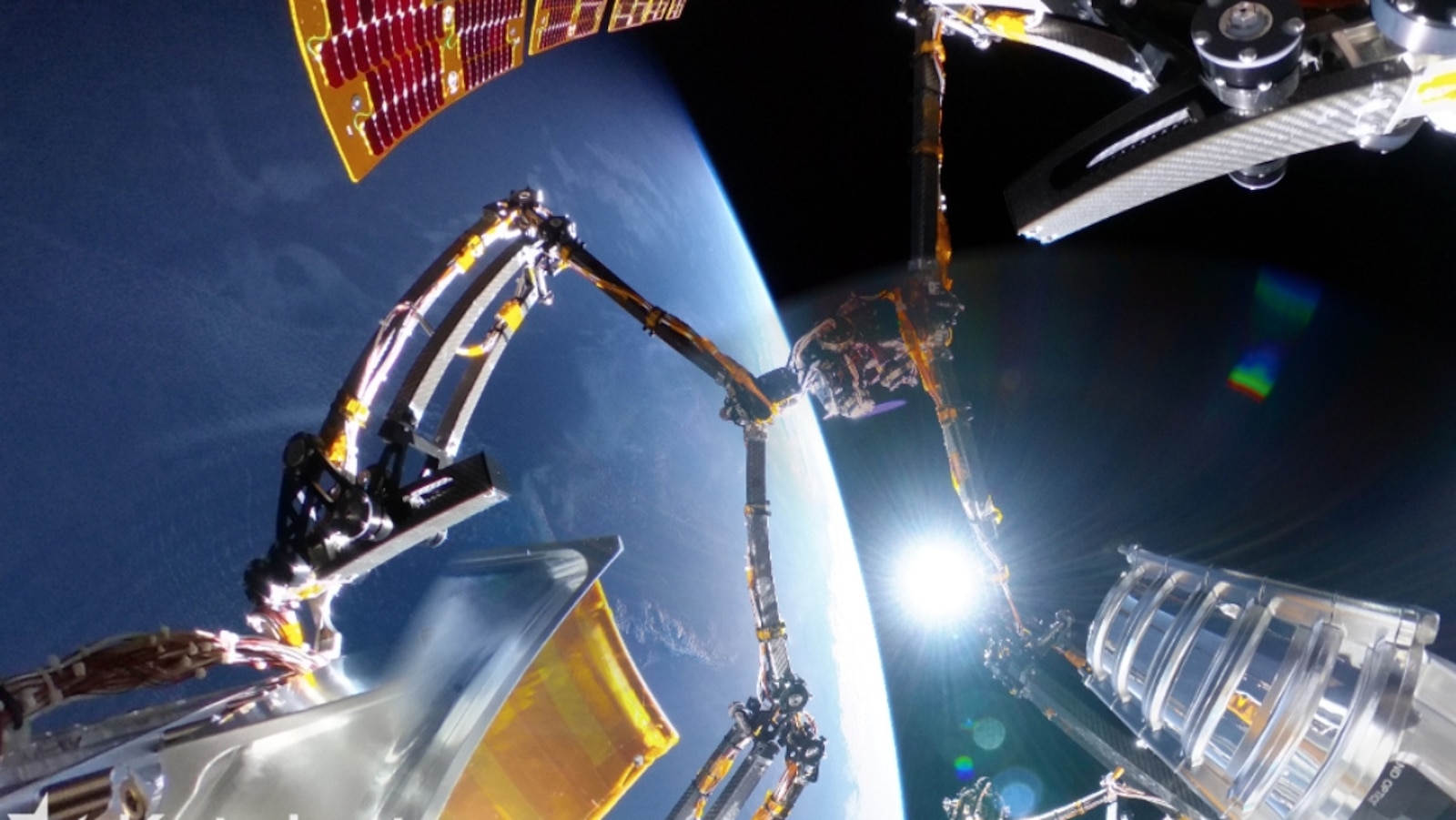
The communications and orientation faults were in basic spacecraft functions, and they arrived before LINK had tried to grab or move anything [10][11]. Its three robotic arms were designed to give it choices about where it could safely take hold of Swift [12]. In the demonstrations that replaced the rescue, the arms and the xenon-powered propulsion system were exercised on their own [12][11]. NASA's account does not report how those demonstrations performed.
I think the flight produced one clear result, and it concerns the calendar. Katalyst was given about a year to design, build, test and launch a servicer [8]. LINK reached orbit in July 2026, ahead of Swift's predicted point of no return that fall [1]. Ghonhee Lee, Katalyst's chief executive, measured it the same way. "This was an ambitious mission on an aggressive timeline. While we did not accomplish every objective we set out to achieve, in less than a year we went from mission concept to launching and operating the first commercial space robot," Lee said [14]. The "first commercial space robot" label is Katalyst's own claim.
"From the beginning, this was a high-risk, high-reward mission," said Shawn Domagal-Goldman, director of the Astrophysics Division at NASA Headquarters [3]. He tied the lessons to the next attempt. "We're very proud of how quickly this team got so far, and we're capturing lessons learned to ensure we're ready to go even farther," Domagal-Goldman said [18].
What to watch
- Whether NASA or Katalyst publishes how LINK's xenon propulsion and robotic arms performed in the demonstrations.
- The date Swift actually re-enters, compared with NASA's end-of-year expectation.
- Whether NASA runs another commercial servicing call using the compressed proposal and approval process built for LINK.