Science1 publisher2 min readPublished
Seventh-century builders in northern Sudan raised a church around a giant carving that may show a Kushite ruler
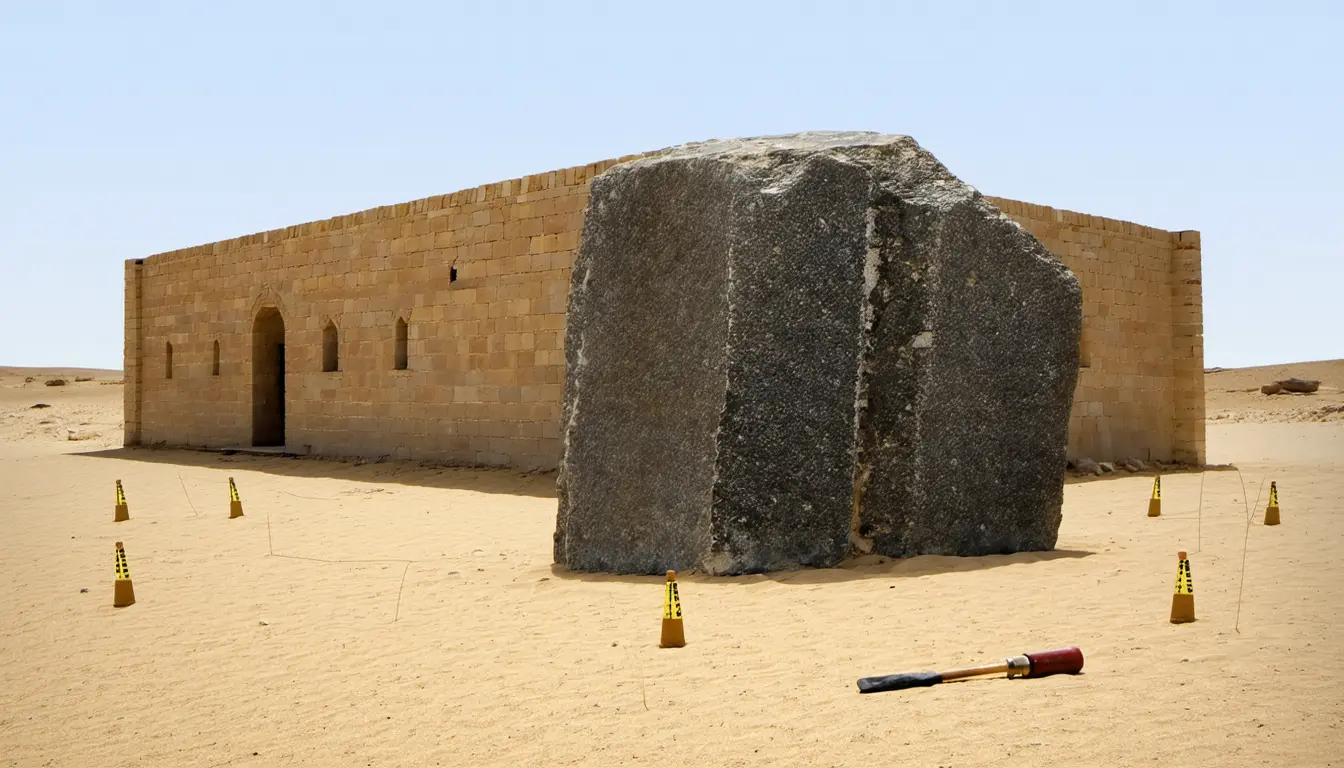
University of Warsaw-led archaeologists who surveyed nearly 300 sites at Miseeda, Sudan, say a 7th-century church was built around a much older rock carving. They suggest the figure may be a Kushite ruler marking a borderland, but the carving itself still needs a date.
The Scientist · Science desk
What happened
- Pottery from the area shows activity peaking in the Mesolithic, in the Late Neolithic/pre-Kerma period around 3000-2500 BCE, and in medieval Christian times.
- The granite hill around the church also bears carvings of lions, elephants and cattle, alongside later Christian crosses and carved ships.
- Local people told the team the church was once a pilgrimage site, but some now call it Beit Sheitan and regard it as both cursed and miraculous.
- The area's main sacred site today is a nearby shrine to a local holy man, Sheikh Kuman.
Compiled by The ScientistSomething wrong?How this is made
Why it matters
- constraint Until the petroglyph is dated, neither the Kushite identity nor the borderland reading can serve as evidence of where a Kushite frontier ran in the Mahas region.
- precedent A Kushite date would place Miseeda beside Gebel Qeili in a rare class of monumental ruler carvings in this part of Africa, giving later comparisons a second fixed point.
- capability A survey of nearly 300 sites with a dated pottery sequence gives the Mahas region an occupation record that a future date for the carving can be checked against.
Only one of the two monuments at the centre of the study has a date. The church went up in the seventh century CE [2]. The team, led by Joanna A. Ciesielska of the University of Warsaw, gives the figure inside it only a relative age in its Antiquity paper, calling it "much older" [3][13]. On an absolute date the authors are direct: "This reinforces the interpretation of the Miseeda representation as a marker of a borderland; however, a more precise date remains to be established," they wrote [8].
The Kushite reading comes from analogy. At Gebel Qeili, which the researchers treat as a similar monument, a giant carving shows Sherkarer, a named king of Kush [7]. The Miseeda figure is a life-size human figure cut into a granite hill [1]. Carvings like these are rare in this part of Africa [9], so one strong parallel carries much of the identification. The authors word their conclusion to match: the figure may depict a ruler and could have marked a borderland [10].
Continuity is a second inference. "The church at Miseeda, erected in the seventh century around the much older petroglyph, appears to have developed around a site that had retained social significance over millennia," the researchers wrote [3]. The observation is placement. Seventh-century builders put the church directly around the carving [2]. The motive is inferred from that. Placement fits the idea that the spot had mattered for a long time, but it cannot show what those builders knew or believed about the figure.
The survey pottery is the evidence that can test the idea. Its last two peaks of activity are about 3,000 years apart, from the end of the pre-Kerma phase around 2500 BCE to the start of the medieval Christian phase in the sixth century CE [6][1]. A peak is not an absence, and the phys.org account of the paper does not say how much material dates to the years in between. Any claim of significance "over millennia" has to span that gap. The hill itself was carved in more than one period [5].
I think the core observation is secure: a seventh-century church stands directly around a far older figure [2][3]. The Kushite borderland is a hypothesis, and a reasonable one given the Gebel Qeili parallel [7]. How far it goes depends on a date for the carving. If the figure falls in the Kushite period, the ruler and frontier readings gain real support. If it falls outside, the pairing of church and carving still stands, but the royal identification weakens.
What to watch
- A direct or stratigraphic date for the Miseeda petroglyph, which the authors say remains to be established.
- Fuller publication of the survey pottery showing whether the roughly 3,000 years between the pre-Kerma and Christian peaks saw steady use of the site.
- Newly recorded monumental figures in the region that strengthen or weaken the Gebel Qeili parallel behind the ruler identification.