Science1 publisher3 min readPublished
The average extraversion variant moves a person from the 50th percentile to the 50.35th, which is why the study's lead author says there is no personality gene, and why these numbers say nothing about scoring one individual.
The Scientist · Science desk

Compiled by The ScientistSomething wrong?How this is made
0.35 percentile points is the number to keep. It is the gap between the 50th percentile and the 50.35th, which the study reports as the average effect of one common variant associated with extraversion [3][1]. No personality questionnaire resolves a difference that small.
Signal at that scale is only visible against an enormous denominator, and the design assembles one: 46 cohorts, more than a million participants, each with a DNA sample and a completed questionnaire, which averages upward of 21,700 people per contributing cohort [2][3]. If percentile points simply added, it would take about 143 average-sized variants to carry someone from the median to the top of the distribution [2]. They do not add that way, so read the figure as a scale marker rather than a prediction. The researchers expect thousands more variants beyond the 1,200 they could resolve [8].
A relatives check anchors the design. A variant can look associated with a trait in a population sample because it travels alongside the household that also teaches the behaviour. Comparing results between relatives tests exactly that, and the team reports upbringing is unlikely to explain the associations, while still emphasising the importance of environment [5]. Ted Schwaba of Michigan State University, the lead author, put the headline finding as an absence: no single personality gene, but many variants together adding up to something more sizeable [4].
Openness to experience shows environment working through geography rather than upbringing. Variants linked to openness to experience predicted that a person would live in a more cosmopolitan area, which the researchers note could in turn reinforce the trait [6]. Part of what a personality-associated variant does in this data is predict where somebody ends up.
What is reported is the average effect of a single variant [3], not how well a summed score sorts individuals, and at the outcome end the relationships stay correlational: conscientiousness tracked lower substance use, more sport and a preference for lower-calorie food, and more conscientious people spent less time in hospital and aged more healthily [7]. That behavioural chain is plausible, and it is also the shape in which a trait score, a behaviour and a hospital record can all sit downstream of something the study did not measure. The associations were estimated in a sample described as mostly European [2], and how they behave in other populations is not part of what is reported.
So on the question of a personality gene, this is about as settled as human genetics gets: at least 1,200 loci, with the typical one worth about a third of a percentile point [1][1]. On the question of whether an aggregate score says anything actionable about a particular person, the reported findings supply effect sizes for variants, not accuracy figures for people.
Ranked by verification strength, evidence, and original report placement.
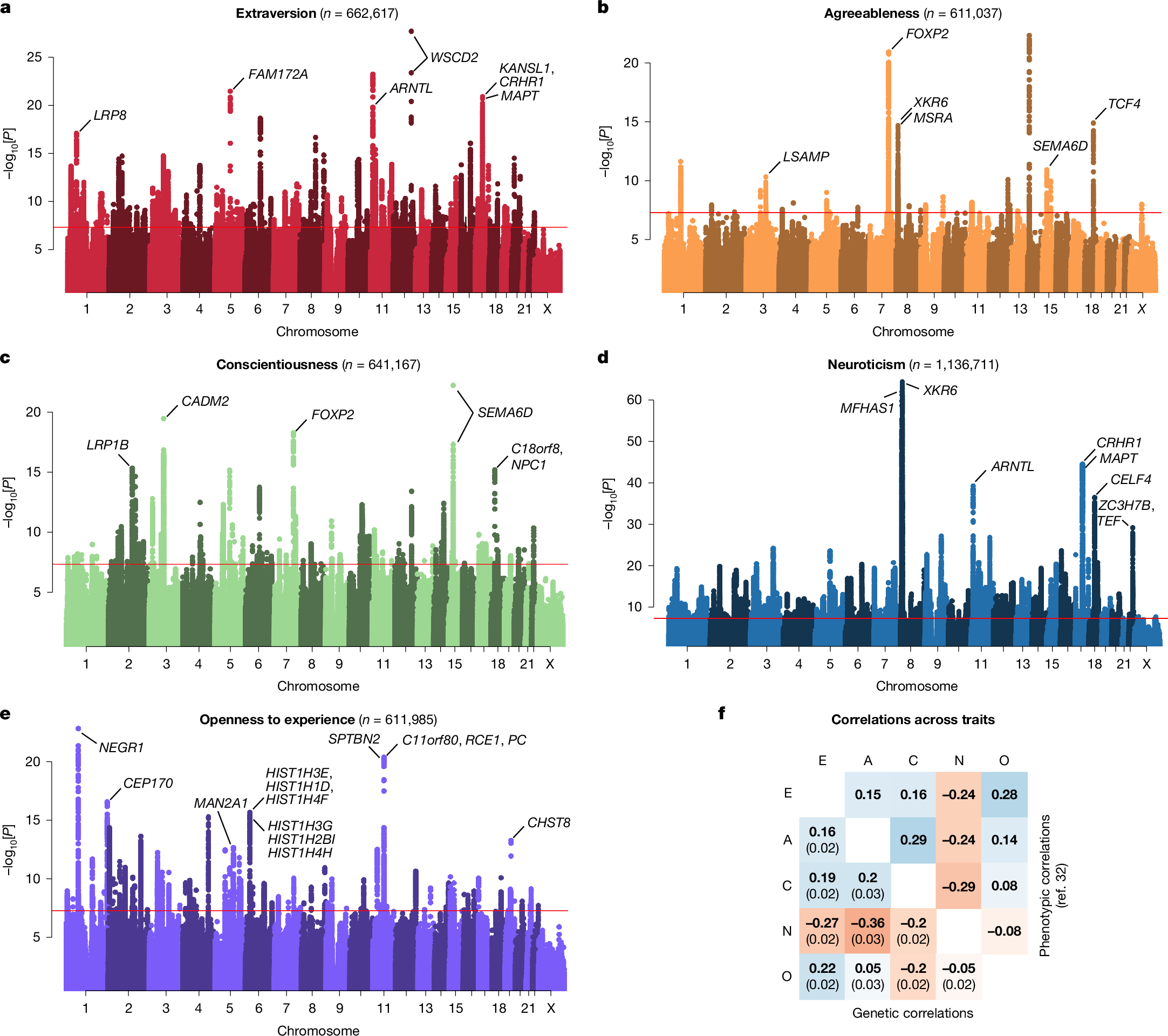
Researchers writing in Nature identified over 1,200 genetic variants linked to the Big Five personality traits, including extraversion and conscientiousness.
Schwaba and colleagues analysed results from 46 cohorts, together involving over a million mostly European participants, each of whom provided a DNA sample and completed a personality questionnaire.
The average effect of a common genetic variant linked to extraversion explained why someone might score in the 50.35th percentile as opposed to the 50th.
Ted Schwaba, lead author and faculty at Michigan State University's Department of Psychology, said in a statement that there is no single 'personality gene', but that even though any individual variant makes very little difference, the effects of many variants together can be more sizeable.
The team compared relatives' results to determine whether the genetic links were actually the result of upbringing; their results suggest this is unlikely, and they highlight the importance of the environment in shaping personality.
Variants linked to openness to experience predicted that a person would live in more cosmopolitan areas, which could in turn reinforce the trait.
Publishers with included, body-backed reporting in this cluster.
Follow any of these and your For You feed starts watching them — no settings page required.
science
The largest personality genome scan caps common-variant prediction at 13.3% of variance1 publisher
science
A pole-on magnetar hands vacuum birefringence its first astrophysical candidate1 publisher
science
The skull is running a lymph node, and it has opinions about your brain tumour3 publishers
science
A phage kinase with no target list: EMBL finds one enzyme that breaks several bacterial defences1 publisher
Evidence-backed comparisons of source perspectives and observed adoption signals. Read the methodology
Which Builder, Operator, and Investor concerns the observed source mix emphasized—not a truth score.
Evidence, demonstrated adoption, hype gap, incentives, and confidence are assessed independently, each on its own current evidence. How these are measured.
Specific figures, one retelling
Every number reaches us through Discover's account of a Nature paper that is cited but which we cannot read alongside it: the 1,200-plus variants, the 46 cohorts, the million participants, the 50.35th percentile. The design description is concrete enough to be checked against the paper, and Discover reports the effect size that undercuts its own headline, which counts in its favour. Missing is the statistical apparatus a claim of this scale needs — variance explained, uncertainty around the effects, and any test of how the variant sets perform outside the mostly European samples they came from.
No use to measure
Nothing in this reporting describes anyone acting on the results: no test, no screening tool, no clinical or occupational use. An association study with no downstream application disclosed leaves adoption unmeasurable rather than low, and Schwaba's hope that other fields pick the traits up is an invitation, not uptake.
Headline count outruns the effect size
The headline counts variants; the body concedes each one shifts a person about a third of a percentile. Discover does much of the deflating itself, so the gap stays narrow, but a reader who stops at '1,200 genetic variants linked to personality' leaves with a stronger story than the study supports. The wider stretch is in the outcomes section, where correlations between traits and hospital time, income or job switching are written in the grammar of prediction.
Framing comes from the author's statement
The interpretive lines both come from a press statement by the study's lead author, who closes by asking physicians and vocational researchers to adopt personality measures in their own work. That is a plain professional interest in the field's expansion, stated in the open. No funding source, commercial partner or genomics vendor appears anywhere in this reporting, and Discover attaches a note on its use of peer-reviewed sources, so what is visible reads as ordinary academic promotion rather than a hidden stake.
Repeatable with attribution, not extendable
One outlet, one press statement, and a paper we have not read. The descriptive claims about the sample, the traits and the correlates are safe to repeat as Discover's account of the study; the arithmetic built on the 0.35-percentile figure is only as sound as that one reported number, and the study as described says nothing about what any individual's genotype implies about their personality.