Invest1 publisher3 min readPublished
Microsoft merges its Copilot products into one business app with metered agents
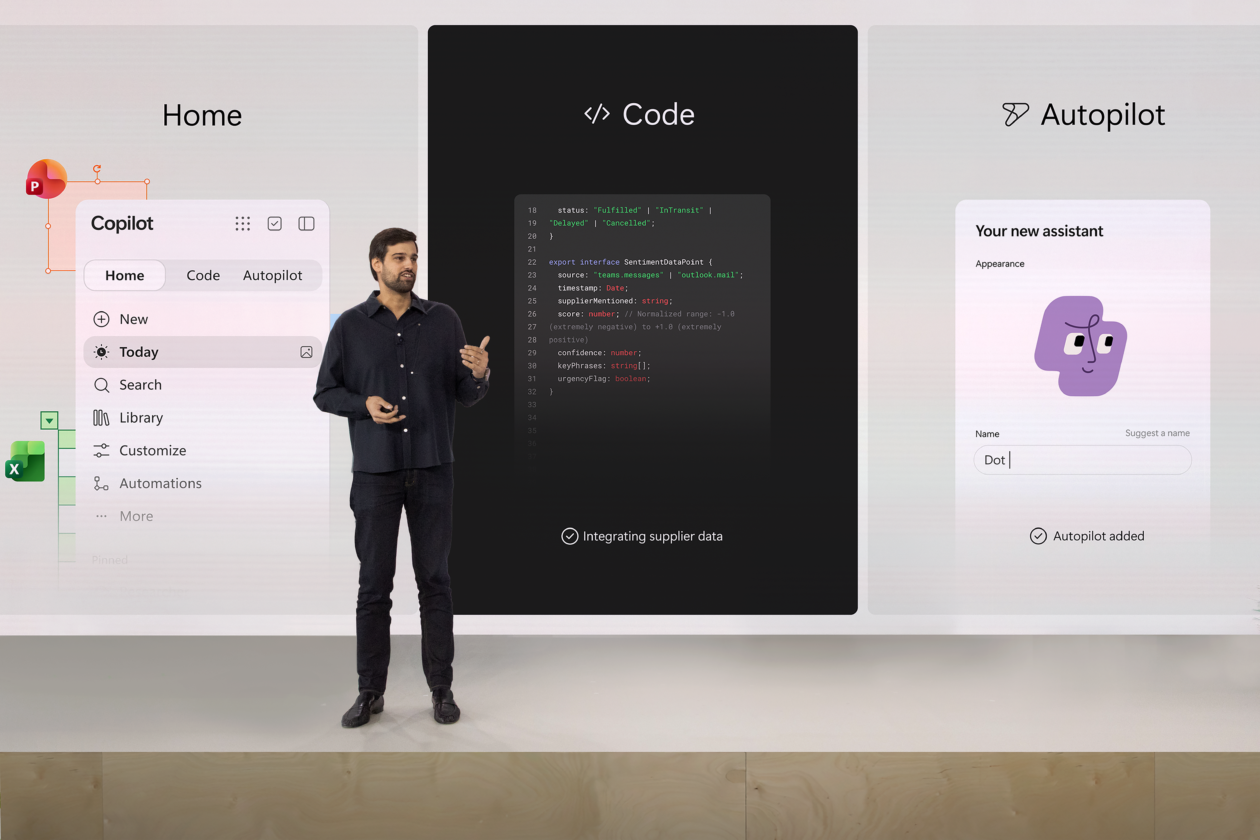
Microsoft merged its Copilot line into one business-focused super app whose most autonomous agents cost extra by usage, on top of 30 million paid seats. Autopilot goes to a restricted test first, so buyers face a metered cost they cannot yet price.
The Investor · Invest desk
What happened
- Microsoft unveiled a redesigned Copilot super app on Friday, aimed at business customers, after pushing to merge its sprawling set of Copilot products into one.
- Autopilot, the app's agent feature, faces a more restricted test than the other new features, and its broad rollout will depend on how testers rate the tools.
- Microsoft said in July that Microsoft 365 Copilot had passed 30 million paid seats, with net seat additions doubling quarter over quarter.
Compiled by The InvestorSomething wrong?How this is made
Why it matters
- cost Enterprise Copilot budgets gain a variable line, because the autonomous features bill by usage on top of subscriptions and their cost tracks agent activity instead of headcount.
- decision IT departments have to decide which employees need a full license, because the free app does not unlock the full feature set that subscriptions and workplace licenses do.
- exposure Agent work that never touches Excel or Word is where OpenAI and Anthropic can compete for Microsoft's enterprise customers without running into its Office connection.
Fortune's account does not include usage rates, so nobody outside Microsoft can yet size the new part of Copilot pricing [5]. The charge covers the most autonomous capabilities, and Autopilot is the clearest case [5]. A user names an agent, gives it a role and a goal, and sets it loose on project updates, deadline tracking, reminders to colleagues and outreach to partners [8]. The extra charge applies to enterprise customers and individual users alike [5].
Fortune reported that for Chief Executive Satya Nadella, the new Copilot is a way to win subscriptions in a business that has become increasingly important to Microsoft [6]. It is also meant to keep Microsoft's productivity offerings from being sidelined by a new generation of AI rivals [6]. "We do want this to become an all-in-one productivity suite," Annie Pearl, Microsoft's corporate vice president of Copilot, told Fortune [7]. The app connects to the business tools that already make Microsoft money, so a user can ask a bot to handle a task in an Excel spreadsheet or change a layout in a Word document [12].
Microsoft has also narrowed where it spends. After the AI boom began about four years ago, it poured resources into consumer and enterprise AI at once. Its most capable technology now goes to business customers [15]. Its consumer Copilot failed to reach mainstream success [16], and earlier this year the consumer and enterprise sides were merged into one Copilot team under Jacob Andreou [17]. A personal agent for food orders and bank statements, the pitch of Meta's consumer Muse app [14], is not where Microsoft is putting its best agent work [15].
Broad rollout of Autopilot depends on how testers rate it [11], and the outcomes split from there. If testers rate it well, the usage charge becomes a second Copilot revenue line next to seats [5]. If they do not, the super app is mostly licensed features gathered in one place [4]. The coding tool, built on GitHub Copilot's tech stack, still reaches Microsoft 365 Premium and Pro subscribers through the test program later this year [10]. A third path runs through rivals. OpenAI unveiled its own super app in July, and it and Anthropic are both pushing into enterprise offerings [13].
I think the merged app is a seat product first. Its job is retention against the new AI rivals, or rather retention plus expansion, since net seat additions were doubling quarter over quarter as of July [18]. The usage charge is an option Microsoft can exercise once Autopilot clears testing [5][11]. The counter-case is that agent usage, once broadly released, grows faster than headcount and the meter ends up the bigger line; that becomes testable when rates are public. For enterprise buyers, the licensing revisit is real but not yet urgent. Seat renewals will not cover the metered work [5], and Microsoft has not set a general-availability date for most of the new features [9]. The view is wrong if Microsoft publishes Autopilot rates and a release date within a year, or if its next seat disclosure shows net additions slowing even with one app to sell [18].
What to watch
- Whether Microsoft publishes usage rates for Autopilot and its other autonomous features, the figure buyers need to size the metered line.
- Tester ratings from the restricted Autopilot phase and any general-availability date that follows them.
- Microsoft's next Microsoft 365 Copilot seat disclosure, measured against July's 30 million paid seats and doubling net additions.