Product1 publisher3 min readPublished
Microsoft pitches its all-in-one Copilot app to IT as a hedge against any single AI lab
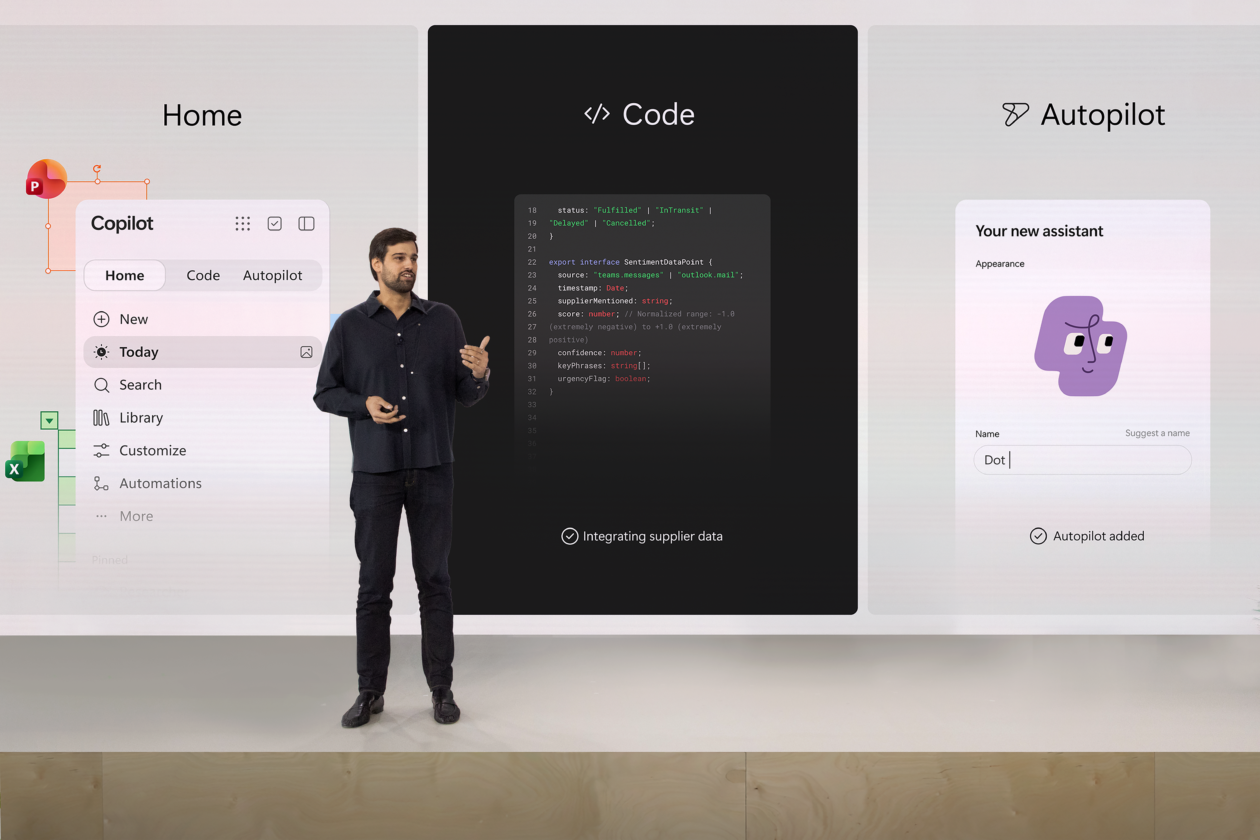
Microsoft put chat, app-building, always-on Autopilot agents and full Word, Excel and PowerPoint into one Copilot app, days before its Sept. 30 deadline. The agents come later as previews billed on usage, so IT has to pick a pilot group before it has a rate card.
The Product Desk · Product desk
What happened
- Microsoft's new Copilot app has three sections: Home pairs chat with the Cowork agent, Code builds apps from plain descriptions, and Autopilot runs always-on agents.
- Full versions of Word, Excel and PowerPoint now run inside Copilot, so people can create and edit documents with AI and co-workers without switching apps.
- GeekWire frames the launch as Microsoft's answer to OpenAI and Anthropic, which sell combined chat, coding and agent apps directly to Microsoft's core business customers.
- Autopilot moves to private preview at the end of the month, and Office in Copilot reaches consumers and Frontier early-access customers in the coming weeks.
Compiled by The Product DeskSomething wrong?How this is made
Why it matters
- cost Seat count no longer sets the ceiling on Copilot spend; finance has to forecast agent usage for products most customers have not yet been able to run.
- decision Security teams comparing Microsoft's Cowork with Anthropic's Claude Cowork now have Microsoft's own test to apply: whether processing sensitive files on a local virtual machine is acceptable.
- exposure A buyer who picks Copilot to avoid a direct OpenAI or Anthropic contract still runs those labs' models, with Microsoft holding the relationship and setting the metered price.
In Microsoft's demo, a product manager had Copilot pull data into an Excel workbook. She accepted her team's tracked changes in a Word document, then had Copilot turn both into a PowerPoint deck without leaving the app [17]. According to Microsoft, co-workers can edit the same files at the same time from the regular Office apps [18]. "This is not just some simplified viewer," said Jacob Andreou, the executive vice president who leads Copilot [19].
The launch account rests on that demo and on a transcript of a Wednesday event that Microsoft provided [23]. What an IT team can actually put in front of users soon is less than the demo showed, because most of the new features won't be widely available until later [14].
Files come first. Andreou said Microsoft knew that "unlike a lot of our competition, sending your most sensitive files down to a local machine into a VM was a complete nonstarter" [7]. GeekWire took that as a reference to Anthropic's Claude Cowork, which runs in a virtual machine on the user's computer [8]. According to GeekWire, the audience is corporate IT departments that have long relied on Microsoft for security and compliance [6].
Model choice comes next. Satya Nadella, Microsoft's chief executive, pitched Copilot as a hedge against relying on any one AI lab [25]. The demo menu offered OpenAI's GPT, Anthropic's Opus, or an Auto mode that picks a model for each request [11]. Microsoft's own MAI models appeared on one of Nadella's slides beside OpenAI, Anthropic and xAI, but not in that menu [12]. "My test of true independence going forward is for you to have a private eval that you can hill climb on and substitute a model," he said [9]. In GeekWire's gloss, a private eval is a company's own set of tests for AI models, and hill climbing means steadily improving results against them [26]. A company that can't do this, Nadella added, has effectively handed the knowledge it builds with AI "to somebody else" [10].
Then there is the bill. A per-user monthly license covers chat and the Copilot features in Word, Excel, PowerPoint, Outlook and Teams [20]. Cowork, Code and Autopilot are billed on usage. So are the newest frontier models, OpenAI's Astra and Anthropic's Claude Fable [21]. That puts five named items on the meter, three agent products and two models [24]. "Our view is that there are two kinds of AI at work," said Jared Spataro, Microsoft's chief marketing officer for AI at Work [22]. The launch account does not include per-unit rates for any of the metered items.
Timing is last. Nadella promised the app at Build in June, then told investors on the July 29 earnings call that it would arrive this quarter, which ends Sept. 30 [13]. Friday's announcement met that with less than a week to spare [14]. Code gets a preview for Microsoft 365 Premium and Pro subscribers later this year [15].
I'd roll out the seat-licensed pieces now and keep Code and Autopilot to a named pilot group until rates are published. The tradeoff is that the pilot runs while OpenAI and Anthropic keep selling directly to the same business customers [4].
To place any team's request, sort it on two lines. The first is whether the work falls under the seat license or the meter. The second is whether the team keeps its own tests for comparing models. Seat-licensed work can go out with or without tests, because the monthly license already fixes the cost. Metered work with tests is the case Nadella described: once rates exist, that team can price each model per task. Metered work without tests is the box to keep small. That team pays by use for output it has no way to score.
What to watch
- Microsoft publishing per-unit rates for Cowork, Code and Autopilot, the figure any budget for the metered tier depends on.
- Whether Auto mode can route an ordinary request to a usage-billed frontier model such as Astra or Claude Fable.
- Whether customers in the Autopilot private preview keep their agents running past the first month.