Product1 publisher3 min readPublished
Meta trades 40 degrees of horizontal view for a 100-gram VR visor
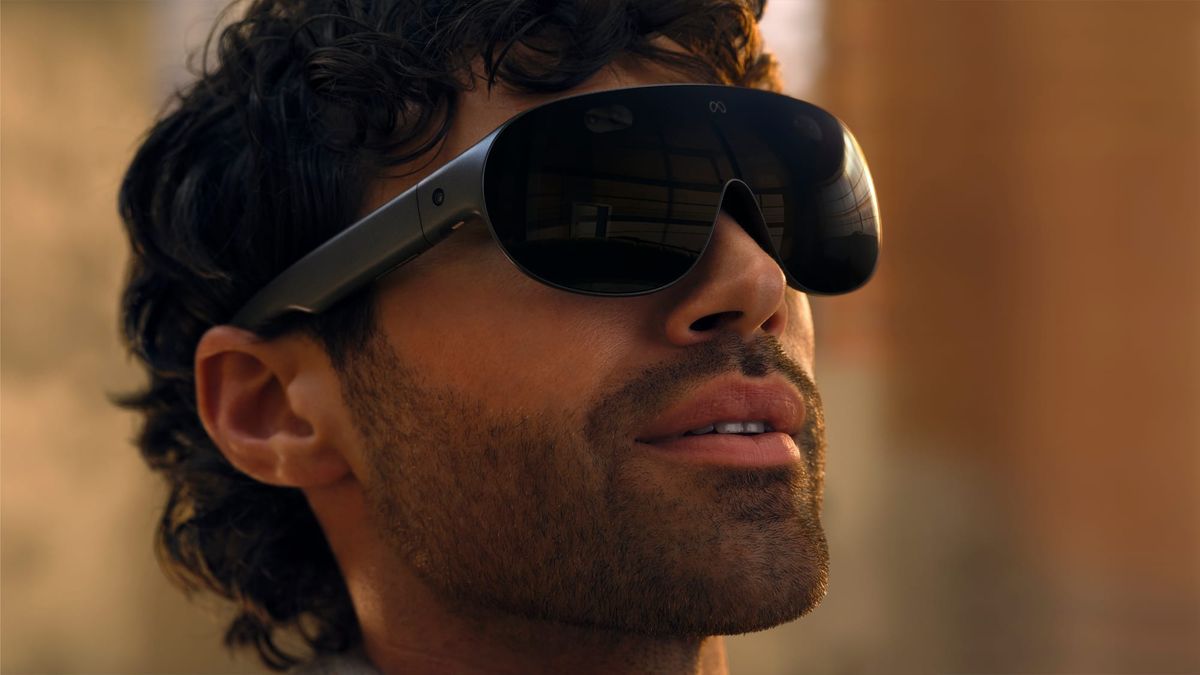
The $1,300 Meta VR Glasses run Quest 3's operating system on a tethered puck, so the existing library and the existing controllers carry over to a headset that shows roughly 44% of the Quest 3 viewing rectangle.
The Product Desk · Product desk
What happened
- Meta announced Meta VR Glasses at $1,300 for spring 2027: a 100-gram visor with 2.4K micro-OLED displays, powered by a tethered puck running Qualcomm's Snapdragon Reality Elite chipset.
- The puck runs the same operating system as Quest 3 and supports all the same content, rendered at higher resolution using the new chipset and eye-tracked foveated rendering.
- Controllers are not in the box, so buyers either order Touch Plus separately in a new all-black finish, pair the pair from a Quest 3 or 3S, or find one of the retail channels carrying a bundle.
- The dual 120Hz 2412x2288 HDR micro-OLED panels are the highest-resolution displays Meta has shipped and its first non-LCD headset since the original Oculus Quest.
- The puck accepts any USB-C DisplayPort device and shows it as a huge virtual screen with no capture card, a first for a Meta standalone device.
Compiled by The Product DeskSomething wrong?How this is made
Why it matters
- decision Content teams face a re-test: anything composed for a 110-degree window has to be judged inside 70 degrees before it goes on the store page.
- constraint With no computing in the visor at all, the puck becomes the thing users must carry, charge and keep cabled, and the thing a support queue will spend its time on.
- cost An existing Quest 3 household absorbs the $1,300 and reuses its controllers; a first-time buyer pays more or goes hunting for a bundle Meta has not tied to a named retailer.
- capability Taking DisplayPort straight into the puck removes the capture card from the multi-monitor setup. That puts the device in reach of desk work.
Somebody will unbox these at a kitchen table in spring 2027 and find that the visor does nothing on its own. Meta VR Glasses have no onboard computing, not even a tracking coprocessor, and take both power and data from the puck through a thin, flexible fiber optic cable [6]. Meta built the visor from magnesium alloy, which it says allows a fanless, passively cooled design at around 100 grams [2].
The form factor costs field of view. Meta advertises 70 degrees horizontal by 66 vertical, against roughly 110 by 96 on Quest 3 [10]. Multiply each pair and you get 4,620 square degrees against 10,560, about 44% [18]. Those rectangles are not measured solid angles, so treat the ratio as a sketch. The horizontal figure is simply 40 degrees narrower [19]. UploadVR, which published the specifications, expects the glasses to feel far less immersive than a Quest once the optional light blockers are attached, and to do better in passthrough mixed reality without them, where seeing your own periphery is the point [11].
Resolution moves the other way. Spread 2412 pixels across 70 advertised degrees and you get roughly 34 pixels per degree horizontally [20]. That density does more for a virtual monitor than for a wide environment. The panels support Dolby Vision, and Meta says this is the first VR device to be IMAX Enhanced certified [9].
For a team shipping XR content before spring 2027, the platform stays the same. UploadVR describes the Snapdragon Reality Elite as essentially an XR2 Gen 3 under a different name, with eye-tracked foveated rendering supplying the rest of the resolution gain [3]. The window is narrower, and controllers stop being the assumed input. Meta announced a set of new hand tracking VR and mixed reality games alongside the hardware, including a hand-tracked Beat Saber mode called Flux [13].
Meta plans to market the product as "a private cinema, multiple virtual monitor workspace, and game console in one device that fits in your bag" [12]. The visor uses an open-periphery design, so the wearer sees the room to the sides and below without taking anything off [7].
Hologram, Meta's productization of its Codec Avatars research, arrives half-built. It will put a photorealistic, face-tracked avatar into flatscreen WhatsApp video calls and show a full-scale avatar to other Glasses owners, with Quest 3 support later [15]. At launch the spatial version is a "2.5D" stereoscopic video stream at true scale, seen only from the front, and it stays head-on even when you walk around it [16]. Meta says it plans to evolve Hologram into a true 6DoF system, and then make it the default platform-level avatar experience in place of the cartoon Meta Avatars [17].
A catalogue splits on two axes here: whether the experience needs peripheral vision, and whether it needs tracked controllers. An experience that can do without both can ship to a 100-gram audience on day one. One that needs both stays a Quest 3 title until someone on the team has spent an hour inside the 70-degree window.
What to watch
- Whether Meta publishes a price for the controller bundle or leaves it to the unnamed retail channels it referred to.
- Whether the 6DoF version of Hologram lands before Meta makes it the default avatar experience over Meta Avatars.
- Xreal Aura pricing, which UploadVR says is still unknown, as the comparison for the same tethered-glasses proposition.