Product1 publisher3 min readPublished
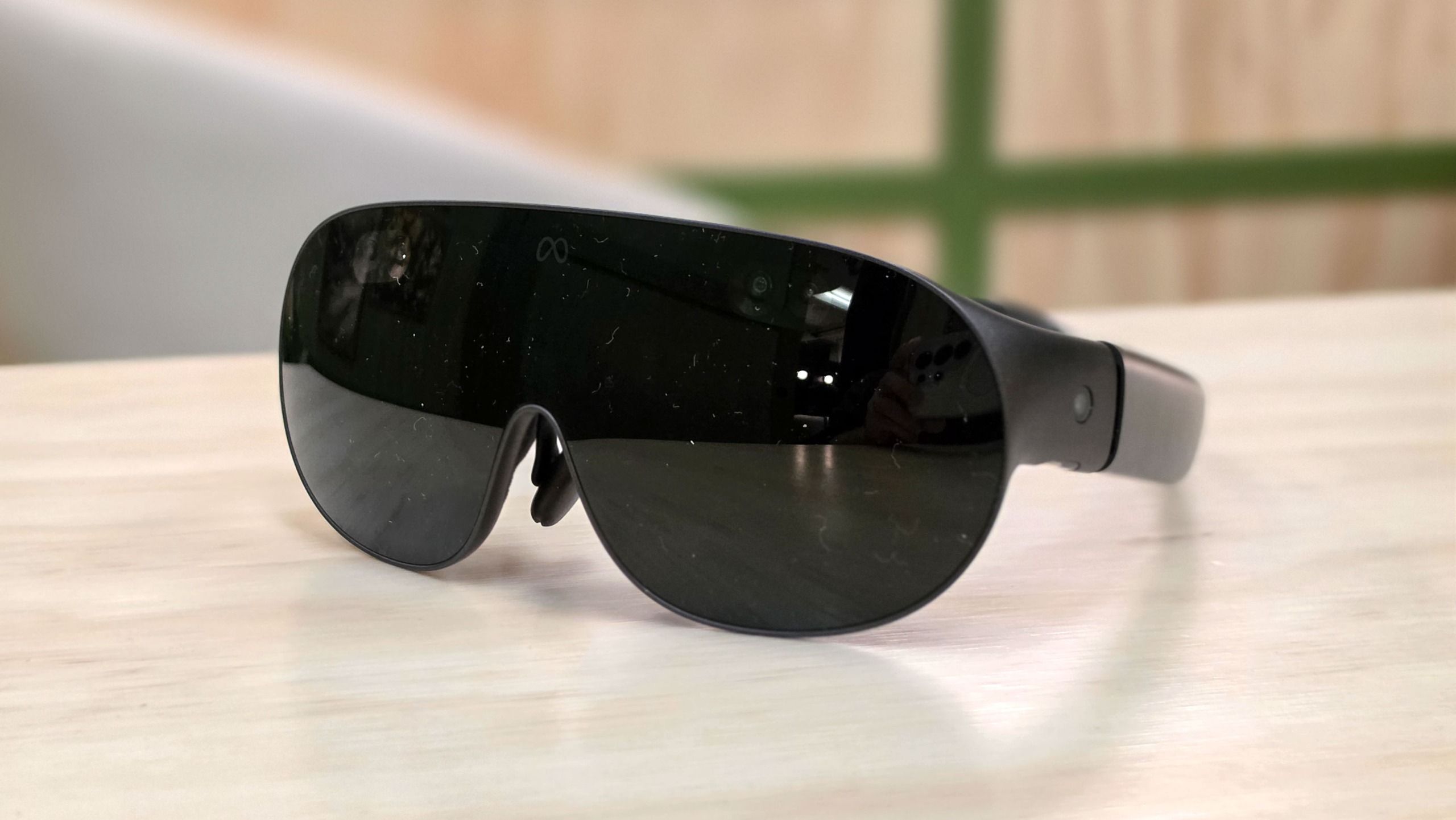
Meta's VR glasses put eye tracking and a pinch where the Quest put controllers
Meta plans to ship the glasses in spring 2027 at $1,299, with 5K micro-OLED lenses on the face and a three-hour puck in the pocket. XR teams have about six months to make their apps work without a trigger.
The Product Desk · Product desk
What happened
- Meta's VR Glasses keep the lenses, display and sensors on the face and move the chip and battery into a tethered puck that Meta says lasts three hours on its own.
- The 5K micro-OLED pancake lenses are Dolby Vision certified according to Meta, and Tom's Guide reported an IMAX certification billed as a first for a headset.
- Eye tracking and hand gestures handle most every interaction, and the glasses come without controllers, though they can pair with Quest Touch controllers over Bluetooth.
- Meta set a $1,299 starting price with shipping expected in spring 2027, and did not specify a storage tier for the launch configuration.
Compiled by The Product DeskSomething wrong?How this is made
Why it matters
- decision Any team whose interaction model depends on a trigger and haptics has to fund a look-and-pinch path or tell buyers to bring their own Bluetooth controllers.
- constraint A three-hour puck caps the session length an app can promise on battery, so long-form training and shift-length tooling need a charging plan attached to the deployment.
- capability Readable web pages and code in a headset make text-heavy internal tools worth porting, a category AR glasses handled badly.
- exposure Whoever buys a batch for a team inherits an unresolved prescription calibration process that Meta handled with staff on site in the demo room.
Look at an icon, pinch two fingers, and the app opens. Tom's Guide did that with hands resting in the lap or flat on a table, because the glasses carry hand sensors on the front of the frame and on the underside [21][22].
That posture is what app layouts have to be built for. Tom's Guide wrote that there is "no strange reaching into the aether for an invisible ball that you usually see" [24].
One demo put up a multi-screen workstation. Tom's Guide found the websites and the code readable, and said it fixes a flaw of AR glasses where reading can be blurry or straining on the eyes [20]. Text-heavy software is the category this hardware opens, if the readability holds outside a demo room. It is still a solo device: Tom's Guide wrote that "as a VR headset they're still isolating, and there are some strange decisions under the hood, but there's something interesting here" [23].
The build target gets muddy at the chipset line. A Meta spokesperson told Tom's Guide the glasses use a Qualcomm XR2 Gen 3 [6]. Tom's Guide reported that Qualcomm never announced a part under that name, and instead announced the rebranded Snapdragon Reality Elite at AWE this year [7].
Quest headsets weigh 1.1 pounds, about 500 grams [8]. The glasses are supposed to weigh 100 grams, or 3.57 ounces [9]. That is one fifth of the Quest figure, 400 grams moved off the face [1]. It moved into the puck holding the chip and the battery, and Tom's Guide said the glasses did not get hot while the puck was quite warm when picked up at the end of the session [5][11]. Against the Viture Pro and the Xreal One, which Tom's Guide put at just under 3 ounces, the Meta pair is roughly 0.6 ounces heavier [10][2].
Price is $1,299 at launch, and Meta did not disclose storage capacity options [14]. Quest 3 sells only with 512GB, the 3S comes in 128GB and 256GB, and Tom's Guide presumes 256GB for the glasses [15]. Tom's Guide put the price at more than twice a Viture Beast and about half an Apple Vision Pro [16].
All of that came out of what Tom's Guide called "locked-in demos" [17]. A scripted session establishes that the eye tracking worked on the icons Meta chose. Time to a first useful task in your app, and whether anyone opens it again a week later, are numbers you will have to get yourself.
A roadmap here turns on two things: whether the core task can be driven by looking and pinching, with hands at rest, and whether a session ends inside three hours away from mains power, the figure Meta gives for the puck on its own [5]. Yes and yes, build now, and reading, review, dashboards and short-form media all sit in that box. Yes and no, you need a charging story before you promise anyone an eight-hour shift. No and yes, you need a Bluetooth controller path, and the glasses do pair with Touch controllers that way even though they ship without them [12]. No and no, and you skip spring 2027 [13].
The glasses walk the wearer through lens and nose pad setup, and Tom's Guide had to nudge the right lens slightly to the left [18]. For prescription wearers, Meta ran a calibration setup at the event, and Tom's Guide reported it is not clear how that would be done for customers once the product is in the wild [19].
What to watch
- Whether Meta publishes a storage tier and a price for extra capacity before the spring 2027 ship date.
- How prescription lens calibration works at retail, after Meta ran it with staff on site at the demo.
- Whether hand tracking at rest holds up in longer, unscripted hands-on sessions with third-party apps.